
Dental Practice CPA
Accounting Built for the Dental Value Chain
Running a dental practice is running a business.
Most CPAs have never seen the inside of one. We have worked across the entire dental value chain: private practices, implant specialists, dental laboratories, and device distribution. We already know your fee schedules, supply costs, and what a healthy practice P&L looks like at every stage of growth.
Based in Los Angeles, we work with clients across the United States: remotely, at our Los Angeles office, or on site at your practice.
Stop Waiting for Month-End PDFs. See Your Practice in Real-Time.
Meet Lantern by SW Accounting — our proprietary client dashboard built for practice owners. We transform raw data into clear, actionable insights, accessible anywhere, anytime.
- Visual P&L & KPI Trends: Track your revenue growth, operating margins, and profit trends at a glance with intuitive charts.
- Deep-Dive Drilldowns: Don’t just look at the numbers. Click any line item — like Dental Supplies & Materials or Outside Services — to instantly view the exact journal entries and underlying transactions.
- 24/7 Financial Clarity: Your practice’s financial health is always at your fingertips, empowering you to make confident decisions on the go.
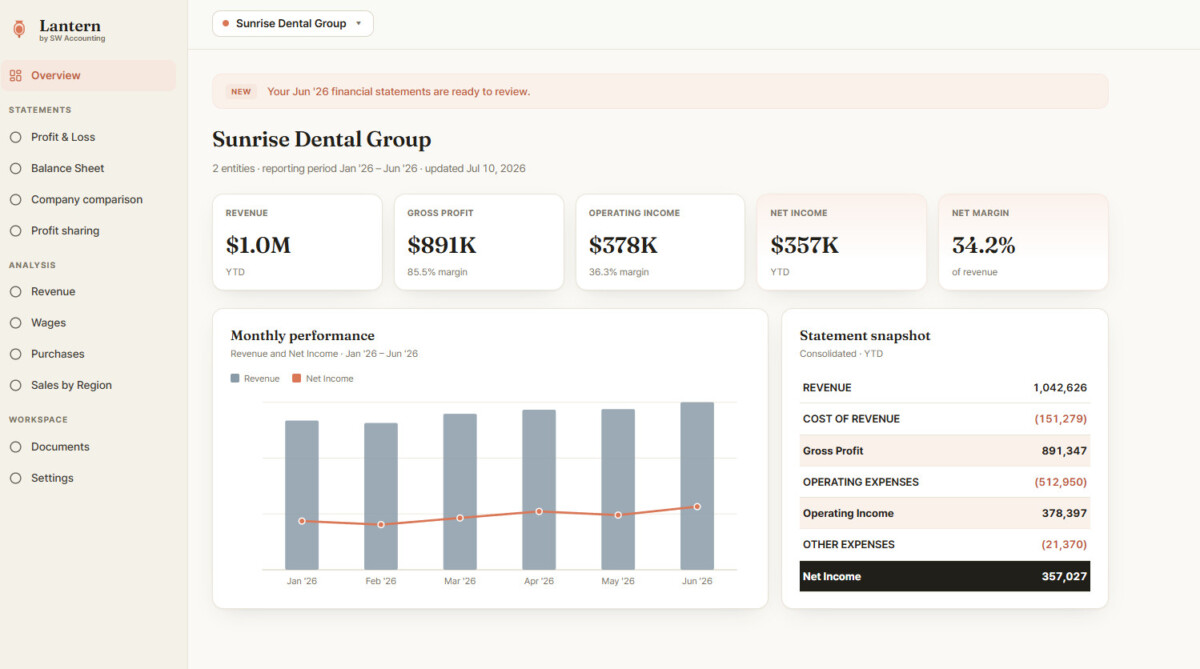
Demo data shown · every number in Lantern drills down to its journal entries.
What do you reconcile every month, and what do I get?
Every month we match what your practice-management software says you produced and collected to what reached the bank, record insurance payments and write-offs, and close the books into a P&L measured against collections.
- Production, adjustments and collections. We compare the production, insurance and courtesy adjustment, and collection reports from your practice-management software, so you can see where production did not turn into cash.
- Deposits by source. Patient payments, insurance carrier payments and patient-financing deposits are matched to bank deposits, so nothing is booked twice or missed.
- Insurance balances. We review the insurance aging report alongside collections each month and flag balances that keep growing.
- Payroll, lab fees and supplies. Staff payroll, associate dentist pay, lab fees and dental supplies are recorded in the month they belong to, so overhead percentages are accurate.
What you send us: month-end production, adjustment, collection and aging reports from your practice-management software, bank and card statements, payroll registers, and lab and supply invoices.
What you receive: a monthly P&L with overhead as a percentage of collections, a balance sheet, reconciled deposits, and Lantern access where every number drills down to its entries.
Do you also work with medical and other professional practices?
Yes. Beyond dentistry, we work with physician practices such as family medicine and with other professional practices, and we are most useful at opening, when the structure, owner pay, payroll and books are set up for the first time.
A new practice makes a handful of decisions in its first months that every later return depends on. We work through them with you at the start:
- Entity and ownership. Whether the practice must be a professional entity and who may own it depend on your state’s rules for your profession; whether an S-corporation election makes sense depends mostly on expected profit. We confirm the state rules and model the tax result before anything is filed. If you also run a consulting or management business, we decide with you whether it belongs in the practice entity or its own, and how the two will bill each other.
- Owner compensation. How you are paid follows from the entity: draws from an LLC that is not taxed as a corporation, or a salary through payroll plus distributions from an S-corporation, where the salary has to be reasonable for the work you do (see our S-corporation guide). We set the amount and the pay schedule with you.
- Expense reimbursement. When you pay practice expenses yourself, such as mileage, a phone, licenses, professional dues or continuing education, the practice can reimburse you under an accountable plan: each expense has a business purpose and a receipt, and any excess advance is returned. If you are on the practice’s payroll, reimbursements made this way are not taxable wages.
- Payroll setup. Federal and state employer accounts, a payroll provider, the owner’s own payroll where the entity calls for it, and onboarding paperwork for your first hires.
- Initial bookkeeping setup. A chart of accounts built for a medical practice, with collections by payer, provider pay, medical supplies and malpractice insurance on their own lines; bank and card feeds; practice and personal accounts kept apart; and a month-end routine that ties your billing system’s reports to deposits, the same way we do for dental practices.
If you want the advice first and will decide later who keeps the monthly books, that is a normal way to start. We handle the setup and planning now; the monthly bookkeeping can come to us, stay with your own staff under our review, or begin once the practice is busy enough to need it.
How you can engage us
In one of four ways, and you can change as the practice grows: full-service, review-only, setup-only or project-based advice.
- Full-service. We keep the monthly books, run payroll and handle ongoing tax compliance, and you receive the monthly statements and Lantern access described above.
- Review-only. Your office manager or bookkeeper keeps the books. We review them on a set schedule, send back adjusting entries, and prepare the year-end returns from the reviewed books.
- Setup-only. Often the right start for a new practice. We set up the entity, payroll, chart of accounts and month-end routine, walk your staff through them, and step back until you need us again.
- Project-based advice. A single decision or project, such as an S-corporation election, an owner pay review, a second location, or buying or selling a practice.
Every engagement is led personally by CEO Sangwon Youn (US CPA, California; KICPA), with a team of associate CPAs handling the monthly work. We work in English and Korean.