
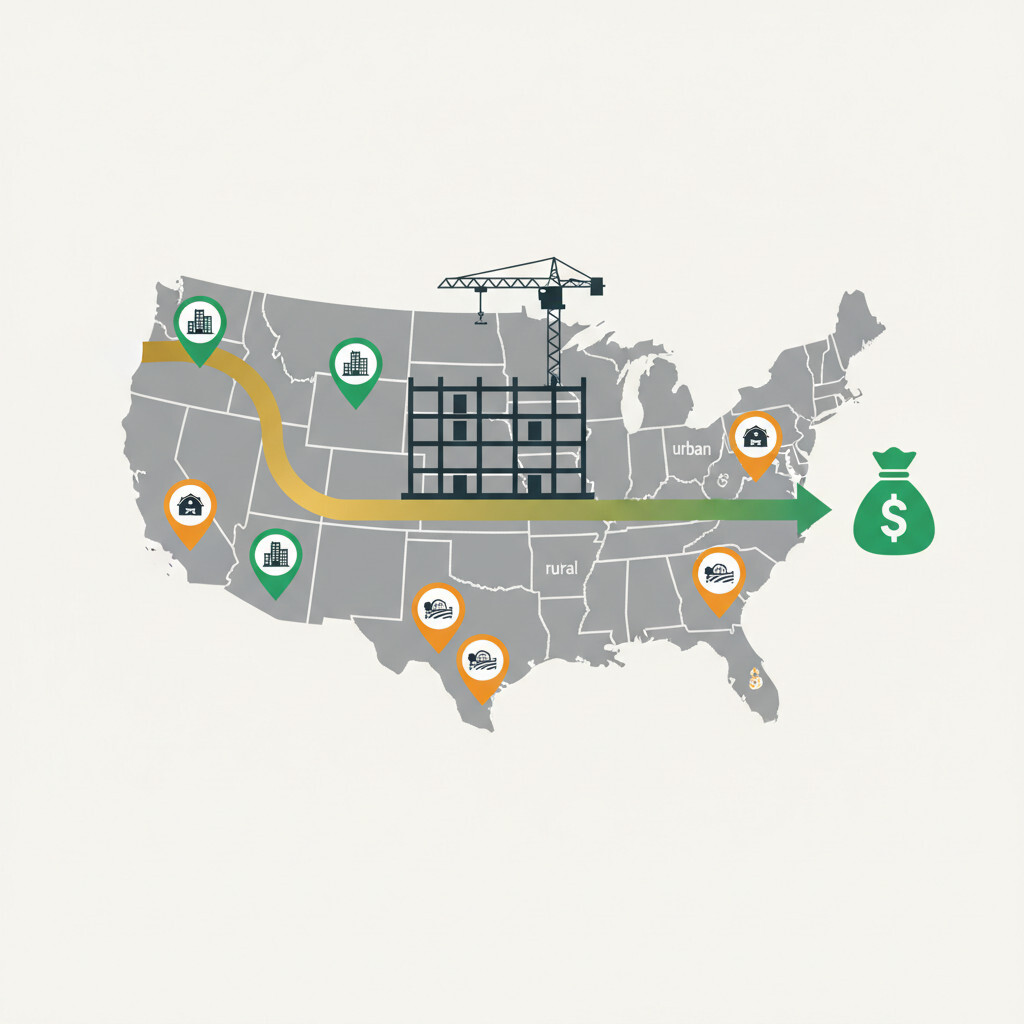
Qualified Opportunity Zone Designation 2027: OBBBA Changes Explained
If you’ve been waiting for clarity on the next round of Opportunity Zones, it’s here. Rev. Proc. 2026-14 — issued by the IRS in April 2026 — provides the procedural roadmap for the qualified opportunity zone designation process effective January 1, 2027, implementing the One Big Beautiful Bill Act’s (OBBBA) significant amendments to Sections 1400Z-1 and 1400Z-2 that took effect July 4, 2025.
At SW Accounting & Consulting Corp, we work with QOF sponsors, real estate developers, and high-net-worth investors who use OZ deferral for capital gain planning. This guide breaks down what Rev. Proc. 2026-14 actually does, what’s new under OBBBA, and what state CEOs and prospective fund managers need to know now.
What does Rev. Proc. 2026-14 cover for qualified opportunity zone designation? 📋
Rev. Proc. 2026-14 provides procedural guidance to State CEOs (and the territories and DC) for nominating low-income community population census tracts to be designated as QOZs effective January 1, 2027 — a fresh designation cycle, not an extension of the original 2018-2027 QOZs.
The legal framework rests on three pieces:
- Section 1400Z-1 — defines what a QOZ is and how it’s designated.
- Section 1400Z-2 — provides the temporary deferral, basis step-up, and exclusion benefits for taxpayers who roll capital gains into a Qualified Opportunity Fund (QOF).
- Section 70421 of OBBBA (P.L. 119-21) — substantially amended both 1400Z-1 and 1400Z-2 effective July 4, 2025, creating the new QOZ regime that Rev. Proc. 2026-14 implements.
The original TCJA (2017) QOZs are technically referenced in the Rev. Proc. as “prior § 1400Z-1” and “prior § 1400Z-2” — distinguishing them from the OBBBA-amended provisions that govern post-2026 designations.
What did OBBBA change about QOZ rules? 🔄
OBBBA’s key amendments include a new Qualified Rural Opportunity Fund (QROF) category, a flexible “applicable start date” replacing the static December 31, 2017 reference, and a re-designation cycle giving state CEOs a new nomination window.
| Item | Pre-OBBBA (TCJA) | Post-OBBBA (Effective 2027) |
|---|---|---|
| Acquisition cutoff | After December 31, 2017 | After “applicable start date” (per § 1400Z-1(e)(2)) |
| Rural-focused fund category | Not separately defined | QROF — Qualified Rural Opportunity Fund (new) |
| State nominations | 2018 designation cycle complete | New designation cycle for 1/1/2027 effectiveness |
| “Rural area” definition | N/A | Outside cities/towns >50,000 inhabitants and contiguous urbanized areas |
| Effective date for QROF amendments | N/A | QOF investments after December 31, 2026 |
The QROF carve-out is a meaningful planning opportunity. To qualify, the fund must hold at least 90% of its assets in QOZ business property substantially used in a QOZ “comprised entirely of a rural area” — or in QOZ stock/partnership interests in a business that is rural-focused. The OBBBA provides enhanced benefits (e.g., faster basis step-up timing) for QROFs. Investors interested in agricultural, rural broadband, or rural healthcare projects should track this carefully.
How does the State CEO nomination process work? 🏛
State CEOs nominate eligible low-income community (LIC) census tracts; the Treasury Secretary then certifies and designates them as QOZs. The number of tracts designated per state is limited per § 1400Z-1(d).
The process under Rev. Proc. 2026-14 follows § 1400Z-1(b)(1):
- State CEO identifies eligible LICs as defined in § 1400Z-1(c)(1) (which references the New Markets Tax Credit definition in § 45D(e)).
- State CEO submits a list of nominated tracts to the IRS following the procedures in Rev. Proc. 2026-14.
- The Treasury Secretary (or delegate) reviews and certifies the nominations.
- Designated tracts become effective QOZs as of January 1, 2027.
- Designation period and re-designation cycles continue per the OBBBA-amended § 1400Z-1(d) limits.
For the 2018 round, the original TCJA designations covered roughly 8,700 census tracts. The 2027 round will follow updated 2020-Census-based LIC data, which will redraw eligibility maps in many states — particularly important for areas where economic conditions shifted significantly since 2018.
What does this mean for QOF investors and sponsors? 💰
2026 is a transition year — existing TCJA-era QOZs continue under prior rules, while the post-2027 round will operate under OBBBA-amended rules. Sponsors should distinguish between investments in old vs. new QOZs and align fund structures accordingly.
Key planning items for QOF sponsors:
- Track designation announcements. States are expected to begin nominations in 2026; the official 2027 QOZ map will not be final until Treasury certifies. Don’t commit capital to specific tracts until designation is confirmed.
- Distinguish old vs. new QOZs. Existing QOZs continue under prior § 1400Z-1/-2; new ones will follow OBBBA amendments. Some properties may be in both old and new QOZs; some may be in only one.
- Consider QROF structuring. If your investment thesis is rural-focused, a QROF may unlock enhanced benefits — but watch the 90% rural-area test and the December 31, 2026 effective date for QROF amendments.
- Update LP marketing materials. Existing fund marketing decks reference TCJA QOZ rules. Add “OBBBA amendments” disclosures and clarify which rules apply to which investments.
The 90% asset test for QOFs measures on specific dates per § 1400Z-2(d)(1)(A) and (B). For a QROF investing across the 2026/2027 boundary, you must satisfy the rural test for all measurement dates from the effective date forward. A QROF that starts as a non-rural-focused QOF and pivots later may have transition complications. Get the structure right at formation.
What about existing TCJA-era Qualified Opportunity Funds? 🔒
Existing TCJA-era QOFs continue under prior § 1400Z-1 and § 1400Z-2 rules. Investors who invested before December 31, 2026 retain their original deferral, step-up, and exclusion mechanics — including the December 31, 2026 final deferral date.
Practical implications:
- December 31, 2026 remains the final deferral date for original-program QOFs — meaning eligible deferred gains must be recognized on that date if not previously recognized.
- Holding-period requirements for the 10% / 15% basis step-up tracked from investment date — although for many late-2018+ investors, those step-ups have already been earned or are unattainable.
- The 10-year hold for full exclusion of post-investment appreciation continues under prior rules.
- QOZ designations made under TCJA remain in effect for prior-program purposes through their original designation period.
Frequently Asked Questions 🗂
For the authoritative IRS revenue procedure, see Rev. Proc. 2026-14 on irs.gov/irb. The IRS Opportunity Zones overview is at irs.gov/credits-deductions/businesses/opportunity-zones. Notice 2025-50 provides the rural area definition and related guidance.
Need help structuring a QOF, QROF, or evaluating an OZ investment? SW Accounting & Consulting Corp’s tax planning team works with sponsors and high-net-worth investors — book a consultation.