
IFRS Update 2025 and Beyond: Key Changes You Need to Know Now
Hello there! 👋 If you’re working in finance or accounting, you know that the only constant is change. [cite_start]As we wrap up another year, entities reporting under IFRS accounting standards are facing a steady flow of new requirements[cite: 139]. From significant shifts in fundamental principles to minor annual improvements, staying updated can feel like a full-time job! 😅
[cite_start]Whether these changes impact your recognition, measurement, or just your disclosures, getting a handle on them now is crucial for your business decisions and information systems[cite: 140, 141]. In this post, I’ll walk you through the key IFRS updates effective as of December 31, 2025, and what’s coming down the pipeline for 2026 and 2027. Let’s dive in!
1. Critical Updates Effective for 2024 🤔
First, let’s look at what should already be on your radar. [cite_start]There are several amendments effective for annual periods beginning on or after 1 January 2024[cite: 205, 247, 264].
Classification of Liabilities (IAS 1)
The amendments to IAS 1 clarify how to classify liabilities as current or non-current. [cite_start]Specifically, they clarify that a “right to defer settlement” must exist at the end of the reporting period[cite: 210].
Management’s expectations don’t matter here! [cite_start]The classification is unaffected by the likelihood that an entity will exercise its deferral right[cite: 211]. [cite_start]Even if you intend to settle early, if you have the right to defer, it impacts classification[cite: 220, 221].
Supplier Finance Arrangements (IAS 7 & IFRS 7)
Transparency is key! [cite_start]New disclosure requirements are here to help users understand the effects of supplier finance arrangements on your liabilities and cash flows[cite: 267]. [cite_start]You’ll need to disclose terms, conditions, and quantitative information about these liabilities at the beginning and end of the reporting period[cite: 272].
2. The 2025 Focus: Lack of Exchangeability 💱
[cite_start]Effective for annual periods beginning on or after 1 January 2025, we have the “Lack of Exchangeability” amendments to IAS 21[cite: 282].
Have you ever dealt with a currency that you just couldn’t convert? [cite_start]This amendment specifies how to determine a spot exchange rate when exchangeability is lacking[cite: 285].
-
[cite_start]
- A currency is “exchangeable” if you can obtain the other currency within a normal administrative delay through a market mechanism[cite: 286]. [cite_start]
- If it’s not exchangeable, you must estimate the spot exchange rate at the measurement date[cite: 287].
3. Future Standards: The Big Changes Coming 📊
The IASB has been busy! There are significant changes coming in 2026 and 2027 that you need to prepare for now.
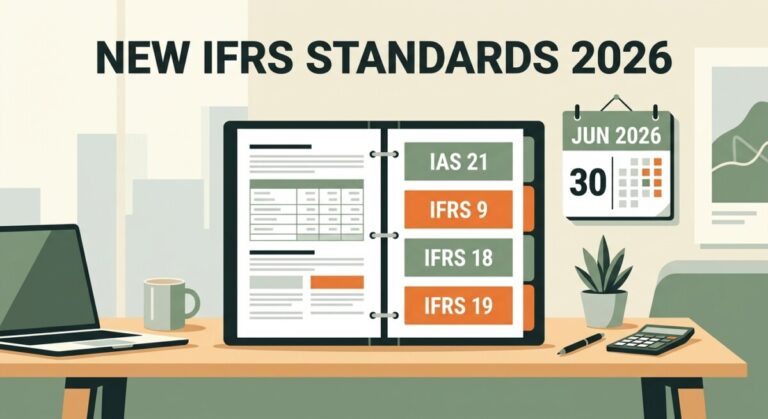
| Standard/Amendment | Effective Date | Key Impact |
|---|---|---|
| IFRS 9 & IFRS 7 (Classification & Measurement) | [cite_start]1 Jan 2026 [cite: 297] | [cite_start]Clarifies derecognition of financial liabilities settled via electronic payment systems[cite: 300, 301]. |
| IFRS 18 (Presentation & Disclosure) | [cite_start]1 Jan 2027 [cite: 366] | [cite_start]Replaces IAS 1. Introduces new categories: Operating, Investing, and Financing[cite: 368, 371]. |
| IFRS 19 (Subsidiaries without Public Accountability) | [cite_start]1 Jan 2027 [cite: 402] | [cite_start]Allows eligible subsidiaries to apply reduced disclosure requirements[cite: 404]. |
[cite_start]IFRS 18 is a game-changer. It introduces the concept of “Management-defined Performance Measures” (MPMs), which must be audited and disclosed in a single note[cite: 378, 379]. Start reviewing your presentation formats early!
Check Your Effective Date 📅
Confused about when a specific standard kicks in? Select a standard below to see its effective date and a quick tip.
🔢 IFRS Effective Date Checker
IFRS Update Key Takeaways
Frequently Asked Questions ❓
Staying compliant with IFRS is a journey, not a destination. With IFRS 18 and 19 on the horizon, the next few years will be transformative for financial reporting. I hope this summary helps you navigate these changes with confidence!
If you have any questions about specific standards or how they might affect your entity, feel free to ask in the comments below! Happy reporting! 😊