Everything about small business retirement plans – solo 401(k), SEP, SIMPLE
If you’re a business owner, you are a master of the hustle. You build, you create, you solve problems. But let’s be real for a second… what’s the end game? What about *your* own retirement? It’s a huge question, and honestly, the options can be kind of dizzying. Solo 401(k), SEP IRA, SIMPLE IRA… it’s easy to get lost in the noise.
But don’t you worry! This is the holy grail for every entrepreneur, isn’t it? How do you take all that success you’re building today and turn it into financial freedom tomorrow? All while—and this is the best part—slashing your tax bill right now. In the next few minutes, we’re going to cut right through that noise and give you a super clear, simple roadmap to picking the perfect retirement plan for you and your business. Let’s get into it! 😊
First, What Are We Comparing? 🤔
To make this decision as easy as possible, we’re not just going to throw a bunch of random details at you. Nope. We’re going to use a consistent checklist to look at each and every plan. This will give you a crystal-clear, apples-to-apples comparison so you can see exactly which plan is the right fit for your specific situation.
For each plan, we’ll look at these key points:
- The Concept: What is it, in plain English?
- Best For: Who is the ideal user for this plan?
- How to Join: What are the setup requirements and deadlines?
- Admin Burden: How much paperwork and hassle is involved?
- Pros & Cons: The good, the bad, and the bottom line.
- Retroactive? Can you still get a tax break for *last* year?
Plans for Solo-preneurs (Just You?) 👩💻
Alright, first up, let’s talk about the solo operators. This is for the freelancers, the consultants, the single-owner businesses. If your entire team is just you, or maybe you and your spouse, then this section is 100% for you.
The Powerhouse: Solo 401(k)
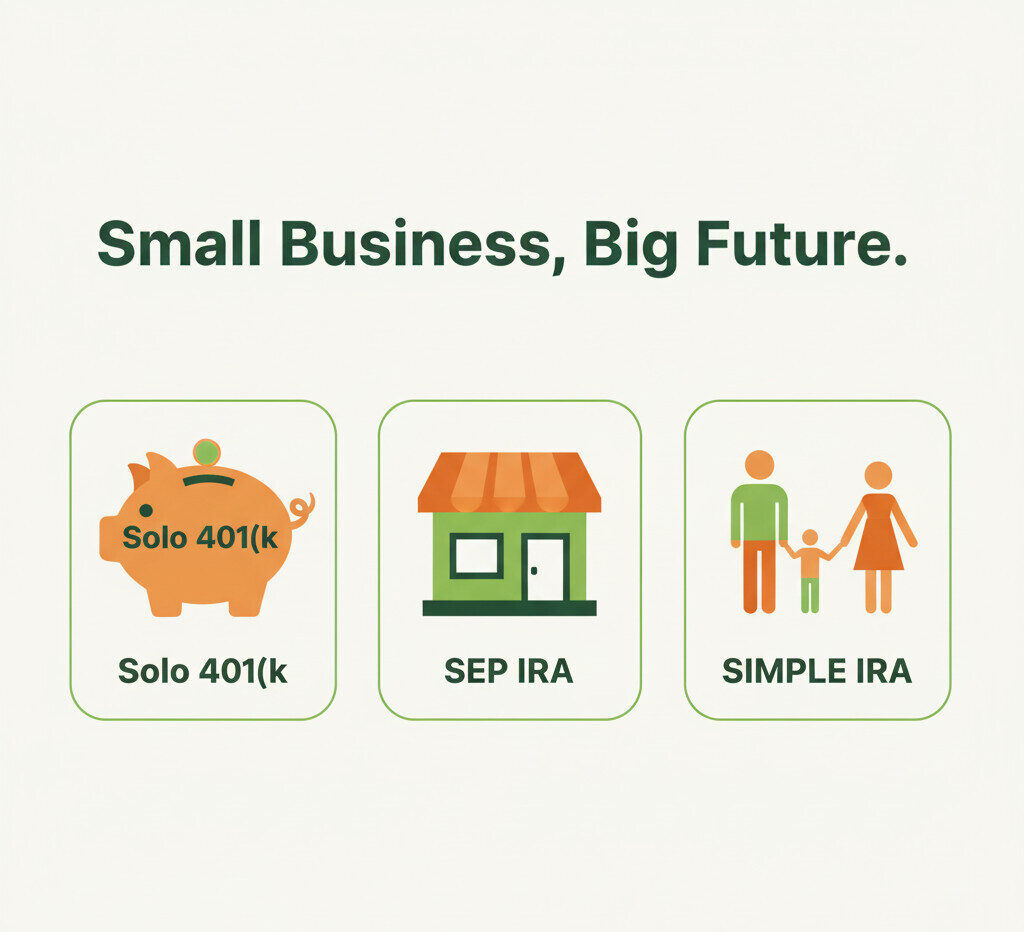
First up is the Solo 401(k), and let me tell you, this thing is an absolute powerhouse. Seriously, it’s like a regular 401(k) on steroids, built just for the self-employed (and their spouse). There’s a reason it’s such a fan favorite: it lets you put away a *massive* amount of cash for retirement.
For 2024, you can stash away up to $69,000 into a Solo 401(k). And if you’re 50 or older, you can throw in an extra $7,500 catch-up contribution. That is a life-changing amount of money that can totally fast-track your journey to financial independence.
The reason the limit is so high is that as a business owner, you get to wear two hats:
- As the Employee: You can contribute up to 100% of your compensation, up to the $23,000 employee deferral limit for 2024.
- As the Employer: Your business can *also* make a profit-sharing contribution, typically up to 25% of your net self-employment income.
A huge pro here is that the Solo 401(k) also gives you the option to make Roth (after-tax) contributions as an employee. This means your money can grow 100% tax-free for retirement. The main “catch” is that you must have the plan set up by December 31st of the tax year. The admin is still super low, but you do have to file a simple Form 5500-EZ once your plan’s balance gets over $250,000.
The Flexible Choice: SEP IRA
The other major player in the solo game is the SEP IRA (Simplified Employee Pension). The name says it all: it’s a simplified, flexible retirement plan. Think of it like a super-sized Traditional IRA for your business.
Unlike the Solo 401(k) where you contribute with “two hats,” the SEP IRA is different: only the employer (your business) contributes. You, as the owner, don’t make employee deferrals. Your business contributes a percentage of your net income, up to a maximum of $69,000 for 2024. Because it’s only an employer contribution, you often have to have higher income to max it out compared to a Solo 401(k).
The SEP IRA’s superpower is its simplicity and flexibility. First, there are zero annual filings, which is a huge relief. But its best feature? You can set one up for *last year* all the way up until your tax deadline (including extensions) this year. Missed the Dec 31st deadline for a Solo 401(k)? The SEP IRA has you covered.
The SEP IRA can also be used if you have a few employees, but there’s a critical rule: If you contribute for yourself, you *must* contribute the same percentage of compensation for all eligible employees. If you contribute 15% for yourself, you must contribute 15% for them, too. This can get expensive, which is why it’s often a better fit for solo-preneurs or those with high turnover (who may not meet eligibility).
Solo 401(k) vs. SEP IRA: Head-to-Head 📊
This is the big question for most self-employed folks. Let’s put them side-by-side in a table.
Solo Plan Comparison
| Feature | Solo 401(k) | SEP IRA |
|---|---|---|
| Concept | A “supercharged” 401(k) for the self-employed & spouse. | A “simplified” pension plan, like a big IRA. |
| Best For | Solo-preneur (or w/ spouse) wanting to maximize savings. | Solo-preneur or small team; those who missed the Dec 31 deadline. |
| Contribution Type | Employee (You) + Employer (Your Business) | Employer (Your Business) Only |
| Max 2024 Limit | $69,000 (+$7,500 catch-up) | $69,000 (no catch-up, harder to max out) |
| Roth Option? | Yes (for employee portion) | No |
| Setup Deadline | By Dec 31st of tax year. | By tax deadline (for prior year). |
| Admin Burden | Simple form (5500-EZ) once balance > $250k. | Zero annual filings. |
Plans for Teams (Growing Your Company?) 📈
Okay, but what happens when your company grows? What about when you move beyond just yourself and start building out a team? Well, your options change. Let’s look at the plans designed for businesses with employees.
The Simple Start: SIMPLE IRA
The name here really says it all. The SIMPLE IRA (Savings Incentive Match Plan for Employees) is designed to be a super straightforward, low-hassle way to offer a retirement benefit to your team. The key feature is that it allows your employees to contribute directly from their paychecks, and as the employer, you are required to chip in with a modest match (either a 2% fixed contribution or a dollar-for-dollar match up to 3%).
For your team, this is a total game-changer. They can put away up to $16,000 per year (for 2024), plus a catch-up if they’re over 50. That’s a huge step up from a standard IRA and makes for a powerful recruiting and retention tool.
The bottom line on the SIMPLE IRA? It’s incredibly low-maintenance. We’re talking minimal costs and zero annual reporting to the government. It really hits that perfect sweet spot for businesses with up to 100 employees that want to offer a great benefit without all the headaches.
The Big League: Traditional 401(k)
And now we get to the big one: the Traditional 401(k). This is the plan you’ve heard of. It’s the gold standard for retirement savings, offering the highest contribution limits and the most features for your employees.
But—and this is a big but—all that power comes with a price, and that price is complexity. Unlike a SIMPLE IRA, a Traditional 401(k) is not something you can just set up on your own. You have to hire specialists to run it, there’s annual paperwork and compliance testing (like filing Form 5500), and yes, it’s more expensive. It’s a fantastic tool, but it’s a much bigger commitment.
The “Ultimate Tool” for Max Savings 🚀
For those of you with ultra-successful, highly profitable businesses, there is a whole other level to this. If you’re looking to contribute *well over* the $69,000 limit and get massive tax deductions, you’ll want to look into a Defined Benefit Plan.
This is the “ultimate tool” for maximizing tax savings. Think of it as a traditional pension. Instead of a contribution limit, it has a *benefit* limit (i.e., it promises a certain payout at retirement). To fund that promise, you might be able to contribute $100,000, $200,000, or even more per year, all of which is a business tax deduction.
These plans are complex and expensive to administer, so they are typically only for highly profitable small businesses. They are often paired with a 401(k) for the ultimate savings and deduction combo.
Which Plan Fits You? Your Final Verdict 🎯
Okay, wow. We have covered a *lot* of ground. We’ve looked at the concepts, the numbers, the pros, and the cons. So now, let’s bring it all together into one simple, actionable guide to help you find your perfect fit.
This is your cheat sheet:
Retirement Plan Recommendation Guide
| Business Type | Primary Recommendation | Key Consideration |
|---|---|---|
| 1-Person Business | Solo 401(k) | Maximize your personal contributions. |
| Small Co (low turnover) | SIMPLE IRA | Empower your employees to save with you. |
| Small Co (high turnover) | SEP IRA | Lower your admin & contribution burden. |
| Medium Co (>100) | 401(k) | Offer a competitive, high-limit package. |
| Highly Profitable Co | DB + 401(k) Combo | Achieve the maximum tax deduction. |
Conclusion: Is Your Business Working for Your Future? 📝
Let’s end right where we started. Your business is your passion, it’s your creation, it is your biggest asset. The real question is, are you making that asset work for *you*? Are you leveraging it to build the future that you have always dreamed of?
I really hope this guide gives you the clarity and the confidence to go out and take that next step. If you have any questions about your own experience with these plans, or if you’re still wondering which is the best fit, feel free to ask in the comments~ 😊