Get Ready for IFRS 18: How to Prepare Your Business for the New Standard
Have you ever tried comparing the financial performance of two different companies and found yourself scratching your head? 🤔 One company’s ‘operating profit’ includes certain items, while another’s excludes them entirely. It can feel like comparing apples and oranges! For years, investors and analysts have faced this challenge due to the flexibility in older standards like IAS 1. But that’s all about to change. The International Accounting Standards Board (IASB) has introduced IFRS 18, the most significant update to financial reporting in over two decades, and it’s designed to bring much-needed clarity and consistency. Let’s dive in and see what this means for businesses and investors. 😊
The Problem with the Old Standard (IAS 1) 🤔
Before IFRS 18, the guiding standard was IAS 1, *Presentation of Financial Statements*. While it provided a framework, it lacked strict rules on how to structure the statement of profit or loss. This flexibility led to a few key problems:
- Inconsistent Subtotals: Companies could create and define their own versions of key metrics like ‘operating profit’ because IAS 1 didn’t define any specific subtotals. This made it incredibly difficult to make fair comparisons.
- Varying Expense Presentation: Businesses had the choice to present operating expenses by their ‘nature’ (e.g., employee costs) or by their ‘function’ (e.g., cost of sales), leading to different-looking reports.
- Lack of Transparency on APMs: There were no specific IFRS rules for so-called ‘Alternative Performance Measures’ (APMs). This meant companies disclosed them with varying transparency, often making it hard for investors to understand how they were calculated, and this information was not always audited.
This “diversity in practice” was a major headache for investors. The primary goal of IFRS 18 is to enhance the quality, transparency, and comparability of financial reports to help them make better-informed decisions.
IAS 1 vs. IFRS 18: The Key Changes 📊
IFRS 18 brings a much more structured approach to financial reporting. Think of it as organizing a messy closet into clearly labeled sections. Here’s a detailed breakdown of the main differences:
| Feature | IAS 1 (Old Standard) | IFRS 18 (New Regulation) |
|---|---|---|
| SoPL Structure | Lacked detailed requirements for classifying income and expenses, leading to diversity in practice. | Mandates five defined categories: operating, investing, financing, income taxes, and discontinued operations. |
| Key Subtotals | No required subtotals were defined; ‘operating profit’ varied by company. | Requires two new defined subtotals: ‘Operating profit’ and ‘Profit before financing and income taxes’. |
| MPMs (APMs) | No specific disclosure rules. Transparency varied and information was not always audited. | Introduces Management-Defined Performance Measures (MPMs) with mandatory, audited disclosure in a dedicated note, including a detailed reconciliation. |
| Grouping of Info | Limited guidance, often resulting in material information being obscured in aggregated items. | Provides enhanced principles for aggregation and disaggregation based on shared characteristics. |
| Cash Flow Statement | Allowed presentation alternatives for interest/dividends and multiple starting points for the indirect method. | Standardizes the starting point (operating profit) and removes presentation options for interest and dividends to improve comparability. |
| Earnings Per Share (EPS) | Allowed additional EPS measures based on any component of comprehensive income. | Restricts additional EPS disclosures to the notes, and the numerator must be an IFRS 18 subtotal or an MPM. |
Implementation: When and How? 🗓️
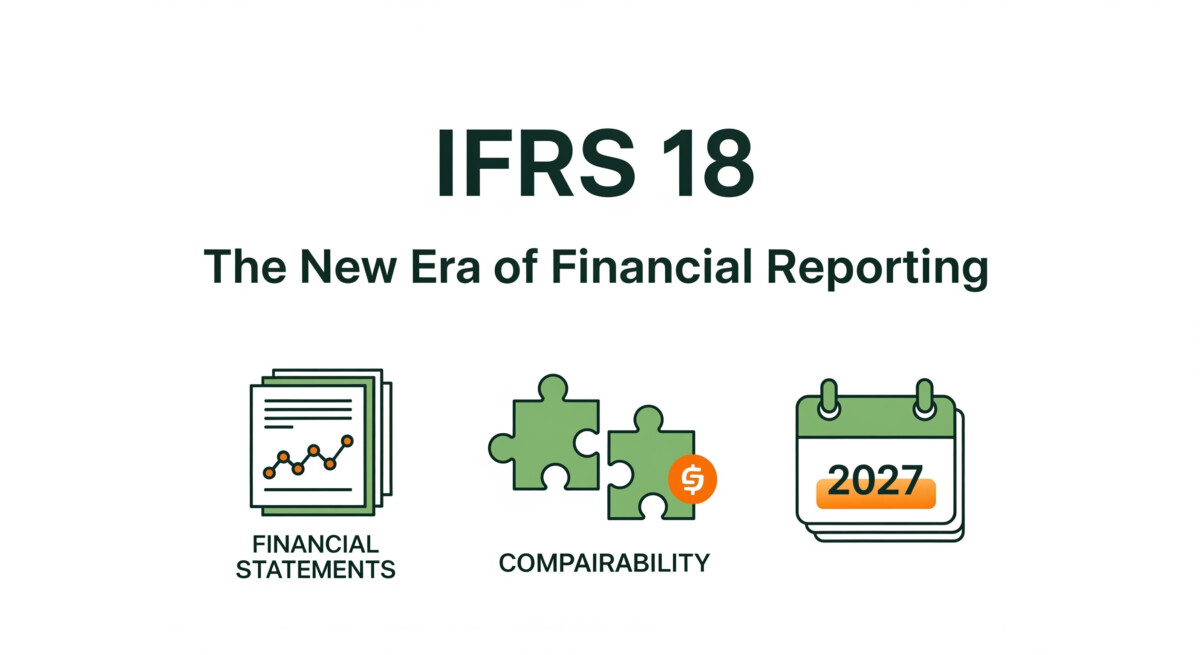
IFRS 18 becomes effective for annual reporting periods beginning on or after January 1, 2027, though companies can choose to adopt it earlier. The biggest challenge? It must be applied retrospectively.
Retrospective application means companies can’t just start in 2027. They will need to restate their 2026 financial data to be comparable. This requires significant early planning to ensure historical data is available and can be reclassified according to the new rules. Don’t wait until the last minute!
How to Prepare for IFRS 18 🚀
The transition will be a significant project. Here’s a more detailed action plan to get started:
Action Plan for IFRS 18 Implementation 📝
- Strategic Impact: Assess how the changes will affect investor communications, internal performance measurement, and market perceptions.
- Process Review: Adapt internal policies, controls, and financial statement preparation processes for the new classification rules and MPM disclosure requirements.
- Data & Systems: Evaluate your chart of accounts and IT systems. You may need to create new accounts and ensure your systems can capture the required data granularity for reclassification and auditability.
- Contracts & Compensation: Review loan agreements, contracts, and management bonus policies that are tied to financial metrics, as their definitions might change under IFRS 18.
- Communication Plan: Prepare to communicate the changes in your reported information clearly to investors, lenders, and other external parties.
IFRS 18 at a Glance
Frequently Asked Questions ❓
IFRS 18 is more than just an accounting update; it’s a fundamental shift towards greater transparency and comparability in financial reporting. While the transition requires effort, the long-term benefits for both companies and the investment community are clear. If you have any more questions, feel free to drop them in the comments below! 😊