
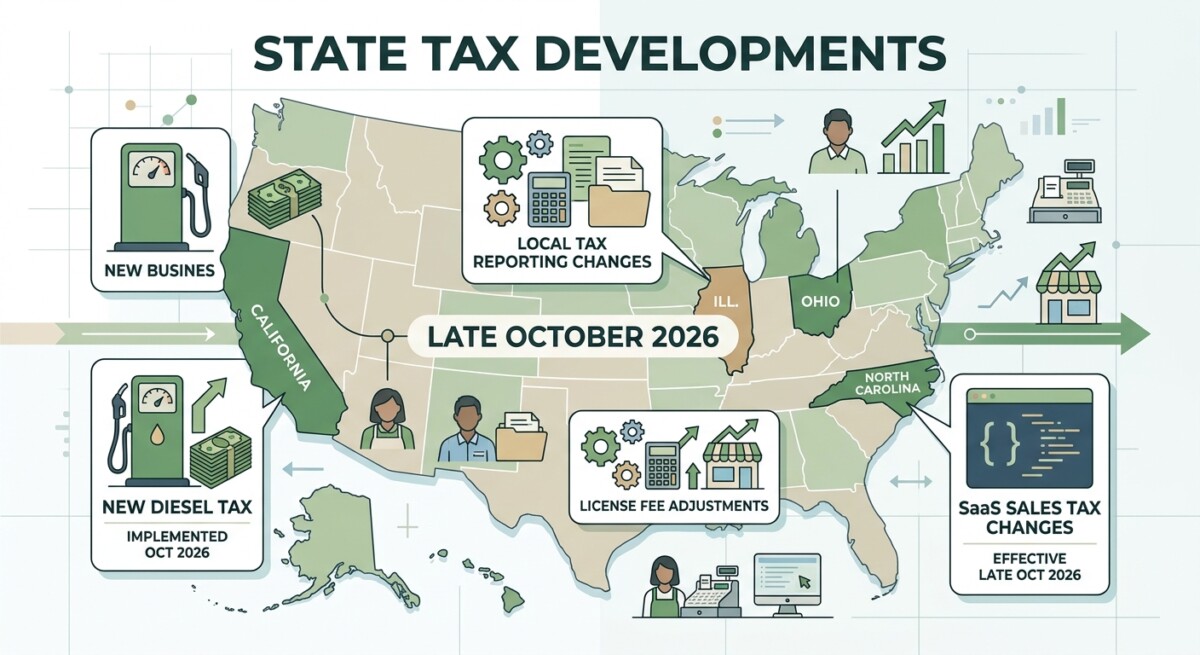
State tax developments: October 2026 roundup
What changed this week
| Development | Who it affects |
|---|---|
| California: digital products and software become taxable January 1, 2027 | SaaS providers, software resellers, and any out-of-state retailer selling downloaded or remotely accessed digital products to California customers. |
| Federal dyed diesel highway relief through December 31, 2026 | Trucking, construction, agriculture, and other fleets that burn diesel for both on-road and off-road use. |
| Illinois Digital Asset Tax: draft rules out, effective date now July 1, 2027 | Digital asset brokers, exchanges, custodial wallets, and payment processors with Illinois customers; Illinois-based clients of those platforms. |
| Ohio capital gains deduction for VCOC investors now live for 2026 | Ohio-resident individual investors in Ohio-focused VCOC funds and Ohio founders or owners selling their business. |
| North Carolina: optional videogame subscription fees are taxable | Videogame publishers, downloadable software companies, and any digital business selling optional access subscriptions tied to a one-time software purchase to North Carolina customers. |
California: digital products and software become taxable January 1, 2027
The California Department of Tax and Fee Administration published a tax guide implementing Senate Bill 122, which was signed into law in June 2026 and takes effect January 1, 2027. The guide extends sales and use tax to retail sales of prewritten computer software and other digital products transferred on physical media, delivered electronically, or accessed remotely, so most downloaded software and SaaS subscriptions sold to California customers become taxable. California’s statewide sales and use tax rate is 7.25% before local district add-ons, and the law also treats a copyright or patent interest sold with the digital product as part of the taxable sale. Custom software, digital books, digital audio works, digital video games, and cryptographically secured digital assets are outside the base. A limited $5 million aggregate relief applies to very large single-customer deals; the retailer is relieved and the purchaser self-accrues use tax on the transaction that pushes aggregate 2027 sales above $5,000,000.
Who it affects: SaaS providers, software resellers, and any out-of-state retailer selling downloaded or remotely accessed digital products to California customers.
What to do
Map which products meet the SB 122 definition, confirm registration with CDTFA, update invoicing to collect California sales or use tax starting January 1, 2027, and set a destination-based sourcing rule using the purchaser’s California address of record. Review resale and multiple-points-of-use certificates with buyers who will redistribute or use the product in several states.
Primary source: CDTFA Tax Guide for Retailers and Purchasers of Digital Products
Federal dyed diesel highway relief through December 31, 2026
On October 5, 2026, President Trump signed Executive Order 14435, Emergency Tax Relief on Diesel Fuel, directing Treasury to defer the federal excise tax and waive related penalties for dyed diesel used on public highways through December 31, 2026. On October 14, 2026, the IRS announced in IR-2026-122 that it will not impose penalties on dyed diesel sold for or used in on-highway use, that the relief is retroactive to October 1, 2026, and that it covers failure-to-deposit penalties and recordkeeping requirements for the period. Fuel compliance officers have been reassigned, so no federal on-road inspections of dyed fuel will occur during the relief window. The relief applies only to the federal excise tax; most state diesel excise taxes and state dyed-fuel rules remain in force.
Who it affects: Trucking, construction, agriculture, and other fleets that burn diesel for both on-road and off-road use.
What to do
Decide whether to use dyed diesel on highways through December 31, 2026, document the gallons burned off-road versus on-road for internal records, and confirm with each state revenue department whether a parallel state relief applies before refueling at state-tax-only pumps. Resume the standard clear-diesel protocol on January 1, 2027.
Primary source: White House Executive Order 14435, Emergency Tax Relief on Diesel Fuel · IRS News Release IR-2026-122, dyed diesel penalty relief
Illinois Digital Asset Tax: draft rules out, effective date now July 1, 2027
The Illinois Department of Revenue published preliminary draft rules on September 28, 2026, implementing the Illinois Digital Asset Tax Act, codified as 86 Ill. Admin. Code Part 497. The draft lays out when a broker-facilitated digital asset transaction is taxable, how value is measured in U.S. dollars when the transaction settles, sourcing to the Illinois customer, and registration and recordkeeping duties for brokers. Public comments are due October 30, 2026. In parallel, the Sangamon County Circuit Court signed an agreed preliminary injunction on October 7, 2026, moving the Act’s effective date from January 1, 2027, to July 1, 2027, while constitutional and federal preemption claims proceed. The tax rate is 0.2% of the value of each covered digital asset activity, and the collection obligation hits brokers with Illinois physical presence or more than $100,000 of Illinois gross receipts.
Who it affects: Digital asset brokers, exchanges, custodial wallets, and payment processors with Illinois customers; Illinois-based clients of those platforms.
What to do
If you broker, custody, or facilitate digital asset transactions for Illinois customers, pull the draft rules, test your fee streams and DeFi flows against the four-part taxability test, and submit comments by October 30, 2026. Push the start of collection systems work to the July 1, 2027 effective date and track the Sangamon County litigation, which could invalidate or further delay the regime.
Primary source: Illinois Department of Revenue, Digital Asset Tax draft rules posted
Ohio capital gains deduction for VCOC investors now live for 2026
Ohio Revised Code section 122.851 creates two individual income tax deductions for capital gains that are first available for tax years beginning on or after January 1, 2026. Investors in a certified Ohio Venture Capital Operating Company (VCOC) may deduct 100% of the capital gain attributable to the VCOC’s investments in Ohio businesses and 50% of the gain attributable to its other investments; a second deduction covers certain qualifying capital gains from the sale of an ownership interest in an Ohio business. To be a VCOC under the statute, the fund must manage or hold capital commitments of at least $50 million in active assets, have at least two-thirds of its managing or general partners resident in Ohio, and apply for annual certification from the Director of Development. The Director has sixty days to decide each application. Certified VCOCs report ownership, gains, and Ohio investment data to the Director and the Tax Commissioner between January 1 and February 1 each year.
Who it affects: Ohio-resident individual investors in Ohio-focused VCOC funds and Ohio founders or owners selling their business.
What to do
If you are an Ohio-resident investor, ask each fund whether it has filed for VCOC certification, since the deduction tracks fund status and ordering (apply after the Ohio Business Income Deduction). Fund managers that want LPs to claim the gain deduction should file the certification form with the Ohio Department of Development now, line up Ohio-resident GPs to meet the two-thirds rule, and set internal procedures for the annual January-February reporting window.
Primary source: Ohio Revised Code section 122.851, Venture capital operating companies
North Carolina: optional videogame subscription fees are taxable
In Secretary of Revenue private letter ruling SUPLR 2026-0006, dated July 16, 2026, the North Carolina Department of Revenue concluded that monthly subscription fees charged by an out-of-state videogame publisher for access to the game’s online functionality are taxable sales for North Carolina sales and use tax purposes. The downloaded videogame itself is prewritten computer software under state law, so the subscription that unlocks multiplayer and other online features is treated as a sale of a license to use the prewritten software and falls within tangible personal property for sales tax. The ruling binds only the requesting taxpayer, but it signals how the Department analyzes subscription paywalls layered over downloaded software, and it distinguishes stand-alone SaaS and IaaS, which North Carolina still generally does not tax.
Who it affects: Videogame publishers, downloadable software companies, and any digital business selling optional access subscriptions tied to a one-time software purchase to North Carolina customers.
What to do
If you sell a downloaded product in North Carolina and charge a separate monthly fee for added features, review the bundle: when the fee unlocks functionality in prewritten software the customer already owns, treat it as a taxable sale and collect state and local sales tax. If the subscription is a stand-alone cloud service with no linked software download, document that split in your pricing pages and tax configuration.
Primary source: North Carolina Department of Revenue, SUPLR 2026-0006
What this means for your business
- If you sell software or digital products, two large markets just moved: California adds SaaS and downloaded software to the sales tax base on January 1, 2027, and North Carolina is taxing subscription fees layered on downloaded games. Price pages and invoicing systems should be updated now, not in December.
- Illinois’ first-in-the-nation 0.2% digital asset tax is slipping from January to July 2027, giving brokers one more quarter to build systems, submit comments, and watch the Sangamon County constitutional case.
- On-highway dyed diesel is penalty-free through December 31, 2026, but only for federal excise tax. State diesel taxes and state dyed-fuel enforcement still bind, so confirm each state before mixing fuel.
- Ohio-resident founders and VCOC investors can deduct 50% to 100% of eligible capital gains starting with the 2026 tax year, provided the fund is certified and reports annually.
- The common theme is that revenue agencies are catching up to digital business models – software, crypto, subscription unlocks. Treat your product catalog as a tax-sensitive object and keep each product-state combination on a review cadence.
This week in state tax, one line
California turns on digital sales tax in January, Illinois delays its crypto tax to July, and Ohio starts paying investors to put money into Ohio-based venture funds.
Frequently asked questions
Q. Does California’s new digital products tax apply to my SaaS subscriptions sold to California customers from out of state?
Yes if the service is prewritten computer software accessed remotely, which covers most SaaS. The CDTFA guide tells sellers to register, collect sales or use tax, and source sales to the California address of record. A limited $5 million aggregate threshold shifts the obligation to the purchaser for very large single-customer deals in 2027.
Q. Can my construction fleet burn dyed diesel on public highways through December 2026?
The federal excise tax penalty is waived through December 31, 2026, so federal enforcement is paused. State diesel excise taxes and most state dyed-fuel rules still apply, so confirm each state before fueling. Keep internal records of gallons by jurisdiction even though the IRS has waived recordkeeping for the relief period.
Q. If my company brokers crypto for Illinois customers, do we have to register now?
Collection does not start until July 1, 2027, after the agreed preliminary injunction, but the draft rules are open for comment until October 30, 2026. Brokers with Illinois physical presence or more than $100,000 of in-state receipts should begin building systems, submit comments, and monitor the Sangamon County constitutional case.
Q. I live in Ohio and want the capital gains deduction. What has to be true?
You must be an Ohio-resident individual, the gain must come from a VCOC certified by the Ohio Director of Development or from the sale of an ownership interest in an Ohio business that meets the statute, and the VCOC must file its annual report between January 1 and February 1. Apply the VCOC deduction after Ohio’s Business Income Deduction.