
A Start-up Guide to the $500,000 R&D Tax Credit Payroll Offset
If you’re building a startup, you know that every single dollar counts. We pour our hearts, souls, and every available penny into developing our products, software, and processes. But for so many early-stage companies, the biggest challenge is cash flow. You’re spending money on R&D, but you’re not profitable yet. So, what if I told you there’s a government incentive that can put cash *directly* back into your pocket, right now? And what if I told you that benefit just doubled? Trust me, you’re going to want to hear this. 😊
First, What is the R&D Tax Credit? 🤔
Let’s start with the basics. The R&D Tax Credit is essentially the government’s way of saying, “Hey, thanks for innovating and pushing the boundaries. Here’s a reward to help you keep doing it.”
Officially, it’s a government incentive that allows companies—both big and small—to reclaim a portion of the money they spend on research and development. Think of it as a direct reward for all that hard work you’re putting into creating something new or making something significantly better. It’s designed to encourage companies to invest in innovation, which is great. But for years, there was a huge catch for startups.
The Classic Startup Problem: “But We’re Not Profitable!” 😫
This brings us to the classic startup problem. An income tax credit is awesome… but what if you have no income tax to pay? Most early-stage startups are pouring every dollar back into growth. We have tons of expenses and little, if any, profit. That means no income tax liability.
For the longest time, this made the R&D credit feel like a “distant promise.” It was something nice to think about for the future, a benefit that was there on paper but one you couldn’t actually use until you were profitable. It didn’t help your cash flow *today* when you needed to make payroll next month. And let’s be real, for a startup, today is what matters. But then, everything changed.
A truly smart provision was introduced that allowed “Qualified Small Businesses” (which includes most startups) to apply the R&D credit against their payroll taxes instead of their income taxes.
Since pretty much every startup has employees and pays payroll taxes (like Social Security and Medicare), this was a total game-changer. Suddenly, the credit wasn’t a future promise anymore. It became an immediate cash-back benefit you could get quarter after quarter.
The Big News: The $500,000 Update That Doubled the Benefit 🚀
This payroll tax offset was already an incredible deal for startups. It was fantastic. But thanks to recent legislation, that fantastic deal just got twice as good.
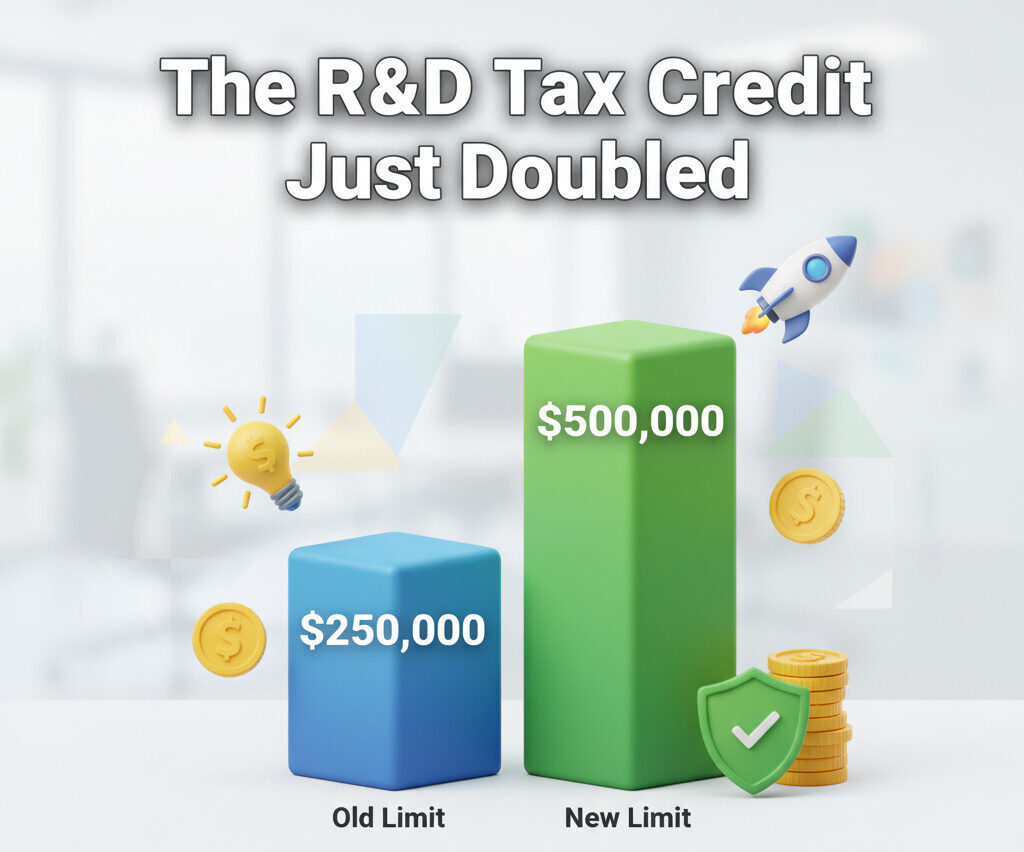
The Inflation Reduction Act of 2022 made a simple but incredibly powerful change. Before this act, a startup could use the R&D credit to offset up to $250,000 in payroll taxes each year. But starting with the 2023 tax year, that limit was literally doubled.
That’s right, the new annual limit is now half a million dollars. Just let that sink in for a second. For a growing startup, a potential cash flow boost of $500,000 a year is nothing short of transformative. This is money you can use to hire more engineers, speed up development, or seriously extend your runway.
How the New $500,000 Limit Works
So how do you get to that big number? The law now lets you apply the credit against two separate parts of your employer payroll taxes. It’s broken down like this:
| Tax Component | Annual Credit Limit | Notes |
|---|---|---|
| Social Security (FICA) | Up to $250,000 | This was the original limit. |
| Medicare (HI) | Up to $250,000 | This is the new part! |
| Total Potential Offset | Up to $500,000 | Effective for tax years 2023+ |
Remember, this isn’t a complicated deduction that just lowers your “taxable income” on paper. This is a dollar-for-dollar credit that reduces the *actual cash* you have to send to the IRS for payroll taxes. It’s an immediate, tangible boost to your bank account every single quarter.
What *Actually* Counts as R&D? (It’s Not Just Lab Coats) 👩💻👨🔧
A half-million-dollar benefit sounds amazing, I get it. But this leads to the next big question I always hear: “What kind of work actually counts as R&D?”
When most founders hear “R&D,” they immediately picture scientists in white lab coats curing a disease or building a spaceship. But the reality is that the tax code’s definition of R&D is so much broader than that.
You don’t need a high-tech lab to qualify. A lot of everyday product development, software engineering, and process improvements can totally count. To see if your work qualifies, the IRS uses a “Four-Part Test.” Your project or activity must meet all four of these criteria:
- Permitted Purpose: You must be trying to create a new or improved product, process, or software. This is about its function, performance, reliability, or quality.
- Eliminate Uncertainty: When you started, there must have been technical uncertainty about *how* you were going to achieve your goal. This could be uncertainty about the right design, the best method, or the capability itself.
- Process of Experimentation: You must have gone through a process of evaluating different alternatives to resolve that uncertainty. This includes testing, running simulations, systematic trial and error, and modeling.
- Technological in Nature: Your work must be based in the “hard sciences.” This sounds intimidating, but it just means it relies on principles of engineering, computer science, biology, chemistry, or physics.
Practical Example: The Phone Case Company 📱
Let’s make this real with an example. A company that makes phone cases doesn’t exactly scream “high-tech lab,” right? But they can qualify.
📝 Case Study: Shock-Absorbing Phone Case
- The Goal (Permitted Purpose): To create a new phone case that is 2x better at absorbing shock than any product on the market.
- The Problem (Uncertainty): The team wasn’t sure what combination of materials or internal structural design would achieve this shock absorption target without making the case too bulky.
- The Work (Experimentation): They went through a systematic process of testing 10 different polymer blends and 5 different internal support structures. They used 3D models and conducted drop tests to evaluate each alternative.
- The Field (Technological): This entire process relied on principles of materials science and mechanical engineering.
Conclusion: This project 100% qualifies for the R&D tax credit because it clearly meets all four parts of the test.
Think about your own work. Are you testing different database architectures for scalability? Experimenting with new algorithms? Trying to automate a complex manufacturing process? All of that could be qualifying R&D!
How to Claim Your Credit: A Step-by-Step Guide 📝
Okay, so you’re listening to this and thinking, “Hey, I think we might actually qualify for this!” Awesome. So, how do you actually claim the credit and get that cash for your business? Here are the key steps:
- Conduct an R&D Study: The whole process kicks off with a study (either internal or with a specialist) to pinpoint exactly which activities, employee wages, and supply costs qualify.
- Document Everything: This is the absolute key, and I can’t stress it enough. You need to document your process as you go. You need to prove your work meets that Four-Part Test. Keep your project notes, test results, and meeting minutes.
- File with Your Income Tax Return: You’ll file a specific form (Form 6765, Credit for Increasing Research Activities) with your annual income tax return. This is where you officially calculate your credit amount.
- Claim Against Your Payroll: After you’ve filed your income tax return, you’ll file *another* form (Form 8974, Qualified Small Business Payroll Tax Credit for Increasing Research Activities) with your quarterly payroll tax filings (Form 941) to *actually apply* that credit and reduce the cash you pay.
Don’t just stop at the federal level. Many states have their *own* R&D tax credits, and in many cases, you can “stack” these benefits on top of the federal credit. This is like a bonus on top of a bonus, which means even more cash back for your startup.
Conclusion: Are You Claiming Your Full Reward? 💰
To bring this all home, here’s the big picture: The immediate cash flow opportunity for startups that are innovating has literally doubled. It went from an already-great $250,000 a year to a massive $500,000 a year.
This is a huge shift that can help you fund new hires, speed up development, and seriously extend your runway. You are already doing the incredibly hard work of building something new and something better.
The only question is: are you claiming the full financial reward you’ve earned for doing it?
R&D Tax Credit: Key Facts
Frequently Asked Questions ❓
If you have any more questions, feel free to ask in the comments~ If you’re a startup founder, this is a benefit you can’t afford to overlook. Go get your reward! 😊