Trust charitable deduction — still Form 1041-A?
The trust charitable deduction under Internal Revenue Code Section 642(c) is one of the quietly powerful provisions in Subchapter J. A properly structured trust can claim an unlimited income tax deduction for amounts distributed to charity, and — subject to the trust’s governing instrument — that deduction is not capped by the percentage limits that would apply to an individual. The trade-off has always been a specific set of reporting rules aimed at making sure the deduction is not claimed twice, and not claimed for income the trust never actually paid out for charitable purposes.
On August 17, 2026, the IRS published proposed regulations (REG-109082-25 in the Federal Register) that would narrow one of those reporting rules — the annual filing of Form 1041-A. The change is not a repeal. It is a pair of common-sense carve-outs that ordinary practitioners have been asking about for years, written in a way that keeps the anti-abuse purpose of the rule intact. We work with owner-operated businesses and the families behind them, and this is the kind of paperwork simplification that we actually welcome — narrow, principled, and easy to explain to a trustee.
What did the IRS just propose about Form 1041-A? 📋
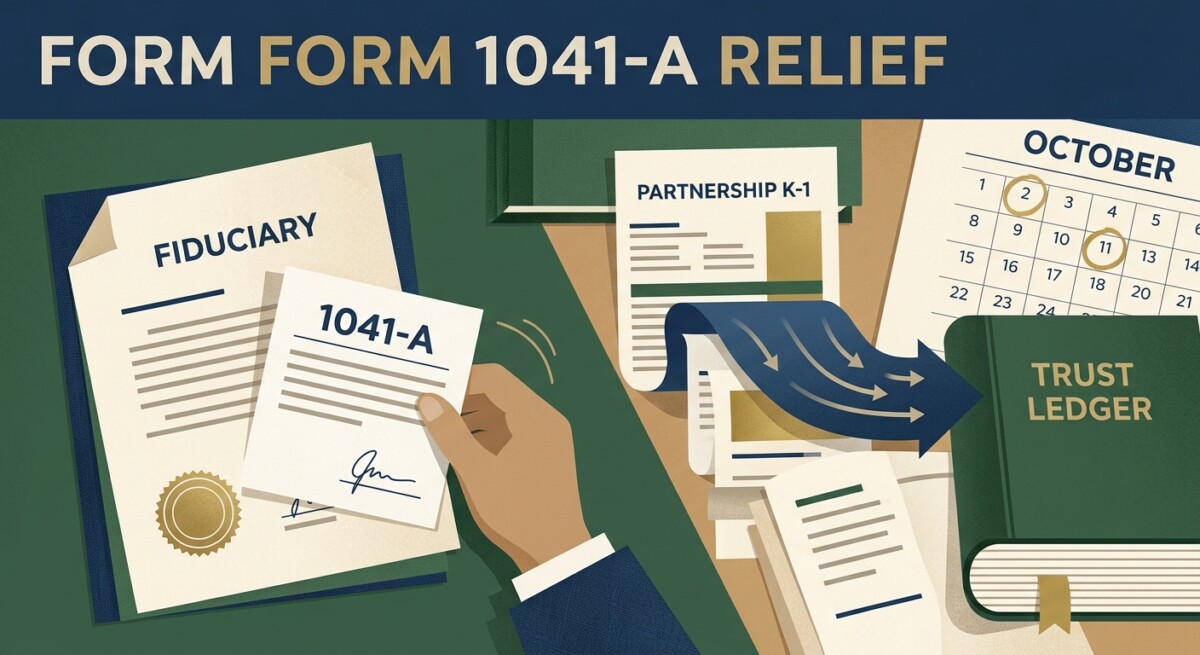
Two carve-outs. First, a trust whose only Section 642(c) deduction is a distributive share from a pass-through entity would no longer file Form 1041-A. Second, a split-interest trust that files Form 5227 would be expressly excluded from Form 1041-A in the regulation itself.
Form 1041-A is the annual information return that reports, for a non-exempt trust, the charitable amounts deducted under Section 642(c) — both amounts distributed for charitable purposes during the year and amounts set aside for such purposes. Congress required it through IRC Section 6034 because IRC Section 642(c) lets a trust take an unlimited charitable deduction and elect, within limits, to treat a distribution as made in the immediately preceding tax year. Left unchecked, that timing flexibility could allow a trust to accumulate income indefinitely while claiming deductions for future — or fictional — charitable distributions. The Form 1041-A reporting closes that loop.
The proposed regulations do not touch the accumulation-plus-deduction case that the reporting rule was designed for. What they do is remove the filing obligation in two situations where the underlying policy concern does not exist. Both are documented on the face of the notice of proposed rulemaking published in the Federal Register, and the amendments would be codified in Treas. Reg. Section 1.6034-1.
Why does a pass-through trust charitable deduction get relief? 🔀
Because in that fact pattern the charitable deduction arises from the entity’s contribution, not from the trust’s ability to accumulate or set aside income. The Section 6034 concern is not implicated, so the annual return is not needed.
IRC Section 702(a)(4) provides that each partner in a partnership takes into account its distributive share of the partnership’s items of income, gain, loss, deduction and credit in determining its own tax. When a partnership makes a charitable contribution described in IRC Section 170(c), each partner — including a trust partner — picks up its share of that deduction. The trust did not decide when to give, how much to give, or which organization to give to. The partnership did.
The IRS’s preamble to REG-109082-25 makes that observation explicit: because the charitable deduction in this scenario arises from the entity’s action rather than from the trust’s ability to accumulate or distribute gross income, the trust cannot use Section 642(c)’s retroactive election to treat the deduction as arising in a prior year, and the deduction is therefore not susceptible to the timing abuse Section 6034 was written to police. Requiring the trust to file an annual information return for a deduction it did not itself create is paperwork without a policy purpose.
In our practice
This carve-out matters most for the trust that owns an operating partnership interest as a passive holding — a family investment vehicle that receives Schedule K-1 items and rarely, if ever, writes its own charitable check. Under current law the K-1 line for charitable contributions was, all by itself, enough to trigger an annual Form 1041-A. Trustees regularly asked us whether the return was really required in that case; under the proposed rules the answer would finally be no, provided there is no direct Section 642(c) distribution in the same year.
Mixed years still file
The carve-out is written as “only” — the trust’s only Section 642(c) deduction for the year is the distributive share. A trust that receives a K-1 charitable contribution AND makes its own direct charitable distribution in the same tax year is not inside the carve-out, and Form 1041-A would continue to apply for that year. Trustees who are considering timing a direct gift for estate-planning reasons should keep this in mind.
Does a split-interest trust still file Form 1041-A? ⏳
No — the proposed regulations confirm what the Form 5227 instructions have said for years. A split-interest trust files Form 5227 and does not also file Form 1041-A.
A split-interest trust is a trust that has both charitable and non-charitable beneficiaries and for which a charitable deduction was allowed on funding — the classic examples are the charitable remainder annuity trust, the charitable remainder unitrust, the pooled income fund, and the charitable lead trust. These trusts already file Form 5227 each year, which reports the trust’s charitable and non-charitable interests in far more detail than Form 1041-A ever did.
Read literally, however, the current text of Treas. Reg. Section 1.6034-1 appeared to layer a Form 1041-A obligation on top of that Form 5227 filing for any split-interest trust that also claimed a Section 642(c) deduction and allowed some discretion over income distributions. The Form 5227 instructions, by contrast, have long stated that Form 5227 replaces Form 1041-A for a split-interest trust. The proposed regulations resolve the inconsistency by amending the regulation to say, on its face, that the Form 1041-A filing requirement expressly excludes split-interest trusts.
For trustees this is more of a rulebook cleanup than a change in practice — competent preparers have followed the Form 5227 instructions all along — but codifying the exclusion in the regulation eliminates a source of examiner-side confusion and reduces the risk of a failure-to-file penalty being asserted on a form that was never really required in the first place.
When does it take effect, and can I rely on it now? 📅
If finalized, the regulations would apply to tax years ending on or after the date of final publication. Taxpayers may rely on the proposed rules before that date. Written comments and requests for a public hearing are due by October 16, 2026.
The reliance statement is specific to REG-109082-25 and is limited to the two carve-outs above. It does not open a broader gate on Section 642(c) reporting, and it does not affect the deduction itself — a trust that qualifies for the carve-out still claims its Section 642(c) deduction on Form 1041 exactly as before. What changes is whether an additional annual information return has to be filed alongside the income tax return.
October 16, 2026 is a comment deadline, not a compliance deadline. Nothing is owed on that date. It is the point at which affected trustees, professional fiduciaries and their advisers can put specific fact patterns into the record — pass-through structures with mixed direct and indirect charitable activity, private trust companies acting as trustee for multiple related trusts, and similar edge cases are exactly the situations where a single, precise comment can shape the final language.
What should trustees actually do now? ✅
Inventory this year’s Section 642(c) deductions by source, decide whether to rely on the proposed regulations for the current filing, and file — or not file — accordingly, with a short memo in the trust file explaining the choice.
- Pull each trust’s tax file and separate its Section 642(c) deductions into two buckets: direct distributions by the trust and distributive shares from pass-through entities
- For any trust whose current-year Section 642(c) deduction is only a distributive share, confirm no direct charitable distribution is planned before year-end — otherwise the trust falls back into the standard Form 1041-A filing pattern
- For every split-interest trust already filing Form 5227, remove any “belt-and-suspenders” Form 1041-A from the workpaper checklist and document the exclusion
- If a trust wants to rely on the proposed regulations for the current year, add a short reliance memo to the trust file — cite REG-109082-25 and the fact pattern that qualifies
- If a trust’s fact pattern turns on a wrinkle the proposed language does not cleanly address, consider submitting a comment before the October 16, 2026 deadline
| Situation | Under current rules | Under REG-109082-25 |
|---|---|---|
| Trust makes its own charitable distributions from accumulated income | Form 1041-A required | Form 1041-A still required |
| Trust’s only Section 642(c) deduction is a K-1 pass-through charitable contribution | Form 1041-A required | No Form 1041-A (new carve-out) |
| Split-interest trust (CRAT, CRUT, PIF, CLT) filing Form 5227 | Regulation and instructions conflicted | Form 1041-A expressly excluded |
| Trust with both a K-1 charitable share and a direct distribution same year | Form 1041-A required | Form 1041-A still required — carve-out does not apply |
The short version
- The trust charitable deduction under Section 642(c) is unchanged — only the annual Form 1041-A reporting is being narrowed
- Pass-through-only trust deductions and Form 5227 split-interest trusts would drop out of Form 1041-A once REG-109082-25 is finalized
- Reliance on the proposed rules is permitted now, in the exact fact patterns the regulation describes
- Comment window closes October 16, 2026 — the last low-cost chance to shape the final rule
Frequently asked questions ❓
Q. Which trusts still have to file Form 1041-A?
Under current law, a non-exempt trust that (1) is authorized to accumulate income and (2) claims an income tax deduction under IRC Section 642(c) for amounts paid or set aside for a charitable purpose must file Form 1041-A each year. The IRS’s August 2026 proposed regulations (REG-109082-25) would keep that requirement for trusts making their own direct charitable distributions, but would carve out two situations described below. Charitable remainder trusts and other split-interest trusts that already file Form 5227 would be expressly excluded once the regulations are finalized.
Q. What exactly do the IRS proposed regulations (REG-109082-25) change?
Two things. First, they would eliminate the Form 1041-A filing obligation for a trust whose only Section 642(c) charitable deduction is a distributive share of a charitable contribution made by a pass-through entity in which the trust owns an interest. Second, they would confirm that a split-interest trust that files Form 5227 does not also file Form 1041-A. Both changes narrow the reporting rule without repealing it — a trust that directly accumulates income and pays out its own charitable contributions still files Form 1041-A.
Q. When do the proposed regulations take effect and what is the comment deadline?
If finalized, the regulations would apply to tax years ending on or after the date of final publication in the Federal Register, and taxpayers may rely on the proposed rules before that date. Written or electronic comments and any requests for a public hearing must be received by October 16, 2026. If you have a fact pattern that hangs on one of the carve-outs, the comment window is the cheapest opportunity to shape the final language.
Q. If my trust owns an interest in a partnership that makes a charitable contribution, do I still file Form 1041-A?
Under the proposed regulations, no — provided that distributive share is the trust’s only Section 642(c) deduction for the year. The IRS reasoned that the deduction in that case arises from the partnership’s action, not from the trust’s ability to accumulate or distribute income under Section 642(c)’s timing rule, so the Section 6034 reporting concern is not implicated. If the trust also makes its own charitable distributions in the same year, the filing obligation continues.
Q. Does the change affect a charitable remainder annuity trust or charitable lead trust?
It clarifies the paperwork, not the tax. Split-interest trusts — including charitable remainder annuity trusts, charitable remainder unitrusts, pooled income funds and charitable lead trusts — file Form 5227 each year, and the Form 5227 instructions have long stated that Form 5227 replaces Form 1041-A for these trusts. The proposed regulations amend Treas. Reg. Section 1.6034-1 to say the same thing on the face of the regulation, removing an apparent inconsistency between the regulation and the form instructions. The underlying tax treatment does not change.
Q. What is the risk of relying on the proposed regulations before they are finalized?
The IRS’s preamble states that taxpayers may rely on the proposed regulations before finalization. That is a specific reliance statement, not the general safe harbor, and it applies only to the narrow carve-outs described here. In our practice we still document the reliance decision in the trust file and would not extend it beyond the exact fact patterns the proposed regs address — particularly where a trust has both a partnership-generated deduction and a direct distribution in the same year.
Every trust is different, and a summary cannot tell you whether your trust falls inside a carve-out or outside it. If you would like us to look at your trust’s Section 642(c) profile, contact SW Accounting & Consulting Corp — a Los Angeles CPA firm working with families and their trustees on both the income tax and estate-planning sides of the return.