AI Disclosures 10-K: Fortune 500 2025 Trends and SEC Focus
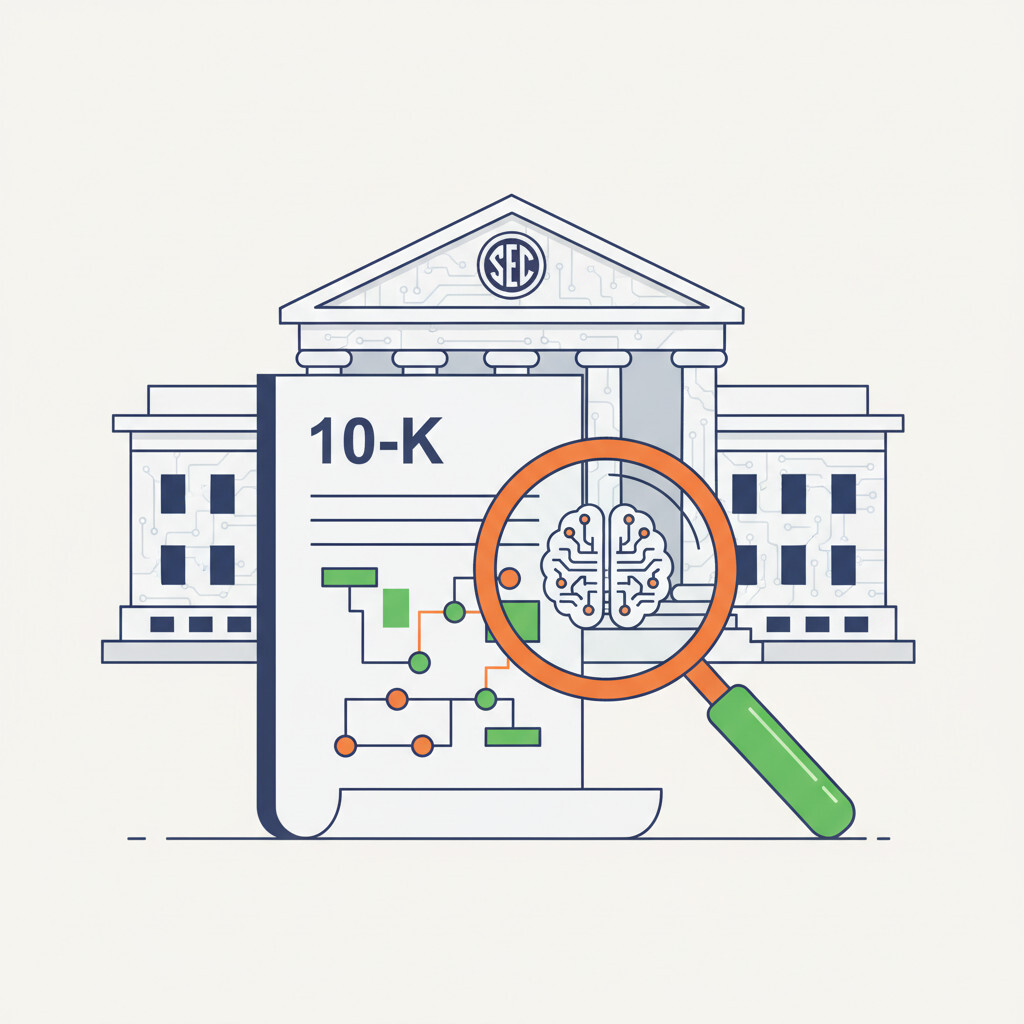
If you’re drafting your 2026 annual report and your draft mentions AI, you’re not alone — but you may not be saying enough. Deloitte’s April 2026 Financial Reporting Spotlight on the 2025 reporting season shows that AI disclosures 10-K have moved from rare to nearly universal, with the SEC pressing registrants to ensure their statements about AI are substantiated, governance-aware, and forward-looking.
At SW Accounting & Consulting Corp, we work with public-company clients refining their disclosures across exactly these themes. This guide summarizes the data, the SEC’s stated priorities, and the practical drafting moves we’re recommending heading into Q2 2026 filings.
How prevalent are AI disclosures 10-K filings now? 📊
95% of Fortune 500 companies disclosed AI-related matters in their latest annual reports, up from 84% the prior year — making AI one of the fastest-growing disclosure topics in modern 10-K practice.
| 10-K Section | 2025 Filings | 2024 Filings |
|---|---|---|
| Risk Factors | 95% | 88% |
| Business | 52% | 42% |
| MD&A | 33% | 25% |
| Financial Statements | 14% | 12% |
The story is in the cross-section: while Risk Factors remained dominant, Business section AI disclosures jumped 10 points (42%→52%) and MD&A grew by a third (25%→33%). Companies are no longer just flagging AI as a risk — they’re actively describing how they use AI, why they’re investing in it, and what financial returns or efficiencies they expect.
What is the SEC saying about AI disclosures? 🎤
SEC Chairman Paul Atkins, Chief Accountant Kurt Hohl, and CorpFin Chief Accountant Heather Rosenberger have all stressed AI governance, model explainability, and transparency about AI-related claims and risks.
At the 2025 AICPA & CIMA Conference on Current SEC and PCAOB Developments, the agency’s senior accounting leadership flagged three priorities for AI-related disclosures:
- AI governance. Boards and management must articulate who owns AI risk, what controls govern model deployment, and how AI use is monitored. The SEC has hinted that disclosure of AI-specific governance policies may become standard practice, not optional commentary.
- Explainability and emerging fraud risks. Model explainability — being able to articulate why an AI produces a given output — is on the SEC’s radar, particularly for AI-driven financial reporting decisions. Concurrently, AI-enabled fraud (deepfakes, synthetic identity, prompt injection) is emerging as a distinct risk category warranting disclosure.
- Substantiation of AI-related claims. Per Heather Rosenberger, registrants making forward-looking statements about AI improving their business must have a reasonable basis for those claims. Vague optimism without supporting evidence is treated as potentially misleading.
In our practice, the gap between “we use AI” and “we govern AI” is the most common drafting deficit. If your AI strategy section talks about generative AI use cases without addressing the governance framework, the SEC may treat that as a material omission. Pair every AI-use statement with a brief governance reference — your Audit Committee charter, your AI policy, or your model-risk-management process.
What concrete AI disclosures should I include in my 10-K? 📋
Risk Factor disclosures are increasingly addressing concrete legal/compliance issues — costs of EU AI Act and state regulatory compliance, AI-enabled cyberattacks, market disruption, and execution risk on AI strategies.
Practical content categories we recommend covering in 2026 filings:
| Section | Disclosure Topics |
|---|---|
| Business | How AI is integrated into operations, customer offerings, or competitive positioning. Specific use cases (not generic “we use AI”). |
| Risk Factors | Regulatory cost (EU AI Act, state AI laws); cybersecurity (AI-driven attacks); operational (model failure, hallucination); reputational (biased outputs); execution risk on stated AI strategies; data privacy; talent. |
| MD&A | AI-related capex/opex trends; impact on revenue, gross margin, or operating expenses; expected efficiency gains and the basis for those claims; productivity metrics where measurable. |
| Financial Statements | AI-related software capitalization (now under modernized ASC 350-40 per ASU 2025-06); intangible assets; impairment of legacy systems being replaced. |
Should AI investments be presented as non-GAAP adjustments? ⚖
No — and the data backs this up. Deloitte found no companies treating AI investments as non-GAAP adjustments because such investments are increasingly viewed as recurring and integral to operations.
Non-GAAP adjustments are appropriate for non-recurring, infrequent, or unusual items. AI infrastructure spending (cloud GPU capacity, model licensing, prompt engineering teams, MLOps tooling) is becoming a permanent cost-of-doing-business line item — like SaaS subscriptions a decade ago. The SEC’s general posture against “AI-adjusted EBITDA” and similar metrics aligns with this analytical reality.
“We expect AI to drive [X]% productivity improvement” is a quantitative forward-looking statement that needs a reasonable basis. If the basis is a single internal pilot or vendor study, disclose that limitation. The PSLRA safe harbor still requires meaningful cautionary language and a reasonable basis for projections — AI doesn’t change either rule.
What should preparers do before the next filing? ✅
- Map AI throughout your 10-K, not just Risk Factors. If AI is in Risk Factors but not Business or MD&A, your disclosure is unbalanced. Update Business to describe specific use cases; update MD&A to address material financial-impact trends.
- Add a governance reference. Even a single sentence — “Our AI use is governed by [policy / committee / framework] reporting to [owner]” — closes the most common SEC comment trap.
- Substantiate forward-looking AI claims. If you say AI will improve productivity by 20%, document the pilot, vendor study, or internal benchmarking that supports it. Consider including conservative language that flags the basis as preliminary.
- Address EU AI Act and state law compliance costs. If you have EU operations or operate in California/New York, the regulatory cost line should explicitly mention AI compliance.
- Coordinate with the audit team on capitalization. ASU 2025-06 modernized internal-use software accounting effective in upcoming periods. Your capitalization policy should reflect the new probable-to-complete threshold for AI development projects.
Frequently Asked Questions 🗂
For SEC speeches and guidance, see the SEC speeches and statements page and the AICPA & CIMA Current SEC and PCAOB Developments archive. Deloitte’s April 2026 Financial Reporting Spotlight provides additional Fortune 500 benchmarking data.
Need help drafting AI-related 10-K disclosures, governance policies, or capitalization policy memos? SW Accounting & Consulting Corp’s technical accounting and SEC reporting team works with registrants across these areas — book a consultation.