Pooled Employer Plan vs State Auto-IRA: PEP 401(k) Guide for Small Employers
If your state has enacted a retirement plan mandate, you’re already on the clock. And if your state hasn’t yet — California, Oregon, Illinois, Maryland, Colorado, and many others already require it — there’s a good chance it’s coming. For many business owners, this feels like a compliance checkbox. But the Pooled Employer Plan structure (PEP, created under the SECURE Act of 2019) lets you transform that compliance burden into a genuinely valuable employee benefit without the administrative overhead of a standalone 401(k).
At SW Accounting & Consulting Corp, we help business owners navigate state retirement mandate compliance, plan selection, and the trade-offs between auto-IRA, single-employer 401(k), and PEP structures. This guide walks through how PEPs work, how they compare to auto-IRA mandates, what the Pooled Plan Provider (PPP) actually handles, and when a PEP is the right answer.
What is the state retirement mandate landscape? 🗺
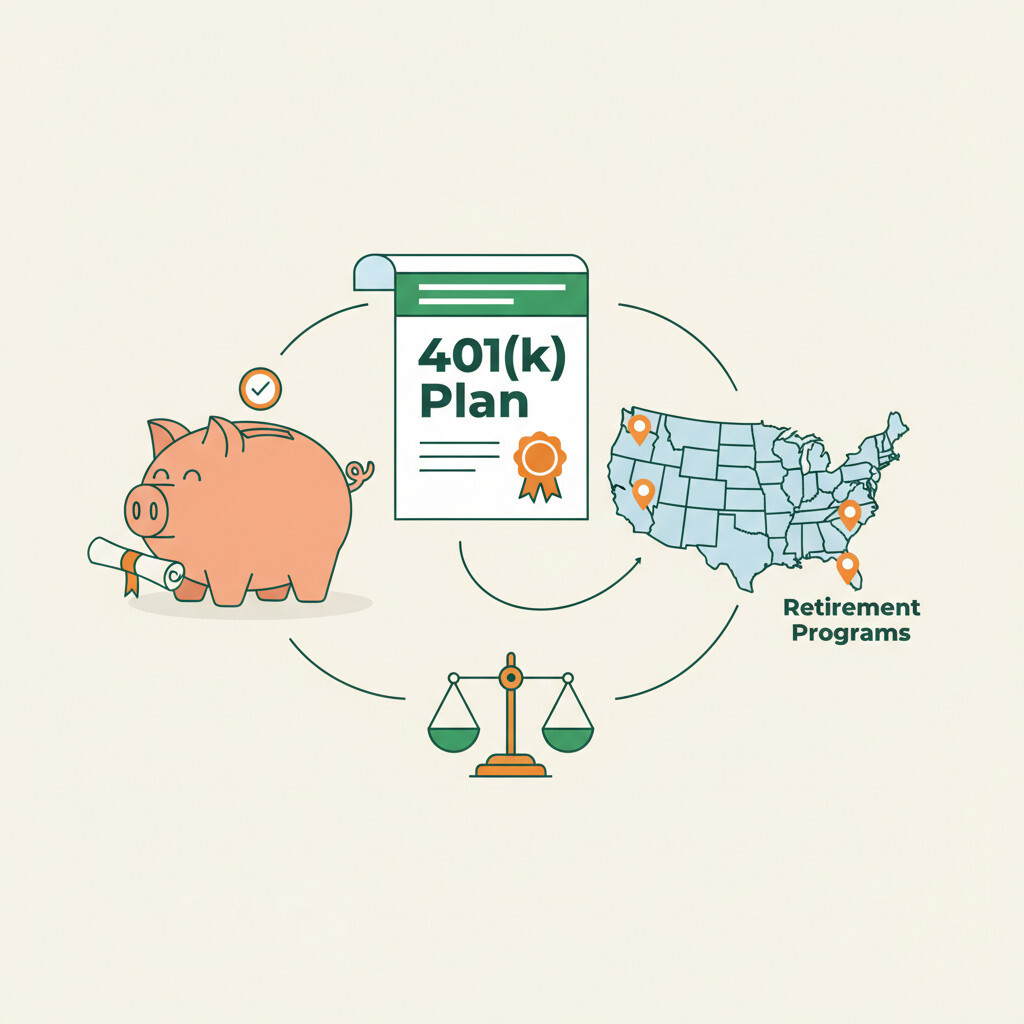
More than 15 states have enacted retirement plan mandates requiring most private-sector employers to either offer a qualified retirement plan or enroll employees in a state-sponsored auto-IRA program — with more states in active legislation.
Active state programs (representative — confirm specific applicability for your state and employer size):
| State | Program |
|---|---|
| California | CalSavers |
| Oregon | OregonSaves |
| Illinois | Illinois Secure Choice |
| Maryland | Maryland$aves |
| Colorado | Colorado SecureSavings |
| Connecticut, Virginia, NJ, NY, others | Various Secure Choice / Saver programs |
The key distinction: a state-sponsored auto-IRA program satisfies the mandate, but a qualified retirement plan structured as a PEP gives you something meaningfully better.
How does a PEP compare to a state auto-IRA program? ⚖
PEP-based 401(k) plans satisfy the mandate AND offer materially higher contribution limits, employer matching, and institutional-quality investments compared to state auto-IRA programs.
| Feature | State Auto-IRA | PEP-based 401(k) |
|---|---|---|
| 2026 employee contribution limit | $7,500 (IRA) | $24,500 (401(k)) |
| Employer matching | Not available | Yes (employer choice) |
| Investment quality | Limited menu, retail pricing | Institutional-quality options at pooled pricing |
| Roth treatment | Roth IRA only | Pre-tax + Roth 401(k) |
| Loan / hardship distribution | Limited IRA mechanics | 401(k) loan + hardship rules available |
| Catch-up contributions (50+) | IRA catch-up ($1,000) | 401(k) catch-up + SECURE 2.0 super catch-up |
For small employers competing for talent, the employer-match feature alone is a meaningful differentiator. State auto-IRA programs literally cannot match employee contributions; a PEP can. We see clients with 10-50 employees use the PEP match (even at 50% of 4%) to dramatically improve retention and signal that the employer values the employee’s long-term wellbeing.
What administrative work does the Pooled Plan Provider handle? 🏢
A standalone 401(k) carries substantial administrative obligations. In a PEP, the Pooled Plan Provider (PPP) serves as named fiduciary and plan administrator — shifting the bulk of the work and the legal risk off the participating employer.
PPP-handled functions:
- Form 5500 filings — annual plan reporting to the DOL/IRS.
- Annual compliance testing — ADP, ACP, top-heavy, coverage tests.
- Plan document updates — SECURE 2.0, interim amendments, restatement cycles.
- Investment selection and monitoring — institutional fund lineup, fee benchmarking.
- Participant loans and distributions — processing, taxation reporting.
- Named fiduciary role — PPP carries ERISA 3(16) administrator liability; participating employer retains limited residual fiduciary duty (selection and monitoring of the PPP itself).
What you (the participating employer) keep:
- Selecting and monitoring the PPP — a fiduciary duty under ERISA.
- Forwarding employee payroll deferrals to the plan timely.
- Choosing employer contribution levels (match, profit-sharing, safe harbor).
- Adopting discretionary plan features.
What does a PEP cost and how is it different from a single-employer 401(k)? 💰
PEPs typically cost less than a standalone 401(k) at the small-employer level because administrative costs are spread across multiple participating employers — and the pooled assets unlock institutional pricing on investments.
| Cost / Burden | Standalone 401(k) | PEP |
|---|---|---|
| Setup cost | $1,500 – $5,000 | Often $0 setup with PPP |
| Annual admin fee | $1,500 – $3,500 | Lower base (pooled) |
| Per-participant fee | $50 – $150 | Typically lower |
| Investment expense ratios | Retail tier | Institutional tier |
| 5500 / audit / testing burden | Sponsor + TPA | PPP-handled |
Costs are not zero. Investment expense ratios and PPP service fees still apply, and quality varies across PEP providers. The fiduciary duty to “select and monitor” the PPP means you owe employees a documented prudent process. Don’t just pick the cheapest PEP — pick the one with strong investment lineup, transparent fees, and robust participant services. Compare at least 2-3 PPPs.
When should an employer choose PEP vs. standalone 401(k) vs. auto-IRA? 🤔
- State auto-IRA (default). Minimum compliance. Reasonable for very small employers (5 or fewer employees) where the admin trade-off isn’t worth the upgrade. No employer cost, no match capability.
- PEP-based 401(k). Best for most employers with 5-100 employees. Compliance + match capability + higher limits + lower admin burden than standalone. Sweet spot for “growth-stage small business.”
- Standalone 401(k). Best for employers wanting maximum design flexibility — custom vesting, profit-sharing tiers, cross-tested plans, ESOP integration. Justifies higher admin cost when sophistication matters.
- SEP-IRA or SIMPLE-IRA. Alternative simple structures for very small businesses where the PEP overhead isn’t justified. Lower limits than 401(k), no Roth option in SEP, limited matching flexibility.
Frequently Asked Questions 🗂
For DOL guidance on Pooled Employer Plans, see the Employee Benefits Security Administration. For state-mandate program details, check CalSavers (CA) and equivalent state portals. Federal qualification requirements are at IRS Retirement Plans.
Need help comparing PEP providers, calculating projected match cost, or migrating from a standalone 401(k)? SW Accounting & Consulting Corp’s retirement plan team supports small-to-mid-sized employers — book a consultation.