Vacation Home Rental Tax: The 14-Day Rule Explained
Summer is prime time to rent out a beach house or lake cabin — and prime time to trip over the tax rules. The vacation home rental tax rules can turn a simple side income into a thorny return, so it pays to know the thresholds before you list the property.
At SW Accounting & Consulting Corp, we help Los Angeles homeowners and investors handle second-home and short-term rental taxes. Below: the 14-day rule, the personal-use test, which days count, and the passive activity loss limits.
Is vacation home rental income taxable? 🏖️
Generally yes — rental income is taxable like most other income, whether you rent online, through an agent, or yourself. But a landlord can deduct ordinary expenses to offset part of that income.
Deductible expenses can include utilities, repairs, insurance, mortgage interest, property taxes, and a depreciation allowance. If you also use the home personally, you generally have to allocate those expenses between rental (business) days and personal days — you cannot deduct the personal share.
What is the 14-day rule for vacation home rental tax? 🗓️
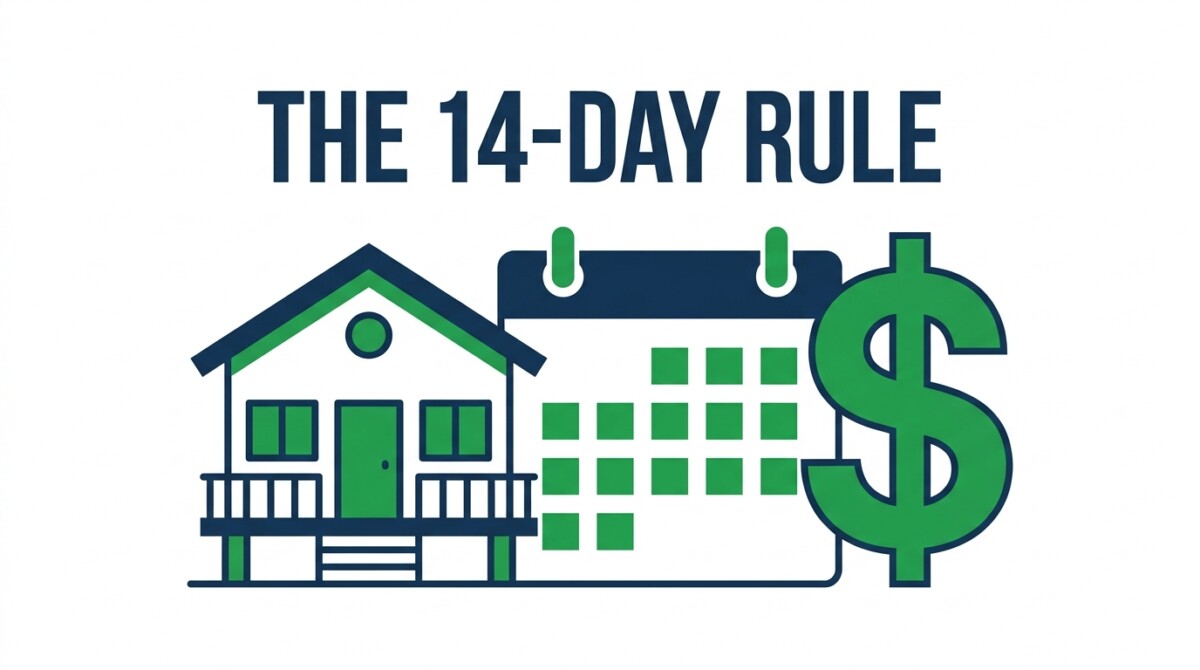
If you rent your home 14 days or fewer during the year, the rental income is completely tax-free — but you cannot deduct any rental expenses either. The IRS treats it as a non-event.
This safe harbor (Internal Revenue Code § 280A(g)) is a genuine freebie for homeowners near a popular event or in a high-demand vacation area: a couple of weeks of rental income, no tax, no reporting of that income. The trade-off is that you give up expense deductions for those days. Stay at or under 14 rental days and the math is simple.
How does the personal-use test work? 🏠
Once you rent more than 14 days, your personal use decides how much you can deduct. You cannot claim a rental loss if your personal use exceeds the greater of 14 days or 10% of the days the home is rented at fair value.
Cross that line and the property is treated as a residence: expenses are limited to rental income (no loss), and you allocate costs between personal and rental days. For example, if your family vacations at the home for the last three weeks of summer, you will likely exceed the personal-use limit no matter how many days you rent — so plan the calendar with the 14-day / 10% test in mind.
| Situation | Tax result |
|---|---|
| Rented 14 days or fewer | Income is tax-free; no expense deductions. |
| Rented >14 days, personal use over the limit | Treated as a residence; deductions capped at rental income (no loss). |
| Rented >14 days, minimal personal use | Treated as a rental; a loss may be allowed, subject to the PAL rules. |
Good records win these cases. We ask clients to keep a simple day-by-day calendar of the home’s use — rental days, personal days, and prep/repair days — because the deduction turns entirely on those counts. A little shuffling of family-use days near year-end can be the difference between a deductible rental and a capped one.
Which days don’t count as personal use? 🔧
Days you spend mainly working on the home — prepping it for a rental or making repairs — do not count as personal-use days, even if family tags along.
This matters because it can keep you under the personal-use limit. A weekend spent painting, fixing, or getting the property rental-ready is a repair/maintenance day, not a vacation day, as long as the main purpose of the trip is the work. Document what you did so the day holds up.
Even when a loss is otherwise allowed, the passive activity loss (PAL) rules generally let you deduct rental losses only against passive income. A limited exception allows up to \$25,000 of loss against other income, but it phases out between \$100,000 and \$150,000 of adjusted gross income. Above \$150,000 AGI, the special allowance is gone.
- Rent 14 days or fewer: income is tax-free, but no expense deductions.
- Rent more than 14 days: income is taxable; you deduct expenses, subject to a personal-use test.
- No loss if personal use exceeds the greater of 14 days or 10% of rental days.
- Prep/repair days aren’t personal use; the \$25,000 PAL allowance phases out from \$100k–\$150k AGI.
Frequently asked questions
Yes. If you rent your home 14 days or fewer during the year, the income is not taxable and you do not report it — but you also cannot deduct rental expenses for those days.
You cannot claim a rental loss if your personal use exceeds the greater of 14 days or 10% of the days the home is rented at a fair rental price. Beyond that, the home is treated as a residence and deductions are capped at rental income.
No. Days you spend mainly repairing or prepping the home for rental do not count as personal-use days, even if family joins the trip, as long as the main purpose is the work.
Sometimes. If it qualifies as a rental (not a residence), a loss may be allowed but is limited by the passive activity loss rules — including a \$25,000 special allowance that phases out between \$100,000 and \$150,000 of AGI.
How can SW Accounting help? 💼
At SW Accounting & Consulting Corp, we help LA-area homeowners and investors plan short-term and vacation rentals — counting the days correctly, allocating expenses, applying the passive activity loss rules, and reporting it right. If you are renting out a second home this year, talk to us before the season ends.
Disclaimer: This article is for informational purposes only and is not tax or legal advice. Consult a qualified professional about your specific situation. Primary sources: Internal Revenue Code § 280A (disallowance of certain expenses in connection with business use of home, rental of vacation homes; 14-day rule at § 280A(g)); IRC § 469 (passive activity losses); IRS Publication 527, Residential Rental Property.