DOL FLSA Opinion Letters 2026: 4 Wage-and-Hour Answers
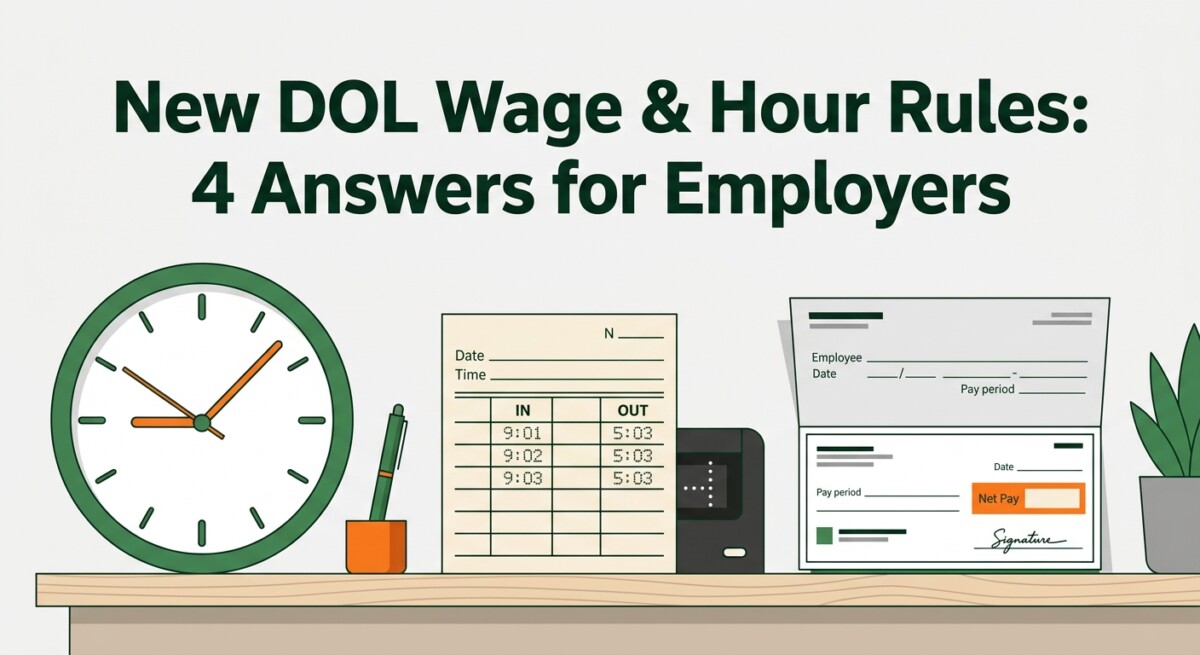
If you run payroll for a small business, you make wage-and-hour judgment calls every week: Do I pay for the time employees spend waiting to clock in? Can my salaried manager pick up hourly shifts? Does my quarterly bonus break the overtime math? In late May 2026, the U.S. Department of Labor’s Wage and Hour Division answered four of these questions in a new batch of FLSA opinion letters — official written interpretations that employers can rely on in structuring their pay practices.
At SW Accounting & Consulting Corp, we handle payroll and employer compliance for Los Angeles dental offices, restaurants, and other small businesses, and each of these four letters touches something we see in real client payrolls. Here is what each one says and what to do about it.
What are FLSA opinion letters and why do they matter? 📋
Opinion letters are official interpretations from the DOL’s Wage and Hour Division answering a specific employer’s fact pattern under the Fair Labor Standards Act.
They matter for two reasons. First, they show how the DOL will apply the rules in an audit or investigation. Second, relying in good faith on an applicable opinion letter can serve as a defense against liability under the FLSA’s safe-harbor provisions. The four letters issued May 28, 2026 — FLSA2026-5, FLSA2026-6, FLSA2026-7, and FLSA2026-8 — cover meal breaks, pre-shift time and rounding, dual roles, and bonus programs.
Do I have to pay employees for meal breaks they spend on-site? 🍽️
No — a bona fide meal period of 30 minutes or more is unpaid as long as the employee is completely relieved of duties, even if leaving the worksite for food is impractical.
In FLSA2026-7, the employer gave workers a 30-minute unpaid meal period and allowed them to stay on the premises. Employees argued the time it takes to cross a large worksite and pass through controlled-access gates effectively eats up the break, so the break should be paid. The DOL disagreed: what makes a meal period unpaid is being relieved of work duties — not how convenient it is to leave. Time an employee voluntarily spends walking off-site to buy or eat a meal is the employee’s own time.
The practical test for employers: during the break, the employee must not be performing any work — answering phones at the front desk while eating lunch turns the break into paid time.
Is waiting in line to clock in compensable time? ⏰
Waiting in line to clock in or out generally is not paid time — but real work performed before the scheduled shift is, and a rounding policy that erases it can violate the FLSA.
FLSA2026-8 examined a hospital where employees could clock in up to seven minutes early to avoid lines at timekeeping stations, and the system rounded early punches forward to the scheduled start time. The DOL drew a sharp line:
- Just waiting or standing in line? Not compensable.
- Receiving patient handoff reports or locating work assignments before the shift? That is integral and indispensable to the job — compensable work.
- Rounding that only benefits the employer? If employees regularly perform compensable work before the shift and every early punch is rounded to the employer’s favor, the practice is not neutral and may create minimum wage or overtime violations.
Can my salaried exempt manager also work a second hourly job for me? 💼
Yes — extra hourly work in a secondary, non-exempt role does not destroy the exemption, as long as the employee’s primary duty remains exempt work and the guaranteed salary rules stay satisfied.
In FLSA2026-5, an executive-exempt employee wanted to pick up additional work in a separate hourly role at the same employer. The DOL confirmed there is no strict percentage limit on how much non-exempt work an exempt employee may perform: the test is whether the employee’s primary duty is still the exempt work (29 C.F.R. Part 541), and whether the employee continues to receive the full predetermined salary each pay period regardless of the extra hours.
For small employers this is welcome flexibility — an office manager can cover occasional hygiene-assistant or host shifts at an hourly rate without converting to non-exempt status. But document the arrangement: the primary-duty analysis is qualitative, and a manager who spends most of their time on hourly floor work will not stay exempt just because the title says so.
How do quarterly bonuses interact with overtime pay? 💰
A bonus paid as a fixed percentage of an employee’s total earnings — including overtime earnings — automatically satisfies the FLSA, because the overtime premium on the bonus is built in.
Most performance bonuses for hourly staff are “non-discretionary” and must be folded into the regular rate of pay, forcing employers to retroactively recalculate overtime for every workweek the bonus covers. FLSA2026-6 blesses the cleaner alternative: a percentage-of-total-earnings bonus. Because the bonus applies the same percentage to straight-time and overtime earnings, it simultaneously pays the extra overtime compensation due — no lookback recalculation needed (29 C.F.R. § 778.210).
If you are paying quarterly bonuses to non-exempt staff as flat dollar amounts, this is worth a redesign conversation before your next bonus cycle.
Quick reference: what’s paid time and what isn’t? ✅
| Scenario | Compensable? | Letter |
|---|---|---|
| 30-min meal break, fully relieved of duties, stays on-site | No | FLSA2026-7 |
| Walking off-site to buy lunch during the break | No | FLSA2026-7 |
| Waiting in line at the time clock | Generally no | FLSA2026-8 |
| Pre-shift handoff reports / locating assignments | Yes | FLSA2026-8 |
| Exempt manager’s extra hourly shifts (primary duty still exempt) | Paid hourly; exemption survives | FLSA2026-5 |
| Percentage-of-total-earnings bonus | Overtime premium built in | FLSA2026-6 |
📌 Key Takeaways
- Unpaid meal breaks are fine if employees are fully relieved of duties — convenience of leaving the site is irrelevant.
- Waiting to clock in is unpaid, but real pre-shift work is paid — and one-sided rounding that erases it can violate the FLSA.
- Exempt employees can take on secondary hourly roles without losing the exemption if their primary duty stays exempt.
- Bonuses set as a percentage of total earnings satisfy overtime automatically — no retroactive recalculation.
Frequently Asked Questions ❓
Q. Are DOL opinion letters legally binding?
They are official agency interpretations, not statutes or regulations. Courts give them varying weight, but good-faith reliance on an applicable letter can protect an employer from FLSA liability under the Portal-to-Portal Act’s safe-harbor provisions.
Q. How long can an unpaid meal break be?
Under federal law, a bona fide meal period is ordinarily 30 minutes or more with the employee completely relieved of duties. Shorter breaks (5–20 minutes) are treated as paid rest breaks. State law — including California’s meal-period rules — can impose stricter requirements on top of the FLSA.
Q. Is all time-clock rounding now illegal?
No. Rounding remains lawful when it is neutral both on paper and in practice, averaging out so employees are fully compensated over time. What FLSA2026-8 flags is one-directional rounding that consistently favors the employer while employees perform real pre-shift work.
Q. Does the exempt employee’s second hourly role change their overtime rights?
If the employee remains properly exempt — primary duty is exempt work and the full guaranteed salary is paid — no overtime is owed even when extra hourly work pushes total hours past 40. The extra hourly pay is simply additional compensation, which the regulations expressly permit.
Q. What makes a bonus “non-discretionary” under the FLSA?
A bonus is non-discretionary when employees expect it under an announced formula, policy, or promise — production, quality, retention, or attendance bonuses, for example. Non-discretionary bonuses must be included in the regular rate for overtime unless, like the percentage-of-earnings design in FLSA2026-6, the overtime premium is built into the payment itself.
Q. Do these letters apply in California?
The letters interpret federal law. California employers must also satisfy the Labor Code and Wage Orders, which are stricter on meal periods, rounding, and overtime. Where the two differ, follow the rule more protective of the employee.
Wage-and-hour compliance is one of those areas where small habits compound into large liabilities. If you would like a payroll practice review — time records, rounding, exemption classifications, or bonus design — contact SW Accounting & Consulting Corp. Primary sources: DOL Wage and Hour Division opinion letters FLSA2026-5 through FLSA2026-8 (May 28, 2026); 29 C.F.R. Part 541; 29 C.F.R. § 778.210.