IRS Rollover Guidance: What Notice 2026-49 Changes
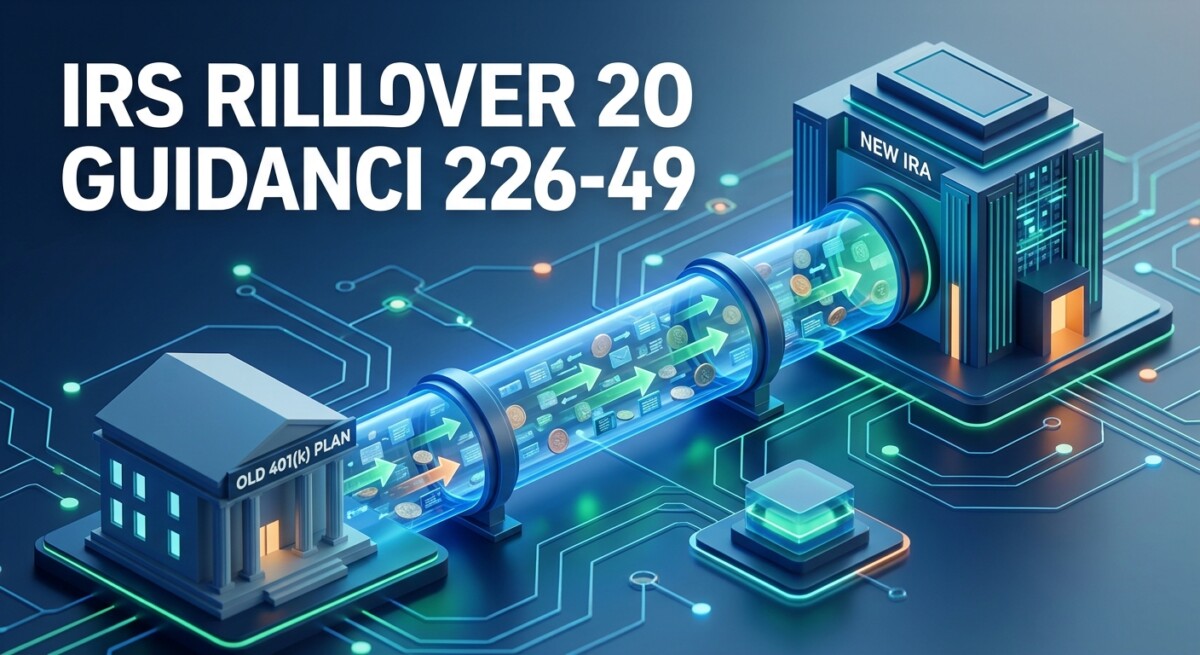
If you have ever tried to move a 401(k) to an IRA — or watched a client wait weeks for a paper rollover check to arrive at the wrong address — you already understand why Section 324 of the SECURE 2.0 Act exists. On its face, a rollover is a simple concept: money moves from one qualified plan to another. In practice, it is a paperwork negotiation between two recordkeepers, an IRA custodian, and a participant who has to broker the whole thing. The new IRS rollover guidance in Notice 2026-49 is the Treasury Department’s first draft answer to that mess.
At SW Accounting & Consulting Corp, we advise Los Angeles individuals and business owners through retirement transitions — job changes, plan terminations, IRA consolidations, Roth conversions. This notice matters because it signals what the direct rollover process is about to look like: standardized forms, encrypted electronic transfers, no more checks handed to the participant, and possible new safe harbors for the recordkeepers that follow the model.
What is IRS Notice 2026-49? 🧾
Notice 2026-49 is the Treasury Department and IRS’s first guidance implementing Section 324 of the SECURE 2.0 Act, providing sample forms and proposed procedures to simplify and standardize direct rollovers.
Section 324 of the SECURE 2.0 Act (Division T of Public Law 117-328) directed Treasury to issue sample forms — written in language the average person can understand — that both distributing and receiving plans could use to complete a rollover. Notice 2026-49 delivers on that mandate. It sets out four sample forms and five sequential procedural steps that carry a rollover from a participant’s request all the way to a completed transfer.
Use of the sample forms is optional today. Treasury is asking for stakeholder comments by October 23, 2026, and will consider providing safe harbors in a future notice for plans that use the forms and follow the proposed protocols. Comments are submitted through the Federal eRulemaking Portal at regulations.gov under docket IRS-2026-0100.
What are the four sample rollover forms? 📄
The forms structure the rollover as a two-plan conversation instead of a paper chase run by the participant.
Under the proposed procedure, the participant no longer serves as the intermediary between plans. The two plans talk to each other directly, using standardized data fields and encrypted communications. The five steps track four forms:
- Step 1 — Form 1 (Participant’s Rollover Request): the participant fills out a request identifying the distributing plan and gives the receiving plan authorization to act on their behalf.
- Step 2 — Form 2 (Receiving Plan’s Request): the receiving plan (IRA custodian or employer plan) forwards Form 1 to the distributing plan.
- Step 3 — Form 3 (Distributing Plan’s Rollover Certification): the distributing plan verifies the participant’s information and transmits account details plus the transfer methods available.
- Step 4 — Form 4 (Receiving Plan’s Rollover Acceptance): the receiving plan confirms it can accept the rollover and selects a transfer method.
- Step 5 — Transfer: the distributing plan sends the funds via the selected method — ideally an encrypted electronic transfer.
The forms apply to rollovers where at least one side is an employer plan and no more than one side is an IRA. They are not intended for IRA-to-IRA transfers, which already run efficiently through the Automated Customer Account Transfer Service (ACATS) under FINRA Rule 11870.
What is the Rollover Identification Number (RIN)? 🔐
The RIN is a unique code, generated by the receiving plan, that lets both plans reference a specific rollover without repeatedly transmitting the participant’s Social Security number and other personal information.
Every rollover under the proposed procedures is tagged with a Rollover Identification Number — the notice suggests something like a 20-digit alphanumeric string. The RIN goes on every form and every follow-up communication between the two plans. That way the plans can coordinate the transfer while keeping personally identifying information out of routine emails, faxes, and messages.
This aligns with U.S. Department of Labor cybersecurity best practices for retirement plans, which recommend encryption of sensitive data at rest and in transit. See the DOL’s Cybersecurity Program Best Practices. It also reduces the surface area for the kinds of impersonation and account-takeover attacks that have hit retirement plans over the past several years.
Is the IRS about to end paper rollover checks? ✉️
Possibly. Notice 2026-49 lists, as guidance under consideration, an amendment to Treasury Regulation §1.401(a)(31)-1 Q&A-4 that would eliminate the current rule allowing distributing plans to hand a rollover check to the participant.
Today, Treasury Regulation §1.401(a)(31)-1 Q&A-4 lets a plan complete a “direct rollover” by writing a check payable to the receiving plan and giving that check to the participant to deliver. The Government Accountability Office has called this out for over a decade. Its 2013 report, 401(k) Plans: Labor and IRS Could Improve the Rollover Process for Participants (GAO-13-30), described the paper-check practice as “archaic” and recommended that direct rollover checks go only to the receiving entities. The 2024 GAO report, 401(k) Plans: Additional Federal Actions Would Help Participants Track and Consolidate Their Retirement Savings (GAO-24-103577), found that nearly one-third of surveyed participants still receive paper checks they must forward themselves.
Notice 2026-49 signals that Treasury is now willing to act. Four items are on the table for future guidance:
- Remove Q&A-4 and the Situation 2 safe harbor in Revenue Ruling 2014-9, both of which support the “check to participant” model.
- Require electronic transfers — or, if a check is used, require it to be mailed or sent directly to the receiving plan, never through the participant.
- Add new safe harbors for plans that use the sample forms — for example, allowing the receiving plan to reasonably conclude the distributing plan is qualified and the rollover is valid.
- Prohibit impermissible procedures such as requiring a Medallion Signature Guarantee or blocking a participant from choosing an electronic transfer when both plans support it.
The notice also cites Executive Order 14247, “Modernizing Payments To and From America’s Bank Account,” which directs the Treasury Department to transition federal payments to fully electronic channels — one more piece of the same policy direction.
What should plan administrators and IRA custodians do now? ✅
Read the notice, map your existing rollover procedures against the four sample forms, and file comments before October 23, 2026.
- Inventory your rollover flow. Where does the participant sit today — as a courier or as an authorizer? How many touchpoints require a wet signature, a Medallion, or a paper check?
- Assess API readiness. Notice 2026-49 encourages plans to program the sample forms into an Application Programming Interface (API) or clearinghouse platform. A future safe harbor is likely to reward plans that already have this infrastructure.
- Standardize your data fields. The forms use a common vocabulary for participant identification, plan type, tax character, and transfer method. Aligning internal fields now reduces the retrofit cost later.
- File comments. Treasury asked for comments on timelines, infrastructure needs, and workable safe-harbor conditions. Recordkeepers, IRA trustees, and plan sponsors are exactly the audience the notice wants to hear from.
IRS Notice 2026-49 at a glance 📊
| Element | Current status | What to watch |
|---|---|---|
| Four sample forms (Forms 1–4) | Optional; no safe harbor yet | Safe harbors in follow-on guidance |
| Rollover Identification Number (RIN) | Proposed; receiving plan generates | Encrypted, PII-lite communications |
| Reg §1.401(a)(31)-1 Q&A-4 (check to participant) | Still valid | Possible removal in future guidance |
| Rev. Rul. 2014-9 Situation 2 safe harbor | Still valid | Possible removal alongside Q&A-4 |
| IRA-to-IRA transfers | Out of scope | Continue via ACATS (FINRA Rule 11870) |
| Public comment deadline | October 23, 2026 | Docket IRS-2026-0100 at regulations.gov |
📌 Key Takeaways
- Notice 2026-49 implements SECURE 2.0 §324 with four sample rollover forms and five procedural steps.
- A Rollover Identification Number (RIN) lets plans coordinate without repeatedly transmitting participant PII.
- Treasury is considering removing the rule that lets checks be handed to participants — future guidance may require electronic transfers or direct-to-plan checks.
- The sample forms are optional today; comments are due October 23, 2026 at regulations.gov (docket IRS-2026-0100).
Frequently Asked Questions ❓
Q. Does IRS Notice 2026-49 change my personal rollover rules?
Not directly. The statutory rules governing eligible rollover distributions under IRC §§401(a)(31), 402(c), and 408(d)(3) are unchanged. What Notice 2026-49 changes is the process — the forms and protocols plans may use to complete a rollover. Participants may notice fewer paper checks and more electronic transfers over time.
Q. Do plans have to use the four sample forms?
No. Use of the sample forms and proposed procedures is optional. Treasury and the IRS are not currently providing a safe harbor for plans that use them, but they may in a future notice after considering stakeholder comments.
Q. Does the notice apply to IRA-to-IRA transfers?
No. The sample forms are designed for rollovers where at least one side is an employer plan and no more than one side is an IRA. IRA-to-IRA transfers already move through the Automated Customer Account Transfer Service (ACATS) under FINRA Rule 11870.
Q. Are paper rollover checks banned now?
No. Treasury Regulation §1.401(a)(31)-1 Q&A-4 still allows a distributing plan to give a check to the participant. Notice 2026-49 only lists possible amendments to that rule as guidance under consideration, and the notice explicitly gives plans time to implement any future electronic-transfer requirement.
Q. What is the RIN and who generates it?
The Rollover Identification Number is a unique code — the notice suggests a 20-digit alphanumeric — generated by the receiving plan and included on every rollover-related communication between the two plans. Its purpose is to reduce transmission of the participant’s personally identifying information.
Q. When are comments due, and how do I submit them?
Comments are due on or before October 23, 2026. Submit electronically at regulations.gov using the search term “IRS-2026-0100,” or by mail to Internal Revenue Service, Attn: CC:PA:01:PR (Notice 2026-49), Room 5503, P.O. Box 7604, Ben Franklin Station, Washington, DC 20044.
The direction of travel is unmistakable: fewer paper checks, more standardized data, and safe harbors for plans that keep participants out of the courier role. If your practice touches rollovers — as a plan sponsor, recordkeeper, IRA custodian, or advisor — this is the moment to model the workflow. To discuss what Notice 2026-49 means for your retirement plan or IRA rollover strategy, contact SW Accounting & Consulting Corp. Primary sources: IRS Retirement Plans, the SECURE 2.0 Act (P.L. 117-328), GAO-13-30, and GAO-24-103577.