Inherited IRA RMD Rules: 10-Year Rule Explained (2026)
For a few years after the SECURE Act passed, the answer to a common client question — do I have to take a distribution this year from an IRA I inherited? — was “technically yes, but the IRS is waiving the penalty.” That is no longer the answer. The final regulations under IRC §401(a)(9) apply for calendar years beginning on or after January 1, 2025, and there is no fourth relief notice. The inherited IRA RMD rules matter in 2026 because 2026 is the first full planning year with the new schedule fully operational.
The mechanics are not intuitive, and the trap sits with people who did nothing during the relief years. In our Los Angeles practice we field this question most often from adult children who inherited a parent’s IRA in 2020, 2021, or 2022 and were told by their custodian they had ten years to withdraw. That was half of the answer. Below is the whole answer, from the primary sources.
Where do the inherited IRA RMD rules actually come from? 📜
From IRC §401(a)(9)(H), added by the SECURE Act, and the final regulations under §401(a)(9) that apply for calendar years beginning on or after January 1, 2025.
The SECURE Act (Pub. L. 116-94), enacted on December 20, 2019 as Division O of the Further Consolidated Appropriations Act, 2020, added §401(a)(9)(H) to the Internal Revenue Code. That subsection is the source of the 10-year rule: if a defined-contribution-plan participant or IRA owner has a designated beneficiary who is not an eligible designated beneficiary, the entire account must be distributed within 10 years of the owner’s death, regardless of whether the owner had reached the required beginning date.
Treasury and the IRS then issued proposed regulations in February 2022, took public comments, and issued three successive waiver notices covering 2021 through 2024 — the IRS Notice 2022-53, the IRS Notice 2023-54, and the IRS Notice 2024-35. Each notice provided that the IRS would not assert the §4974 excise tax on “specified RMDs” missed in the years listed, and announced that the final regulations would apply no earlier than the following calendar year. Notice 2024-35 stated the final regulations would apply for calendar years beginning on or after January 1, 2025. That is the current rule.
Who is an eligible designated beneficiary (EDB)? 👥
A surviving spouse; a minor child of the employee (only until the age of majority); a disabled or chronically-ill person; and any individual not more than 10 years younger than the employee. Everyone else is a designated beneficiary subject to the 10-year rule.
Under §401(a)(9)(E)(ii), an EDB gets access to the life-expectancy payment alternative — annual payments over the beneficiary’s own life expectancy, starting the year after the owner’s death. This is the modern replacement for what people used to call the stretch, and for the four EDB categories it looks similar in practice.
The category most often missed in planning conversations is the fourth: any individual not more than 10 years younger than the employee. That covers a sibling only a few years younger, an unmarried partner of similar age, or an older friend. If the beneficiary fits this description, they are not subject to the 10-year rule at all; they can take life-expectancy payments instead. That is one of the few remaining structural planning levers on beneficiary designations.
A minor child of the employee is treated as an EDB only until reaching the age of majority. At that point the 10-year rule starts running, and the account must be distributed by the end of the 10th year after the child’s age-of-majority birthday.
What actually has to happen in years 1–9 of the 10-year window? 🗓️
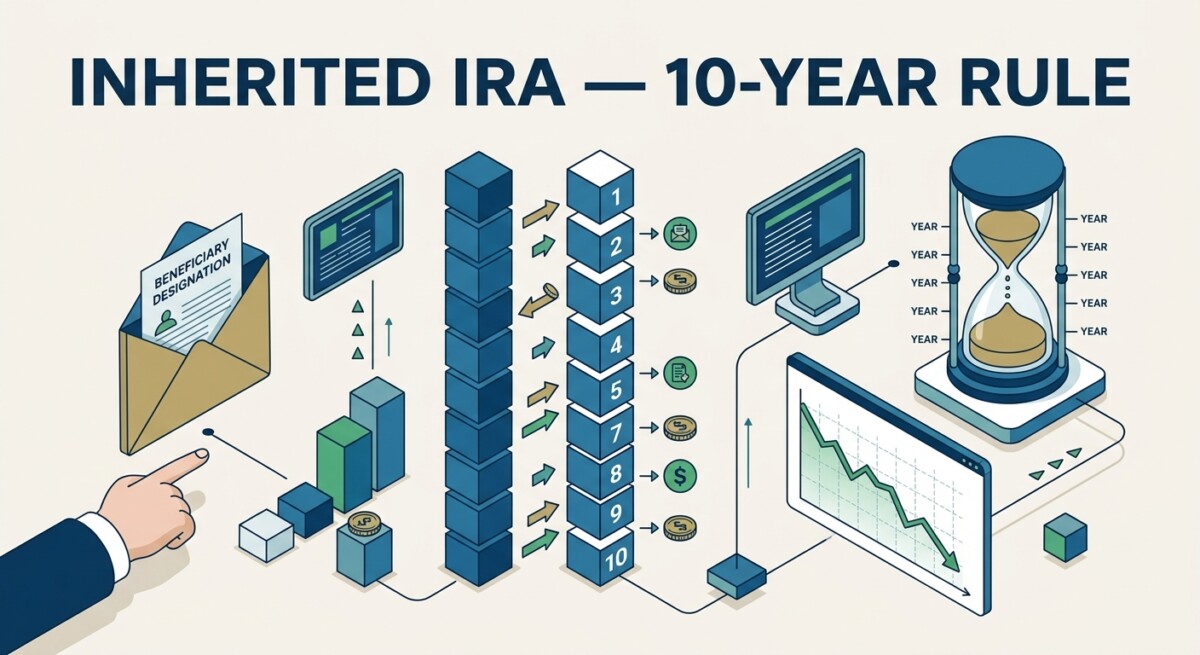
It depends on whether the original owner had already reached their required beginning date (RBD) for lifetime RMDs. If they had, annual RMDs are required in years 1 through 9. If they had not, no annual RMDs are required — but the account must still be empty by the end of year 10.
This is the least intuitive part of the rule. Under the final regulations, a non-EDB designated beneficiary whose owner died on or after the RBD must continue the owner’s “at least as rapidly” schedule during the 10-year window. In plain English, someone has to keep taking annual RMDs after the owner’s death; the 10-year rule sets the outside limit on the total drawdown, and the annual-RMD rule sets the pace inside that window.
| Owner’s death timing | Beneficiary category | Years 1–9 | Year 10 |
|---|---|---|---|
| Died before RBD | Non-EDB designated | No annual RMD required | Full distribution |
| Died on/after RBD | Non-EDB designated | Annual RMDs required (2025+) | Full distribution |
| Any death | EDB — life-expectancy alternative | Annual life-expectancy RMDs | Continues until entire interest distributed |
| Any death | Roth IRA — non-EDB | No annual RMD (owner treated as pre-RBD) | Full distribution |
The people most at risk missed the 2025 pivot
In our practice the beneficiaries who missed 2025 are not the disorganized ones. They are the ones who set up an inherited-IRA withdrawal plan in 2021 or 2022 based on the assumption that no annual RMD was due — the plan matched the notices in force at the time — and never revisited it after Notice 2024-35 said the relief would not continue past 2024. Their 2025 return is the first place a missed RMD shows up on paper, and 2026 is the year to catch and correct it before the correction window closes.
What is the penalty for a missed inherited IRA RMD in 2026? ⚠️
25% of the shortfall under IRC §4974(a), reduced by SECURE 2.0. If corrected within the correction window, the rate drops to 10%. Report the missed RMD and correction on Form 5329.
Section 302 of the SECURE 2.0 Act (Pub. L. 117-328), enacted December 29, 2022, reduced the §4974(a) excise tax on a missed RMD from 50% to 25% for taxable years beginning after December 29, 2022. If the failure is corrected by the end of the correction window — generally the end of the second year that begins after the year of the missed distribution — the excise tax is further reduced to 10%.
The correction window is a hard cutoff
A missed 2025 inherited-IRA RMD can be corrected at the 10% rate through the end of 2027. After that the rate reverts to 25% and the shortfall carries interest from the original due date. The correction is mechanically simple — take the make-up distribution and file Form 5329 with the return for the year the RMD was missed — but the deadline is unforgiving. If a beneficiary has been sitting on an inherited IRA since 2020 or 2021 without touching it, 2026 is the year to run the numbers, not 2027.
The Form 5329 process is worth flagging separately. Line 52 (in the current form’s format) reports the required distribution, line 53 the amount actually distributed, and the difference triggers the excise tax on line 55. To claim the reduced 10% rate for a corrected shortfall, the make-up distribution is taken and reported, and a statement explaining the reasonable cause and the correction is attached — practices vary, but the statute is clear that the reduction requires an actual correction.
Do the inherited IRA RMD rules apply to Roth IRAs and Roth 401(k)s? 🎯
The 10-year outside deadline applies, but the annual RMDs in years 1 through 9 do not — because a Roth IRA owner is treated as having died before the required beginning date.
A Roth IRA owner has no lifetime RMD, so the concept of “died on or after the RBD” does not arise. When a non-spouse beneficiary inherits a Roth IRA subject to the SECURE Act rules, the 10-year full-distribution deadline applies but the year-1-through-9 annual RMD requirement does not. The account can grow tax-free for up to ten years and then be emptied in year 10, which is a legitimate planning position for a beneficiary in a high tax bracket with other cash flow available.
The Roth designated account inside a 401(k) or 403(b) plan works differently in mechanical detail but landed in a similar place after SECURE 2.0 removed pre-death RMDs on designated Roth accounts. Plan-by-plan differences matter here — the plan document is the first place to look — but the overall pattern is that the 10-year rule sets the outside limit while the annual-RMD pace does not apply to accounts treated as pre-RBD.
What should I actually do in Q4 2026? 🎬
Confirm the beneficiary category, confirm whether the owner died before or after the RBD, look at the last three tax years for missed year-1-through-9 RMDs, and plan the distribution schedule for the remaining years.
For anyone holding an inherited IRA subject to §401(a)(9)(H), the Q4 2026 checklist is short but concrete:
- Confirm the beneficiary category on the account and whether the original owner had reached their required beginning date at death — the two facts that decide the schedule
- Compute the year-of-death balance and the annual RMD amounts for each open year in the 10-year window using the beneficiary’s single life expectancy (or the owner’s remaining life expectancy where applicable)
- For any 2025 RMD not yet taken, take the make-up distribution before December 31, 2026 and plan to file Form 5329 with the 2025 return (or amended return) to claim the 10% rate
- Model the tax impact of front-loading, back-loading, or level-loading the remaining distributions — a beneficiary who is currently below their eventual bracket often benefits from front-loading rather than compressing into year 10
- For Roth inherited accounts, decide whether to defer through year 10 or spread — the answer usually depends on whether other taxable income might trigger the surtax bands
More detail on the rule mechanics — including the tables used to compute the annual amount — is in IRS Publication 590-B, and the current beneficiary-by-scenario grid is on the IRS RMD rules for IRA beneficiaries page. Both are updated annually; work from the current-year version, not from a custodian’s summary from an earlier year.
The short version
- For most non-spouse beneficiaries of IRAs whose owner died after 2019, the account must be emptied by the end of the 10th year — the SECURE Act 10-year rule
- If the owner died on or after their required beginning date, annual RMDs are required in years 1 through 9, and 2025 was the first year the IRS did not waive the penalty
- The missed-RMD excise tax is 25% under §4974, reduced to 10% if corrected within the correction window — generally two years
- Roth inherited accounts still hit the 10-year deadline but skip the annual-RMD requirement in years 1 through 9
Frequently asked questions ❓
Q. What are the inherited IRA RMD rules under the SECURE Act 10-year rule?
For most non-spouse beneficiaries who inherited an IRA or defined-contribution plan account from an owner who died after December 31, 2019, the entire account must be distributed by the end of the 10th calendar year following the year of the owner’s death. If the original owner died on or after their required beginning date and the beneficiary is not an eligible designated beneficiary, annual RMDs are also required in years 1 through 9 of that 10-year window. The 10-year rule and the annual-RMD requirement were added to IRC §401(a)(9)(H) by the SECURE Act and are the subject of the final regulations that apply beginning with the 2025 distribution calendar year.
Q. Who is an eligible designated beneficiary under IRC §401(a)(9)(E)?
An eligible designated beneficiary (EDB) is a designated beneficiary who, on the date of the account owner’s death, is one of the following: the surviving spouse, a minor child of the employee (only until the child reaches the age of majority), an individual who is disabled or chronically ill as defined in the statute, or an individual who is not more than 10 years younger than the employee. An EDB may take life-expectancy payments starting the year after the owner’s death instead of applying the 10-year rule; a minor child of the employee applies the 10-year rule once they reach the age of majority.
Q. When do annual RMDs actually start under the 10-year rule?
For deaths in 2020 through 2023, the IRS waived the excise tax on missed year-1-through-9 RMDs through Notices 2022-53, 2023-54, and 2024-35. For distributions in calendar years beginning on or after January 1, 2025, the final regulations under §401(a)(9) apply, and no further blanket relief has been announced. In practical terms, 2025 was the first year the annual RMD requirement had teeth for non-eligible designated beneficiaries whose owner died on or after the required beginning date, and 2026 is the first full planning year on the new rules.
Q. What happens if I miss an inherited IRA RMD in 2026?
The excise tax under IRC §4974(a) is 25% of the shortfall, reduced under §302 of the SECURE 2.0 Act. If the missed RMD is corrected by the end of the correction window — generally the end of the second year that begins after the year of the missed distribution — the excise tax is further reduced to 10%. To claim the reduced rate you also file Form 5329 with the return for the year of the missed RMD, showing the shortfall and the correction.
Q. Does the 10-year rule apply to Roth IRAs and Roth 401(k) accounts?
Yes for the 10-year distribution deadline. A non-spouse beneficiary who inherits a Roth IRA generally must empty the account by the end of the 10th year after the owner’s death. However, because a Roth IRA owner is treated as having died before the required beginning date for RMD purposes, annual RMDs are not required in years 1 through 9 of the 10-year window for an inherited Roth IRA. The end-of-year-10 full distribution deadline still applies.
Q. What if I inherited before 2020?
The pre-SECURE Act rules generally continue to apply. Non-spouse beneficiaries who inherited before January 1, 2020 typically remained on the stretch — annual life-expectancy payments over the beneficiary’s life — subject to the older rules and the reduced-by-one method. The SECURE Act 10-year rule applies to distributions with respect to employees who died after December 31, 2019, and later effective dates apply for certain collectively bargained and governmental plans.
Q. How is a surviving spouse treated differently?
A surviving spouse who inherits an IRA has more options. The spouse can treat the inherited IRA as their own by rollover or by election, in which case the account resets to the spouse’s own RMD schedule based on their age. Alternatively, the spouse can remain a beneficiary and use the life-expectancy alternative for eligible designated beneficiaries. Which choice is better depends on the age gap, whether the spouse has other retirement income, and whether Roth conversions are on the table.
If you inherited an IRA in the last several years and are not sure whether you are on the annual-RMD track or on year-10-only, contact SW Accounting & Consulting Corp — a Los Angeles CPA firm working with owner-operated businesses and individual taxpayers across California.