Form 990 Filing & the 3-Year Automatic Revocation Trap
For a nonprofit, the annual Form 990 filing is not a formality — it is the single requirement that keeps tax-exempt status alive. Miss it three years running and the IRS revokes exemption automatically by operation of law. This guide covers which form your organization files, when it is due, how to extend, the per-day penalties, and how to avoid (or recover from) automatic revocation.
At SW Accounting & Consulting Corp, we work with Los Angeles area nonprofits, foundations, and exempt organizations on annual compliance. Below: the Form 990 series decision, deadlines and extensions, the §6033(j) revocation trap, and what to do if status has already lapsed.
Which Form 990 must you file? 📋
Which return an organization files generally depends on its financial activity — gross receipts and total assets. Filing the wrong (or no) form still counts as a failure to file.
| Form | Who files it |
|---|---|
| Form 990-N (e-Postcard) | Small organizations with gross receipts normally ≤ $50,000 — an electronic notice, not a full return. |
| Form 990-EZ | Mid-size organizations — generally gross receipts under $200,000 and total assets under $500,000. |
| Form 990 | Larger organizations — generally gross receipts ≥ $200,000 or total assets ≥ $500,000. |
| Form 990-PF | Private foundations — regardless of financial size. |
| Form 990-T | Any exempt organization with unrelated business taxable income (UBTI) — filed in addition to the information return. |
| Form 4720 | Organizations (and certain persons) owing excise taxes under Chapters 41 and 42 of the Internal Revenue Code. |
Organizations too small for a full return are NOT off the hook — they must file the Form 990-N e-Postcard. “We’re too small to file” is the single most common path to automatic revocation. A $50,000-gross-receipts charity that never files the e-Postcard for three years loses its exemption exactly like a large one.
When is the return due, and how do you extend? 📅
The annual return is due the 15th day of the 5th month after the end of the organization’s accounting period. For a calendar-year organization, that is May 15. File Form 8868 for an automatic extension.
- Calendar-year filer — accounting period ends December 31, return due May 15.
- Fiscal-year filer — count 4 months and 15 days after the fiscal year-end (e.g., June 30 year-end → November 15 due date).
- Form 8868 extension — Application for Extension of Time To File an Exempt Organization Return; generally must be filed by the original due date of the return it relates to.
- Form 990-N has no extension — the e-Postcard cannot be extended, but there is also no monetary late penalty; the danger is the 3-year revocation clock.
What are the penalties for late or non-filing? 💸
An organization that does not meet its Form 990 or 990-EZ filing requirement may owe a penalty for each day the return is late. Penalties scale with organization size, and continued non-filing escalates to the ultimate consequence: automatic revocation.
Penalty mechanics (see Form 990 / 990-EZ instructions, “Failure-To-File Penalties”):
- Per-day penalty — accrues for each day a required return is late, with the daily amount and cap scaling by the organization’s gross receipts.
- Responsible-person penalties — if the organization fails to file after IRS demand, penalties can be imposed on the individuals responsible.
- Reasonable cause — penalties may be abated if the organization shows the failure was due to reasonable cause and not willful neglect; document the circumstances.
What is the §6033(j) automatic revocation trap? 🚨
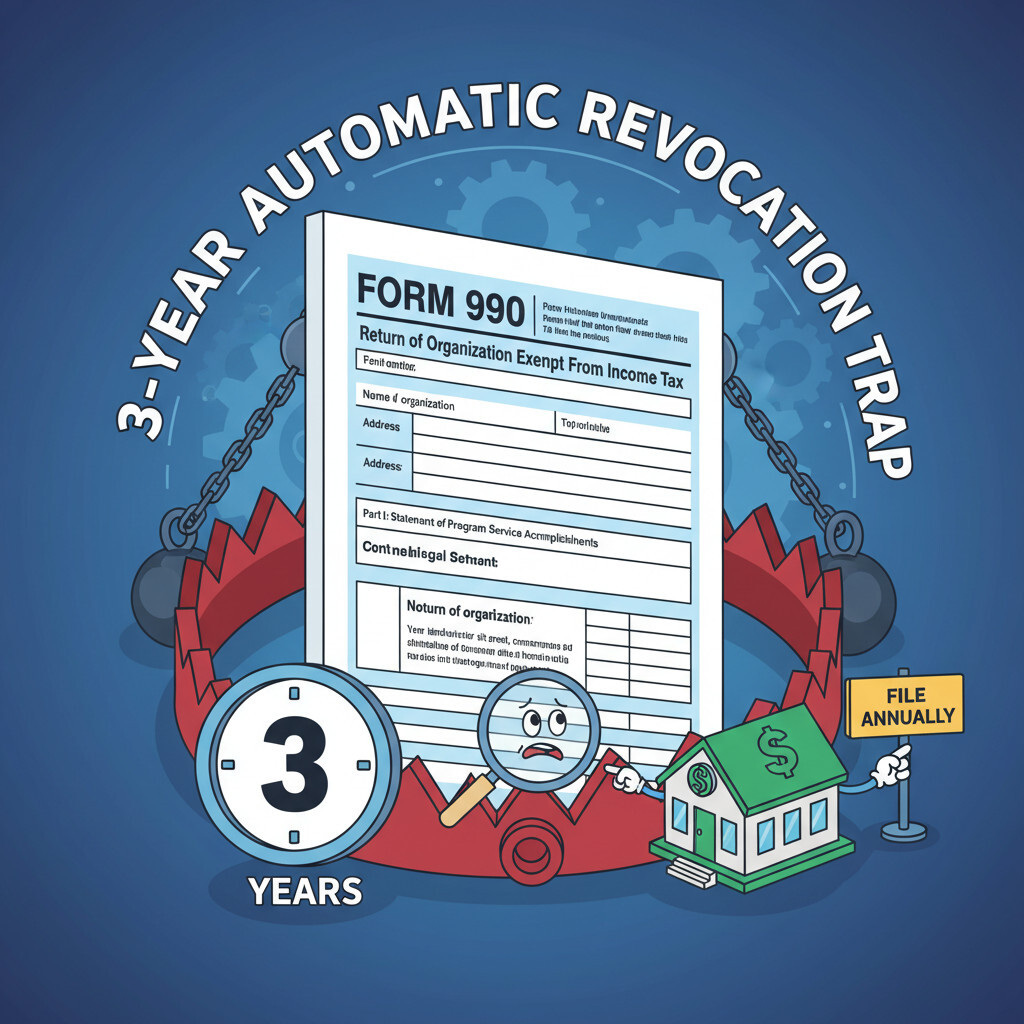
Under Internal Revenue Code §6033(j), the tax-exempt status of an organization that does not file a required return or notice for three consecutive years is automatically revoked — as of the due date of the third unfiled return. This is automatic by operation of law: no separate IRS determination or warning is required.
Why this is so dangerous:
- No warning required — revocation happens by statute on the third missed due date; the organization may not learn until donors or a bank flag it.
- Public list — revoked organizations appear on the IRS Auto-Revocation List, visible to donors, grantmakers, and the public.
- Donations may become non-deductible — once exemption lapses, contributions are generally no longer tax-deductible to donors.
- Income may become taxable — the organization can become subject to income tax for the period it is no longer exempt.
The organizations most often caught by §6033(j) are the smallest — all-volunteer charities that assume they have nothing to file. They do: the Form 990-N e-Postcard. It takes minutes and there is no fee, but skipping it for three years revokes exemption just as surely as ignoring a full Form 990. Put the e-Postcard on a recurring annual calendar reminder.
How do you get reinstated after revocation? 🔄
Reinstatement of tax-exempt status after automatic revocation requires filing a new exemption application (Form 1023, 1023-EZ, or 1024) and paying the user fee — it is not automatic. The IRS provides streamlined and retroactive reinstatement procedures depending on the organization’s size and how quickly it acts.
General reinstatement paths:
- Streamlined retroactive reinstatement — generally available to smaller organizations (those eligible for 990-EZ/990-N) acting within 15 months of revocation.
- Retroactive reinstatement (reasonable cause) — requires a reasonable-cause statement for the failure to file.
- Post-mark date reinstatement — exemption restored prospectively from the application date if retroactive relief is unavailable.
Each path involves a new application, a user fee, and time — far costlier than simply filing the annual return on schedule.
Frequently asked questions about Form 990 filing
The 15th day of the 5th month after the end of your accounting period. For calendar-year organizations, that’s May 15. Use Form 8868 to request an automatic extension by the original due date.
Under IRC §6033(j), your tax-exempt status is automatically revoked as of the due date of the third unfiled return — no warning required. You then appear on the IRS Auto-Revocation List and must apply for reinstatement.
Yes. If your gross receipts are normally ≤ $50,000, you file the Form 990-N e-Postcard. It’s free and takes minutes — but skipping it for three years still triggers automatic revocation.
Often yes — smaller organizations acting within 15 months may use streamlined retroactive reinstatement; others need a reasonable-cause statement. All paths require a new exemption application and user fee. Consult a professional promptly.
How can SW Accounting help? 💼
At SW Accounting & Consulting Corp, we keep LA-area nonprofits compliant — determining the correct Form 990-series return, calendaring deadlines and Form 8868 extensions, preparing and e-filing the return, handling Form 990-T (UBTI) where applicable, and managing reinstatement applications for organizations recovering from automatic revocation. We make sure the annual filing never becomes a §6033(j) emergency.
📩 Schedule a nonprofit compliance review
Disclaimer: This article is for informational purposes only and is not legal or tax advice. Always consult a qualified professional regarding your specific facts. Primary sources: Internal Revenue Code §6033(j); IRS Form 990, 990-EZ, 990-PF, 990-N, 990-T, 4720; Form 8868; Forms 1023/1023-EZ/1024; IRS Publication 557; IRS.gov Annual filing and forms for tax-exempt organizations.