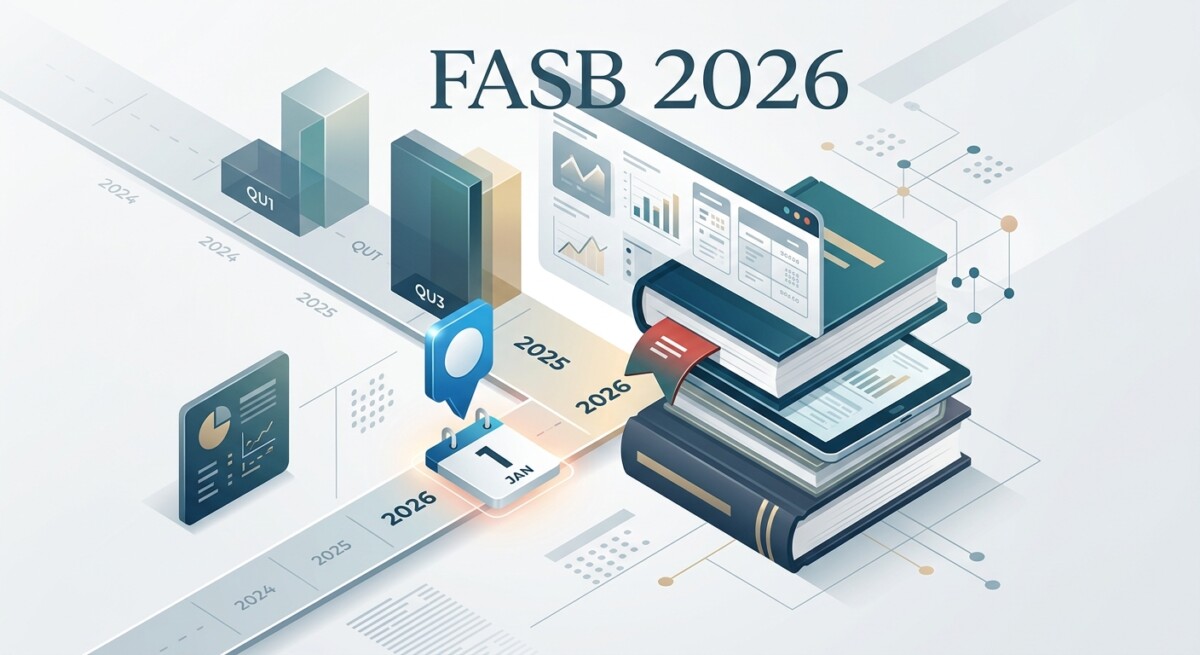
FASB effective dates 2026: which ASUs kick in this year?
Most public business entities finished the biggest wave of new GAAP standards in 2025. What lands next is heavier for private companies, not-for-profits, and any entity that touched convertible debt or profits-interest awards on the way through the last cycle. If you are a controller or a CFO looking at your calendar-year 2026 close, the FASB effective dates 2026 you actually need to plan around are a much shorter list than a full ASU log — because the rest either already applied in 2025, or do not apply until 2027 or later.
This post walks the ASUs that are first effective for calendar-year fiscal 2026 entities, using primary sources (the ASUs themselves at FASB and the FASB Accounting Standards Codification), with the practical implications we see coming through our Los Angeles practice. Where a standard is on the horizon rather than in force, we flag the planning window separately at the end.
What are the FASB effective dates 2026 for calendar-year entities? 📅
For calendar-year entities, fiscal 2026 first-effective ASUs are a small, high-impact list. All entities pick up ASU 2024-04 (induced conversions of convertible debt). Private companies and other non-PBE entities pick up ASU 2023-09 (income tax disclosures), ASU 2024-01 (profits interest awards), ASU 2024-02 (codification cleanup), and ASU 2025-05 (AR credit losses PCC expedient).
| ASU | Title / topic | Who it first affects in 2026 | Effective for FY beginning after |
|---|---|---|---|
| 2023-09 | Improvements to Income Tax Disclosures (Topic 740) | Private companies, not-for-profits, other non-PBE entities | December 15, 2025 (annual) |
| 2024-01 | Scope Application of Profits Interest and Similar Awards (Topic 718) | Private companies and other non-PBE entities | December 15, 2025 |
| 2024-02 | Codification Improvements — Amendments to Remove References to the Concepts Statements | Private companies and other non-PBE entities | December 15, 2025 |
| 2024-04 | Induced Conversions of Convertible Debt Instruments (Topic 470-20) | All entities | December 15, 2025 |
| 2025-05 | Measurement of Credit Losses for Accounts Receivable and Contract Assets (Topic 326, PCC) | Private companies and eligible not-for-profits electing the expedient | December 15, 2025 |
A staggered effective date is the FASB norm: PBEs generally adopt one year ahead of non-PBE entities. Several of the ASUs above have already been in effect for PBEs since fiscal 2025 — for a private client the 2026 close is the first real one under the new architecture.
What does ASU 2023-09 change about the income tax disclosure? 🧾
It restructures the rate reconciliation into required categories, adds disaggregation of income taxes paid by jurisdiction above a quantitative threshold, and expands the qualitative discussion of material reconciling items. For calendar-year private companies, first-effective annual period is 2026.
ASU 2023-09 amends Topic 740 (Income Taxes). The two moves that reshape the audit workpaper package the most are:
- A standardized rate reconciliation. The prior guidance let a reporting entity choose the categories in its rate reconciliation. The ASU replaces that with specific required categories, and requires further disaggregation of reconciling items above a quantitative threshold. That closes the historical gap where two similar entities disclosed their reconciling items differently.
- Income taxes paid, disaggregated. Total income taxes paid, disaggregated by federal, state, and foreign, and further by jurisdiction where the amount paid exceeds a quantitative threshold. For a private client operating in three or four states, this is a workpaper build, not just a footnote update.
- Qualitative context. The ASU expects entities to explain material reconciling items, not just tabulate them. Where an item recurs (a permanent difference driven by a stock-based compensation gap, for example), the narrative has to line up year over year.
For a calendar-year private company, the first annual report under ASU 2023-09 is the fiscal 2026 statement. The workpaper build begins now — the disaggregation categories drive how the general ledger and the tax provision are captured through the year, not just how the disclosure is drafted at year-end.
Which convertible debt fact patterns fall under ASU 2024-04? 🔁
ASU 2024-04 clarifies which early settlements of convertible debt are treated as induced conversions under Topic 470-20. It broadens the set of fact patterns qualifying for induced-conversion accounting, particularly for convertible instruments with cash-conversion or bifurcated features. First effective for all entities for fiscal years beginning after December 15, 2025.
If a client issued a convertible note during the recent cycle and repurchases it, converts it early on modified terms, or negotiates a cash-plus-share settlement, the induced-conversion analysis under the amended Topic 470-20 needs to be re-run. The practical impact is on the loss-on-extinguishment line and the equity roll-forward. For a mid-market issuer with a single convertible on the books, this can be a same-day analysis; for a serial issuer with several tranches, it is a broader project.
What about ASU 2025-05, the credit-losses PCC expedient? 🧮
ASU 2025-05 gives eligible private companies and certain not-for-profits a practical expedient for measuring current expected credit losses (CECL) on accounts receivable and contract assets. It reduces the modeling burden for entities that historically found CECL disproportionate to their AR risk. First effective for fiscal years beginning after December 15, 2025.
The PCC (Private Company Council) route is an election. Firms with clean, short-cycle AR portfolios often gain the most by taking the expedient — a probability-weighted, historical-loss-rate approach without the full CECL forecast machinery. The election belongs on the accounting policies checklist for every private client with material AR going into the 2026 close.
From our practice: run the 2026 planning conversation now
In our practice, the two ASUs that produce the most audit-season friction for private clients are 2023-09 (income tax disclosures) and 2024-04 (induced conversions). The disclosure architecture for 2023-09 has to be built into the tax provision workpapers in the first quarter, not retrofitted at year-end. The 2024-04 review has to happen before any convertible instrument is renegotiated, because the accounting turns on how the modification is structured.
What’s already on the 2027 horizon (and worth planning for in 2026)? 🔭
For calendar-year public business entities, ASU 2024-03 (Disaggregation of Income Statement Expenses) is first effective for annual periods beginning after December 15, 2026 — the fiscal 2027 annual statement. ASU 2025-06 on internal-use software is first effective for fiscal years beginning after December 15, 2027. Both are heavy data-collection projects that start in 2026.
- ASU 2024-03 Disaggregation of Income Statement Expenses (Topic 220-40). PBEs must disaggregate specific expense categories (employee compensation, depreciation, amortization, and others) within relevant income statement captions. The data model usually requires ERP and payroll re-mapping. Start the design conversation in 2026 so the general ledger is capturing the right buckets before the first fiscal-2027 quarter.
- ASU 2025-06 Internal-Use Software (Subtopic 350-40). Targeted improvements for capitalization and impairment of internal-use software. Effective for fiscal years beginning after December 15, 2027. IT and finance need a joint policy refresh before then; a mid-2026 dry run is the usual pattern.
- ASU 2025-08 Purchased Loans (Topic 326) and ASU 2025-09 Hedge Accounting Improvements (Topic 815) — first effective for fiscal years beginning after December 15, 2026, so also 2027 for calendar-year entities. Financial institutions and hedgers should scope these during the 2026 close cycle.
Do not read effective-date tables in isolation
Every ASU has its own effective-date paragraph, and most have transition options that alter timing (modified retrospective vs. full retrospective, interim vs. annual first application, early-adoption windows). Read the ASU itself on FASB reference library or the corresponding paragraph in the Codification. A summary table gets you to the shortlist; the ASU decides the accounting.
Summary: FASB effective dates 2026
- For calendar-year 2026, the first-effective ASUs to plan around are 2023-09 (income tax disclosures, private companies), 2024-01 (profits interest awards), 2024-02 (codification cleanup), 2024-04 (induced conversions of convertible debt, all entities), and 2025-05 (AR credit losses PCC expedient).
- PBEs already adopted several of these in 2025; private-company 2026 statements are the first ones under the new architecture.
- ASU 2024-03 (disaggregation of income statement expenses) is a 2027 PBE standard but a 2026 data-collection project.
- Early adoption is usually available. Confirm on the specific ASU.
- The Codification at asc.fasb.org is the definitive text; use it, not a summary.
Frequently asked questions about FASB effective dates 2026 ❓
Q. Which FASB standards take effect for calendar-year 2026 entities?
The largest new items landing in calendar-year 2026 for private companies are ASU 2023-09 (income tax disclosures, Topic 740), ASU 2024-01 (profits interest and similar awards, Topic 718), and ASU 2024-02 (codification improvements to remove references to concepts statements). For all entities, ASU 2024-04 (induced conversions of convertible debt, Topic 470-20) is first effective for fiscal years beginning after December 15, 2025, and ASU 2025-05 gives eligible private companies and not-for-profits a practical expedient for measuring credit losses on accounts receivable and contract assets.
Q. Are these effective dates the same for public and private companies?
Usually not. The FASB typically staggers effective dates so public business entities (PBEs) adopt one year ahead of private companies and other non-PBE entities. That means several standards that PBEs already picked up in 2025 — including ASU 2023-09 income tax disclosures — are only now first effective for calendar-year private clients in 2026.
Q. Can we early-adopt these ASUs?
Most of them allow early adoption; the effective-date pages in the ASUs themselves say so explicitly. If a client wants to align its private-company reporting with its public parent, or accelerate the 740 rate-reconciliation disclosure ahead of the mandatory date, early adoption is usually available. Confirm on the specific ASU because a few have restrictions on interim early adoption.
Q. Is ASU 2024-03 on disaggregation of income statement expenses effective in 2026?
No, not for calendar-year public business entities. ASU 2024-03 is first effective for annual reporting periods beginning after December 15, 2026, which for a calendar-year PBE means fiscal 2027 annual statements. Interim periods follow one year later. It still belongs on the 2026 planning list because gathering the disaggregated expense data usually takes the year leading up to first adoption.
Q. What does ASU 2023-09 actually require in the income tax disclosure?
The core changes are a standardized rate reconciliation with specific categories and disaggregation, disclosure of income taxes paid disaggregated by jurisdiction above a quantitative threshold, and enhanced qualitative discussion for material reconciling items. For calendar-year private companies, this is first effective for annual periods beginning after December 15, 2025.
Q. Where can we look up an ASU’s own effective-date paragraph?
Every ASU has an effective-date section near the front, and each amended paragraph in the Codification carries a transition citation. The primary source is fasb.org and the Codification at asc.fasb.org — do not rely on third-party summaries for the definitive text, especially for standards with staggered adoption or transition alternatives.
This article is general information, not accounting or audit advice for your situation. Adoption of a specific ASU turns on your reporting facts. If you would like a review of the 2026 close impact on your entity, contact SW Accounting & Consulting Corp for a confidential review.