FTB overcollection vs. overpayment: SOL changes
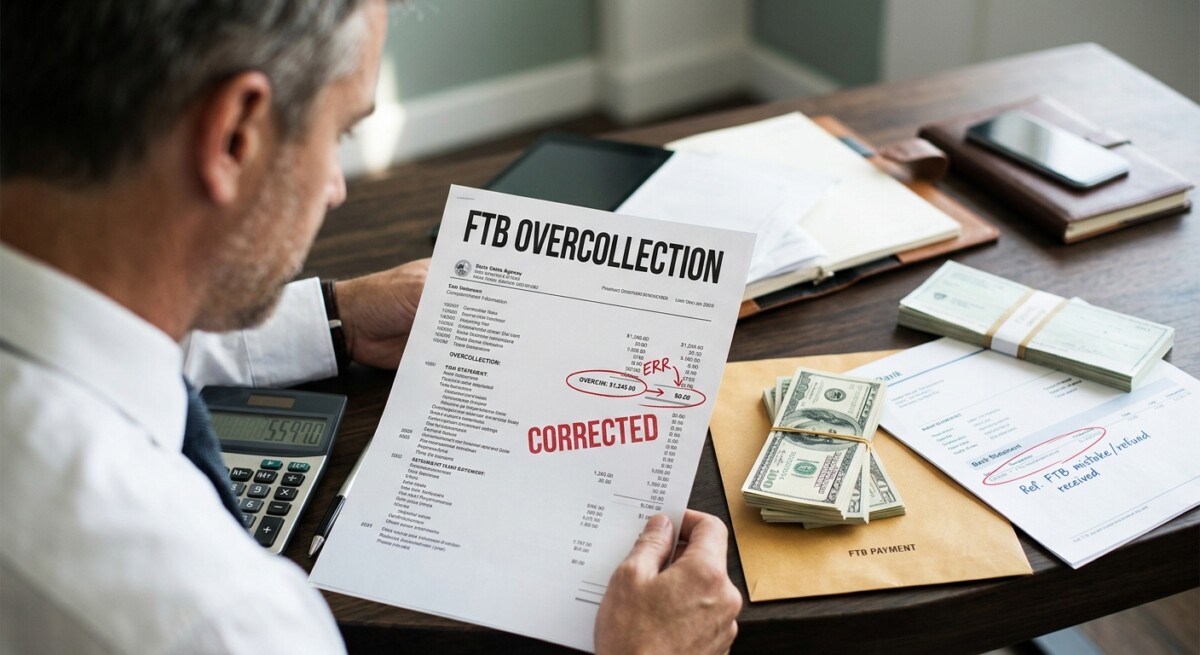
Every California tax practitioner has seen the call. A client’s bank account is drained by a Franchise Tax Board levy, or a garnishment keeps running after the tax has been paid, or a notice arrives about an old year the client had never really understood. By the time the client realizes something is wrong, the four-year refund window in R&TC section 19306 has quietly closed. The question is whether anything can still be done. The FTB’s answer, published on August 21, 2026 as FTB Legal Ruling 2026-02, is a narrow but real yes: if the excess money in FTB’s hands is an FTB overcollection rather than an overpayment, the statute of limitations does not bar its return. This post walks through the ruling, the six factual situations it works through, and how to spot an overcollection in practice.
What is an FTB overcollection, and how is it different from an overpayment? 🧾
An overpayment is the taxpayer’s excess payment against an actual (or assumed) tax liability. An FTB overcollection is an excess collected by FTB itself through a mechanical or clerical error during an involuntary collection action — never through a valid assessment properly enforced.
Legal Ruling 2026-02 opens with a straightforward statutory framing. Under R&TC section 19301, if a taxpayer has paid more than the actual tax liability, the overpayment is credited against amounts due and the balance is refunded. The refund is bounded by the familiar four-year / one-year statute in R&TC section 19306.
An overcollection is a different animal. The ruling defines it as FTB collecting an excess amount at the time the collection action is taken as a result of a mechanical or clerical error by FTB. The moment a payment is made pursuant to a valid assessment and proper collection procedure, even if the assessment is later shown to be wrong, the money is an overpayment — and the SOL applies. The overcollection category exists for situations where FTB itself takes more than the assessment authorized, or takes money through a collection process that failed on its own terms.
Two consequences flow from that framing. First, the four-year refund statute in R&TC section 19306 is a rule about overpayments; it does not bar the return of an overcollection. Second, the interest provisions in R&TC section 19340 reach only overpayments of tax; an overcollected amount is not an overpayment of tax and therefore carries no statutory interest. R&TC section 19349 independently blocks interest on payments not made incident to a bona fide and orderly discharge of an actual liability.
When does the statute of limitations not bar a return? ⏳
It does not bar the return of an FTB overcollection. It does bar the refund of an overpayment that arose because the taxpayer failed to file a timely return or timely claim, even where FTB’s estimated assessment turned out to be too high.
The ruling is careful about this line because it is the line taxpayers get wrong most often. A taxpayer who lets FTB estimate income from a W-2 or an occupational license, then files years later showing the estimate was too high, has produced an overpayment — not an overcollection. FTB acted on the information it had; the extra tax exists because the taxpayer did not file on time. The SOL bars that refund. Situations three, four, and five in the ruling all end this way, and the ruling is explicit that the estimation method the FTB used (average business income for licensed real estate brokers, for example) is one the courts have upheld.
An overcollection, by contrast, is FTB’s own math or its own process failing at the collection stage. A wage-garnishment order that keeps running after the tax is paid; an assessment computed on the wrong income figure and then collected; a collection notice mailed to the wrong address so the taxpayer never had the chance to challenge it. In each of those cases the excess is not the taxpayer’s mistake to bear.
The ruling is not a route to reopen closed audits
Legal Ruling 2026-02 does not reopen assessments that were valid when made and properly collected. A taxpayer who wants to contest the underlying liability after the SOL has to work a different angle — a reasonable-cause reconsideration, a financial-hardship petition, or a claim-of-right analysis — not this ruling.
Six situations from FTB Legal Ruling 2026-02 📋
The ruling works through six concrete fact patterns and shows which are overcollections that can be returned after the SOL and which are overpayments that stay barred.
The situations are worth reading in full, because they are the kind of factual detail that decides real cases. The table below summarizes each one and the FTB’s holding.
| Situation | What happened | Overcollection or overpayment? |
|---|---|---|
| 1 — EWOT continues after tax paid | FTB issued an Earnings Withholding Order for Tax. After the liability was fully satisfied, the employer sent one or more additional payments before the order was withdrawn. | Overcollection. A timing / clerical error at FTB. Returnable after the SOL. |
| 2 — Assessment computed on wrong income | FTB assessed additional net income of $50,020, but the tax collected was calculated on $50,220 because of a clerical error at final-billing. | Overcollection. The excess $200 of income was never authorized by the assessment. Returnable. |
| 3 — Late return after full collection | FTB collected $3,164 on a valid deficiency assessment from unreported wages. After the SOL, the taxpayer filed a return claiming deductions that reduced the tax to $2,000. | Overpayment. FTB’s assessment was correct on the information it had. The taxpayer’s late filing produced the excess. Refund barred. |
| 4 — Bad W-2, late corrected filing | FTB estimated a $80,000 wage from a W-2 and collected in full. After the SOL, the taxpayer showed the W-2 was wrong and actual wages were $18,000. | Overpayment. Valid assessment based on the W-2 in hand. Refund barred. |
| 5 — Estimated income from a license | FTB ascribed real-estate-broker income to a licensed taxpayer who did not file, then collected. After the SOL, the taxpayer filed showing no filing requirement. | Overpayment. Estimation method upheld by the courts. Refund barred. |
| 6 — Notices mailed to the wrong address | FTB clerical error sent collection notices to 122 Main Street instead of 123 Main Street. Corporation never saw them, involuntary collection ran, and the underlying assessment turned out to be overstated. | Overcollection. Corporation did not receive due process on collection. Returnable after the SOL. |
Situations 2 and 6 are the most instructive for CPAs. Situation 2 is the classic clerical typo — the assessment says one number, the bill says another, and the difference gets collected. Any client with a large EWOT or bank-levy history is a candidate to reconcile the assessment number against the collected number. Situation 6 is a due-process story: if the collection notice never reached the taxpayer’s last known address, the collection itself is not ‘in accordance with the law,’ and the amounts collected can be returned even years later.
Does FTB pay interest on overcollections? 💰
No. Statutory interest under R&TC 19340 attaches only to overpayments of tax. R&TC 19349 independently blocks interest where the payment was not made incident to a bona fide and orderly discharge of an actual liability.
The absence of interest is the price of the extended return window. A taxpayer who recovers an overcollection years after FTB took it gets back the principal, not the time value of money. For a small-business owner whose payroll account was hit by an EWOT that ran an extra month, that may still be a meaningful recovery. For a corporation whose notices went to the wrong address and lost the ability to contest an assessment years earlier, the return of the collected tax is a real remedy but not a full one — the interest and the compliance cost of the years in between are gone.
The lesson for taxpayers is not to rely on the overcollection path as a substitute for timely refund claims. Where a claim inside the four-year / one-year window in R&TC section 19306 is available, that claim will carry statutory interest under R&TC section 19340. The overcollection path is a backstop for cases where the ordinary refund route was never realistically available — because the collection error itself is the injury, or because the taxpayer never got the notices needed to trigger the refund clock.
What should California taxpayers and CPAs do now? 🧭
Reconcile every collected dollar against the underlying assessment, watch for notice-delivery defects, and separate overcollection facts from ordinary late-filing overpayments before writing to FTB.
- Pull the collection ledger before the assessment ledger. Ask FTB or MyFTB for every payment credited to the year — EWOT withholdings, bank levies, refund offsets, voluntary payments — and compare the total against the tax, penalties, and interest actually assessed. Any positive difference is a candidate for an overcollection.
- Confirm the assessment math. Situation 2 in Legal Ruling 2026-02 is a $200 clerical typo. Small differences are still overcollections. A quick tie-out between the Notice of Proposed Assessment, the final billing, and the collection total often surfaces these.
- Test the notice-delivery record. If the client’s address on file with FTB during the collection years differs from where notices were mailed, situation 6 is on the table. Print the FTB-recorded address history and compare it to the mail dates.
- Distinguish the client’s failure from FTB’s failure. A late-filed return that produces a lower tax is an overpayment (situations 3–5) and is barred after the SOL. That fact pattern is not helped by Legal Ruling 2026-02, no matter how sympathetic. Save the ruling for the FTB-caused excess.
- Ask for the principal, not interest. A written request for the return of an overcollection should quote Legal Ruling 2026-02, identify the specific mechanical or clerical error, and acknowledge that R&TC 19340 interest does not apply. That framing matches how FTB itself has now told the world it will analyze these requests.
From our practice: the collection file is the file
In our Los Angeles practice, the cases that recover after the SOL are the ones where the client kept the EWOT stubs, the bank-levy notices, and the FTB address printouts. The cases that die are the ones that arrive with only a late return and a request to ‘undo’ an old assessment. Legal Ruling 2026-02 does nothing for the second group. It does real work for the first.
Summary: FTB Legal Ruling 2026-02
- An overpayment is the taxpayer’s excess against a valid assessment; the four-year / one-year SOL in R&TC 19306 bars refund claims filed late.
- An FTB overcollection is an excess taken by FTB clerical or mechanical error during involuntary collection; the SOL does not bar its return.
- Six situations in the ruling map the line: EWOT overrun and wrong-income arithmetic and wrong-address notices are overcollections; late-filed lower returns and estimation-method disputes are barred overpayments.
- R&TC 19340 interest is limited to overpayments — a returned overcollection carries no interest. R&TC 19349 independently blocks interest on non-liability payments.
- Practical work: reconcile collections against assessments, check the notice-address record, and treat late-filing overpayments and FTB-caused overcollections as separate cases.
Frequently asked questions about FTB overcollection ❓
Q. What is the difference between an FTB overcollection and an overpayment?
An overpayment happens when a taxpayer pays more than the actual tax liability shown on a valid assessment or return. An FTB overcollection happens when the Franchise Tax Board itself takes more money than the assessment authorized, because of a clerical or mechanical error during an involuntary collection action. FTB Legal Ruling 2026-02 treats the two categories very differently for statute-of-limitations and interest purposes.
Q. Does the four-year statute of limitations bar the return of an FTB overcollection?
No. The statute of limitations in R&TC section 19306 applies to refunds of overpayments, not to returns of overcollections. If FTB collected an excess amount because of its own clerical or mechanical error, the excess can be returned to the taxpayer even after four years from the original due date and even after the one-year window from the date of overpayment has closed.
Q. Does FTB pay interest on the return of an overcollection?
No. Interest on refunds under R&TC section 19340 is limited to overpayments of tax. An overcollection is not an overpayment of tax, so no interest is owed. R&TC section 19349 also blocks interest on payments not made ‘incident to a bona fide and orderly discharge of an actual liability.’ A taxpayer who recovers an overcollected amount gets the principal back, not interest for the years FTB held it.
Q. An estimated assessment turned out to be too high after the SOL. Is that an overcollection?
Usually no. If FTB issued an estimated assessment based on information it reasonably had (a W-2, a licensed occupation, a rental license) and later collected in full through valid procedures, the resulting overstatement is an overpayment that arose from the taxpayer’s failure to file a timely return. Legal Ruling 2026-02 treats that as an overpayment barred by the statute of limitations, not as an overcollection.
Q. If FTB sent notices to the wrong address, does that change the analysis?
It can. In one of the ruling’s situations, FTB mailed collection notices to the wrong address, took involuntary collection action, and later learned there was no underlying tax liability. Because the corporation never received due process on the collection notices, FTB treated the collected amounts as an overcollection that could be refunded, even after the statute of limitations.
Q. What should a California CPA do when a client is hit by an FTB collection action they think was wrong?
Log the exact source of every dollar collected (EWOT, bank levy, refund offset), pull the assessment file and every notice FTB mailed, and identify whether the excess came from an FTB clerical error, a due-process defect, or the client’s own filing failure. That distinction decides whether Legal Ruling 2026-02 opens a return path after the SOL, or whether the taxpayer needs to work an inside-SOL refund claim or an audit reconsideration.
This article is general information about FTB Legal Ruling 2026-02, not tax or legal advice for your situation. Overcollection facts turn on the assessment record and the notice history. If you or your client has an FTB collection you believe was wrong, contact SW Accounting & Consulting Corp for a confidential review.