Foreign artist withholding in California: who is liable?
BTS Week has Los Angeles thinking about K-pop, and it is not only stadiums. Korean and other international acts play theaters, festivals, church events, corporate galas, and private parties across Southern California every month. The organizers are often small businesses, nonprofits, and families who have never paid a foreign performer before, and they learn about foreign artist withholding from an IRS notice a year later. This guide is written for the payer side: what you must withhold, what paperwork changes the amount, and what to put in the contract so the artist expects it.
Why is the payer responsible for foreign artist withholding? 🎤
Because the tax law collects from whoever controls the payment. When the payee is a nonresident, the payer is the withholding agent and is personally liable for any tax not withheld.
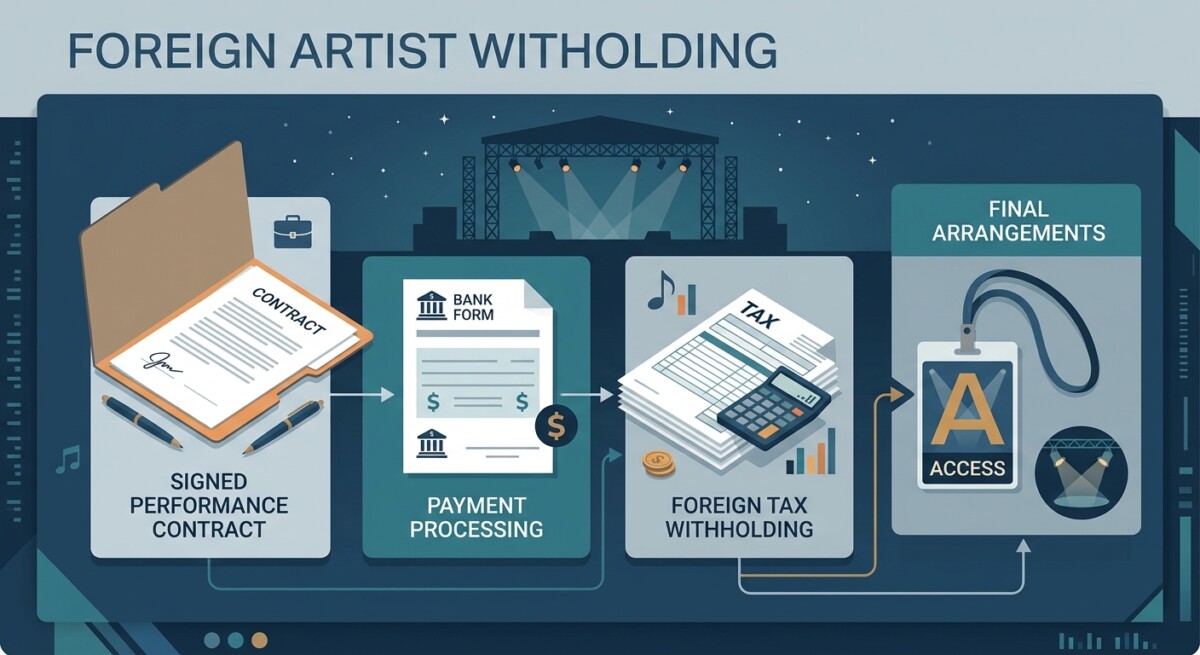
Internal Revenue Code section 1441 requires any person paying U.S.-source income to a nonresident alien to withhold 30 percent of the gross amount. Performance fees for shows in the United States are U.S.-source income no matter where the contract was signed or where the money is wired. IRS Publication 515 describes the withholding agent’s duties in detail: withhold at the time of payment, deposit the tax, and report it.
The liability is not theoretical. If the withholding agent fails to withhold, the IRS can assess the full amount plus penalties and interest against the agent. The artist may also owe the tax, but the IRS does not have to chase a performer in Seoul or London when there is a promoter in Los Angeles with a bank account.
- Promoters and venues are the obvious withholding agents.
- Nonprofits hosting a benefit concert are withholding agents on the artist fee.
- Companies paying an act for a corporate event or product launch are withholding agents.
- Churches and community groups paying a visiting choir or singer are withholding agents.
- Individuals hiring a performer for a wedding or private party are withholding agents.
How much federal tax is withheld, and what reduces it? 💵
Thirty percent of the gross fee, before expenses. It goes down only with an IRS Central Withholding Agreement letter or a valid treaty claim, and both must be in your hands before you pay.
“Gross” is the number that surprises first-time payers. A $50,000 fee that covers the artist’s flights, hotels, and a six-person crew is still a $50,000 payment for withholding purposes. The default withholding is $15,000. The artist’s actual U.S. tax on the net profit might be a fraction of that, but the refund comes through a later tax return, not through the payer.
Two documents change the amount.
- Central Withholding Agreement (CWA). Under the Central Withholding Agreement program, the artist applies on Form 13930 with a tour budget showing expected income and expenses. The IRS then sets withholding on estimated net profit rather than gross. The IRS issues a letter to the designated withholding agent stating the reduced amount. Applications are supposed to be filed at least 45 days before the first event. Without that letter in your file, you withhold 30 percent.
- Treaty claim on Form 8233. Some treaties exempt small performance income. The U.S.-Korea income tax treaty has no separate entertainer article. Its independent personal services article (Article 18) exempts income only when the performer is present under 183 days and earns $3,000 or less in the year, so it almost never covers a real engagement. Treat a Form 8233 from a Korean act with skepticism unless the fee is tiny.
If the payee is a foreign company rather than the individual performer, ask for Form W-8BEN-E or Form W-8ECI. A valid W-8ECI stating that the income is effectively connected with a U.S. trade or business removes the section 1441 withholding requirement, because the company will file its own U.S. return. Keep the form. A W-8BEN-E without an effectively-connected claim does not remove withholding on personal services income.
A W-8 form is not a waiver
Payers sometimes treat any W-8 as permission to pay gross. A W-8BEN from an individual performer documents foreign status; it does not reduce withholding on services performed in the United States unless a treaty article applies. Only a CWA letter, a valid Form 8233, or a W-8ECI from an entity changes the 30 percent.
Does California add its own foreign artist withholding? 🐻
Yes. Seven percent of California-source payments to nonresidents over $1,500 a year, and neither the federal treaty nor a federal CWA reduces it.
California Revenue and Taxation Code section 18662 requires withholding on payments of California-source income to nonresidents. Under the FTB nonresident withholding rules, the rate is 7 percent and applies once total payments to a payee exceed $1,500 in the calendar year. Regulation 18662-6 applies the rule specifically to entertainers, athletes, and speakers, and to payments made to their loan-out companies and agents.
Two things surprise payers who have already handled the federal side.
- Federal treaties do not apply to California tax. An artist with a complete federal treaty exemption still has 7 percent withheld for the state.
- A federal CWA does not reduce California withholding. The artist must separately file Form 588 for a waiver or Form 589 for reduced withholding with the Franchise Tax Board and hand you the FTB’s written approval. Form 589 is the one that matters for touring acts, because it lets the FTB set withholding on estimated net income after tour expenses.
You remit California withholding with Form 592-V, report it on Form 592, and issue Form 592-B to the payee so the artist can claim the credit on a California nonresident return. Payments to a foreign entity performing in California are subject to the same 7 percent unless the FTB approves otherwise.
| Item | Federal | California |
|---|---|---|
| Default rate | 30% of gross | 7% of gross over $1,500 per year |
| What reduces it | IRS CWA letter or valid Form 8233 | FTB Form 588 waiver or Form 589 reduction |
| Entity payee | W-8ECI removes withholding | Still 7% unless FTB approves |
| Deposit | EFTPS | Form 592-V |
| Annual reporting | Form 1042, 1042-S to payee | Form 592, 592-B to payee |
What goes in the contract so the artist expects it? 📝
The gross fee, a statement that U.S. and California withholding will be deducted unless approved reduction documents arrive by a date certain, and the forms attached.
Touring acts and their agents know these rules. Disputes happen when a first-time payer agrees to a “net” fee without saying so, then discovers that grossing up a $30,000 net payment for 30 percent federal and 7 percent state withholding costs closer to $47,600. Put the mechanics in writing before signature.
- State the fee as a gross amount in U.S. dollars.
- State that required federal and California withholding will be deducted at payment unless the artist delivers an IRS CWA letter, a valid Form 8233, or FTB Form 588 or 589 approval by a stated date, typically 14 days before the show.
- Attach Form W-8BEN or W-8BEN-E and Form 8233 as exhibits and require the artist’s completed copies before the deposit is released.
- State that Form 1042-S and Form 592-B will be issued to the artist by the following January 31 so the artist can file for any refund.
- If the artist insists on a net fee, price the gross-up into the budget and have the artist acknowledge the withheld amounts in writing.
From our practice: the deposit is the moment that matters
In our practice, the payers who get this wrong are not careless; they are early. The deposit goes out at signing, months before anyone thinks about tax, and it is paid gross. When the balance is paid at the show, the payer withholds on the balance only. The IRS looks at the total payment. Withhold on the deposit or hold enough of the balance to cover the whole fee.
What if the artist is paid through an agent or a loan-out company? 🏢
Withholding still applies. Regulation 18662-6 and Publication 515 both look through agents and loan-out companies to the performer for services performed in the state.
Many acts are paid through a management company, a booking agency, or the artist’s own loan-out corporation. For federal purposes, payments to a foreign agent for a nonresident performer’s services remain subject to withholding unless the agent is itself a qualified withholding agent or the entity provides a W-8ECI. For California, Regulation 18662-6 expressly covers payments to an entertainer’s agent or loan-out company and treats the venue or promoter as the withholding agent unless the FTB has approved a reduction for that entity.
The practical answer is the same in both cases: obtain the forms from the entity that will receive the money, not only from the performer, and withhold unless the approval names that entity.
Foreign artist withholding checklist before the wire goes out ✅
Seven items. If any is missing, withhold at the default rates and let the artist claim a refund.
| Step | Federal | California |
|---|---|---|
| Collect payee form | W-8BEN (individual) or W-8BEN-E / W-8ECI (entity) | Same forms |
| Reduction evidence | IRS CWA letter or Form 8233 | FTB Form 588 or 589 approval naming the payee |
| Default if nothing on file | Withhold 30% of gross | Withhold 7% of gross over $1,500 |
| Deposit timing | Withhold on the deposit or hold enough of the balance | Same |
| Remit | EFTPS | Form 592-V |
| Annual filing | Form 1042 and 1042-S | Form 592 and 592-B |
| Contract | Gross fee, withholding clause, forms attached | Same clause |
Summary: foreign artist withholding in California
- The payer is the withholding agent and is liable for tax not withheld.
- Federal default is 30% of the gross fee; only an IRS CWA letter, a valid Form 8233, or an entity’s W-8ECI reduces it.
- The U.S.-Korea treaty has no entertainer article and its $3,000 independent-services exemption rarely applies.
- California adds 7% over $1,500 a year. Treaties and federal CWAs do not reduce it; FTB Form 588 or 589 does.
- Report on Form 1042 / 1042-S and Form 592 / 592-B. Withhold on the deposit.
- Put the gross fee and the withholding clause in the contract before signature.
Frequently asked questions about foreign artist withholding ❓
Q. Who is the withholding agent when a California venue books a foreign artist?
Whoever controls the payment. That is usually the promoter or venue, but it can be a nonprofit hosting a fundraiser, a company paying for a corporate event, a church paying a visiting performer, or an individual paying for a private party. Nonprofit status does not remove the duty.
Q. How much federal tax must be withheld from a nonresident performer’s fee?
Thirty percent of the gross fee under Internal Revenue Code section 1441, before the artist’s travel, hotel, and crew costs. The amount is reduced only if the artist delivers an IRS Central Withholding Agreement letter or a valid treaty claim on Form 8233 before payment.
Q. Does the U.S.-Korea tax treaty exempt a Korean performer from withholding?
Almost never for a real engagement. The treaty has no separate entertainer article. Its independent personal services article exempts income only when the performer is present under 183 days and earns $3,000 or less in the year.
Q. Does a federal CWA reduce California’s 7 percent withholding?
No. Federal treaties and federal CWAs do not apply to California tax. The artist must separately obtain an FTB waiver on Form 588 or reduced withholding on Form 589 and give you the approval before payment.
Q. What forms does the payer file for foreign artist withholding?
Federal: deposit through EFTPS, then Form 1042 annually and Form 1042-S to each payee. California: remit with Form 592-V, report on Form 592, and issue Form 592-B to the payee.
Q. What happens if I pay the full fee and the artist leaves the country?
The IRS and the FTB assess the unwithheld tax, penalties, and interest against you as the withholding agent. There is no practical way to recover it from a performer overseas, which is why professional promoters withhold first and let the artist claim a refund later.
This article is general information, not tax advice for your specific situation. If you are organizing an event with international performers this fall and want the withholding handled correctly, contact SW Accounting & Consulting Corp before you sign.