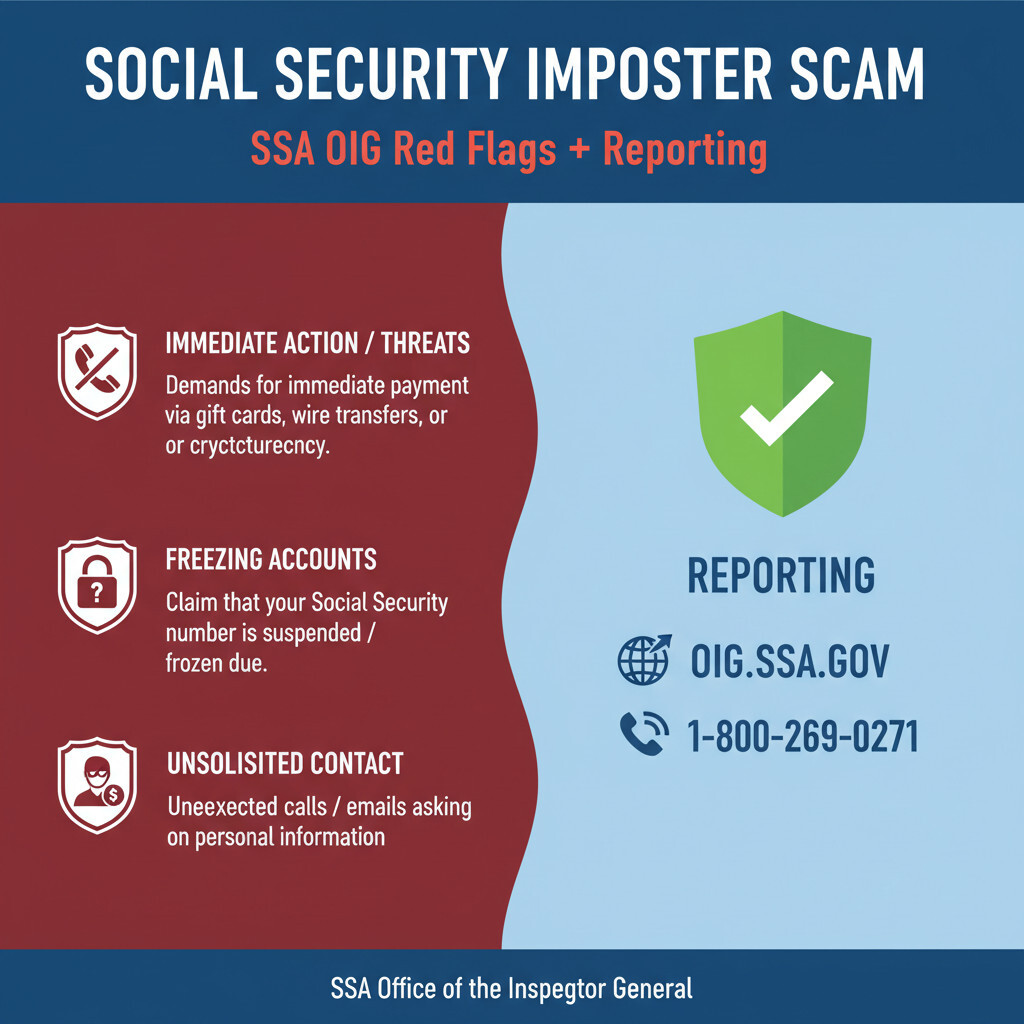
Social Security Imposter Scam: SSA OIG Red Flags + Reporting
Imposter scams remain one of the highest-volume frauds targeting U.S. taxpayers. The SSA OIG’s recent advisory highlights a tactic shift: scammers no longer just spoof phone numbers — they now build fake “trust” by sending photos of badges and federal credentials lifted from public sources. This Social Security imposter scam wave overlaps heavily with IRS impersonator schemes on the 2026 Dirty Dozen, and both use the same playbook: fear, urgency, untraceable payment.
At SW Accounting & Consulting Corp, we work with Los Angeles area individual taxpayers and small business owners — many of whom receive these scam contacts every tax season. Below: the exact scam pattern federal officials are warning about, the unconditional red flags, the payment methods that prove fraud, and what to do if you have already been victimized.
What is the SSA OIG warning about? 🚨
Per the SSA OIG advisory, criminals are impersonating Social Security Administration and Office of the Inspector General staff by harvesting employee names and photos from social media profiles and fabricating federal credentials (badges, ID cards, letterhead). They use these doctored materials to “verify” their identity to victims and pressure immediate payment.
The scam mechanics:
- Initial contact — phone, text, email, social media DM, or physical mail. Caller ID may show a real federal phone number (spoofed).
- The hook — “There is a critical problem with your Social Security number, benefits, account, or identity.” Sometimes framed as “your SSN has been suspended” or “identity theft has been detected on your account.”
- The pressure — fear and urgency: imminent arrest, frozen benefits, deportation, legal action. Victim is told they must act in minutes or hours.
- The “proof” — scammer sends a photo of a federal badge or ID card via text or email, supposedly to confirm legitimacy. The credentials are doctored or stolen from public photos.
- The ask — payment in untraceable form: wire transfer, cash (sometimes via courier), cryptocurrency, gift cards (iTunes/Google Play/Amazon), or precious metals (gold bars).
What are the unconditional red flags? 🚩
Federal officials emphasize: these are absolute rules. There is no edge case, no exception, no “but my situation is different.” If you see ANY of the following, you are talking to a scammer.
| Pattern | What real federal employees do |
|---|---|
| Sends a photo of their badge / credentials | NEVER. No legitimate federal employee sends credential photos to the public. |
| Threatens arrest or legal action unless you pay immediately | NEVER. Real agencies use written correspondence and due process. |
| Demands payment via gift cards, gold bars, crypto, wire, or cash | NEVER. Federal payments go through Treasury — never to a private wallet, gift card, or courier. |
| “Suspends” your SSN or freezes your benefits over the phone | NEVER. SSN suspension is not a real action. SSA decisions arrive in writing. |
| Caller ID shows a federal number | Easily spoofed. Caller ID is NOT a verification mechanism — ignore it. |
No federal agency in the United States — IRS, SSA, FBI, USPS, ICE, ANY agency — accepts payment in gift cards, cryptocurrency, gold bars, or courier cash. Period. The moment a “federal employee” mentions any of these payment methods, the conversation is over. You are not legally required to stay on the call.
What should you do if contacted? 🛡
Three steps, in order:
- Stop talking. Hang up the phone, delete the text, do not respond to the email. You owe scammers nothing — not even basic courtesy. Engagement only feeds the script.
- Verify independently. If you believe there might be a real issue with your SSN or benefits, look up the SSA’s contact information from a trusted source (SSA.gov directly, not links from the suspicious message) and call them. Better yet, create or log into a personal “my Social Security” account at ssa.gov to view real account status.
- Report. Even if you did not lose money, report the contact — this builds the federal case file used to track and prosecute scam operations.
How do you report a scam? 📞
Three federal reporting channels — file with all three for maximum impact.
| Agency | Where to file | When to use |
|---|---|---|
| SSA OIG | oig.ssa.gov (Report Fraud, Waste or Abuse) | Any SSA-impersonator contact, whether or not you lost money |
| FBI IC3 | ic3.gov | Internet-based contact (email, social media, online payment) |
| FTC | reportfraud.ftc.gov | Any fraud or attempted fraud; feeds the federal consumer-protection database |
If you have already lost money:
- Stop all communication with the scammer immediately. Do not “give them one more chance” or try to negotiate a refund.
- Contact your financial institution — bank, credit card, crypto exchange, gift card issuer. Some transactions can be reversed if reported fast enough.
- File a local police report — required for many financial institutions to process reimbursement claims.
- File with all three federal channels above.
- Consider an IRS Identity Protection PIN (IP PIN) if your SSN may have been exposed — apply via your IRS Online Account.
Frequently asked questions about Social Security imposter scams
Generally no — the SSA primarily uses mail. They may occasionally call if you have an existing case, but they will never threaten you, demand immediate payment, ask for gift cards, or send credential photos.
Doesn’t matter. Real federal employees do not send photos of their credentials to the public — even genuine badges in messages are a red flag. Authenticity of the badge image is not the question; the act of sending it is.
No. SSN data is extensively breached and traded on dark-web marketplaces. A scammer reciting your SSN means your data has been compromised, not that they work for the government. Treat it as an additional reason to monitor your credit.
No. Scammers cannot arrest anyone. Real federal arrests follow a legal process — warrants, prosecutors, courts. They are never resolved by a phone payment in gift cards.
How can SW Accounting help? 💼
At SW Accounting & Consulting Corp, we help LA-area individual taxpayers and small business owners verify suspicious IRS or SSA contacts, set up IRS Identity Protection PINs, monitor for identity-theft red flags on tax accounts, and respond to actual federal correspondence (which always arrives in writing). If you are not sure whether a contact is real, ask us before paying anything.
📩 Verify a suspicious tax or SSA contact
Disclaimer: This article is for informational purposes only and is not legal or tax advice. Always consult a qualified professional regarding your specific facts. Primary sources: Social Security Administration Office of the Inspector General (oig.ssa.gov) imposter-scam advisory; FBI Internet Crime Complaint Center (ic3.gov); Federal Trade Commission (reportfraud.ftc.gov); IRS Identity Protection PIN program.