IRS Offer in Compromise: Form 656-B + 2026 OIC Mills Warning
For taxpayers struggling with tax debt they cannot pay in full — or where full payment would cause financial hardship — the IRS Offer in Compromise is one of the most powerful relief tools the federal tax code provides. It is also one of the most misunderstood and most heavily targeted by predatory marketing. The IRS has warned about “pennies on the dollar” advertising for years, and in 2026 the agency once again named OIC mills as a top scam on the Dirty Dozen List.
At SW Accounting & Consulting Corp, we represent Los Angeles area taxpayers in OIC submissions, audit defense, and IRS collection matters. Below: how the OIC process actually works, the three grounds for an OIC, how the IRS calculates “reasonable collection potential,” and what to look for when choosing an OIC representative versus an OIC mill.
What is an Offer in Compromise? 💵
An OIC is an IRS-administered settlement under Internal Revenue Code §7122 that allows the IRS to accept less than the full tax liability when collecting the full amount would be unlikely or create undue hardship. The IRS uses three statutory grounds for accepting an OIC.
| Ground | When it applies |
|---|---|
| Doubt as to Collectibility (most common) | Taxpayer’s assets and future income are insufficient to pay the tax liability in full before the collection statute expiration date (CSED — generally 10 years from assessment) |
| Doubt as to Liability | Genuine doubt that the assessed tax is correct (e.g., new evidence overturning prior audit results) |
| Effective Tax Administration (ETA) | Full collection would cause economic hardship, OR there are compelling public policy or equity considerations |
Most OICs are filed under Doubt as to Collectibility. The numbers do the work — if your “reasonable collection potential” (RCP) is less than the assessed debt, you have a basis for an OIC.
How does the IRS calculate Reasonable Collection Potential? 📊
Reasonable Collection Potential (RCP) is the IRS-formulated minimum offer amount. RCP = (Realizable Equity in Assets) + (Future Income for a defined multiplier period). The IRS will not accept an offer materially below the RCP unless ETA grounds apply.
Components:
- Realizable Equity in Assets — quick sale value (typically 80% of FMV) of all assets minus secured debt. Includes real estate equity, vehicle equity, bank accounts, retirement accounts, business interests, and unencumbered personal property over reasonable thresholds.
- Future Income — monthly disposable income (gross income minus IRS-allowable expenses per the Collection Financial Standards) multiplied by either 12 (for a lump-sum cash offer) or 24 (for a periodic payment offer).
- IRS Collection Financial Standards — fixed national/local allowances for housing, transportation, food, healthcare. Your actual expenses are NOT used if they exceed the Standards — only the Standards amount is allowed.
Many taxpayers come in expecting to use their actual rent or car payment. The IRS will substitute the lower of (your actual / their Standard) for most expense categories — so a $4,000/month LA rent gets reduced to the IRS housing standard for your county and family size (often substantially less). Plan your offer around the Standards, not your bank statements.
What does the application look like? 📑
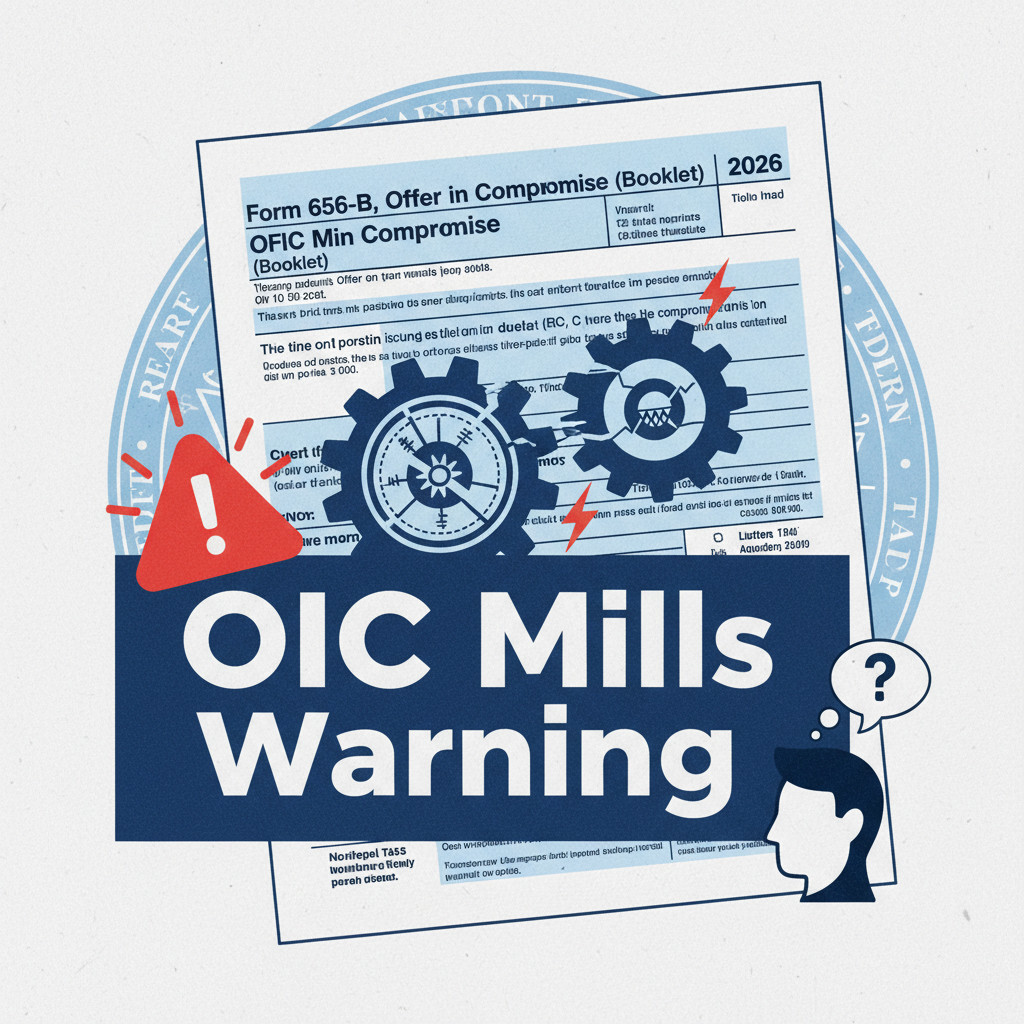
The Form 656-B Offer in Compromise Booklet contains everything needed: the Form 656 (offer itself), Form 433-A (OIC) for individuals or Form 433-B (OIC) for businesses (financial disclosure), the worksheet for calculating your minimum offer, and the application fee/initial payment schedule.
| Item | Amount / Detail |
|---|---|
| Application fee | $205 (waived for qualifying low-income taxpayers) |
| Initial payment — lump sum cash offer | 20% of offer amount with application; remainder within 5 months of acceptance |
| Initial payment — periodic payment offer | First proposed monthly payment with application; continue paying through evaluation |
| Forms required | Form 656 + Form 433-A (OIC) [individuals] or Form 433-B (OIC) [businesses] |
| Payment channels | Individual Online Account (individuals); Business Tax Account (businesses can make OIC payments online, but cannot submit the OIC application via BTA) |
| Typical IRS evaluation time | 6-12 months; statutory acceptance if not acted on within 24 months |
How do you avoid OIC mills? 🚨
“OIC mills” — listed on the 2026 IRS Dirty Dozen — are aggressive marketing schemes that promise “settle for pennies on the dollar,” charge large upfront fees, and submit OICs for taxpayers who don’t actually qualify. The IRS rejects most of these offers, the taxpayer loses the application fee plus the upfront mill fee, and ends up worse off.
| Red flag (OIC mill) | Legitimate representative |
|---|---|
| “Settle for pennies on the dollar” guarantee | No guaranteed outcome — settlement depends on RCP analysis |
| Large flat-fee upfront ($3,000-$10,000) before reviewing your facts | Hourly or staged-fee structure; initial consultation reviews facts |
| TV/radio “tax debt forgiveness” advertising | Local enrolled agent, CPA, or tax attorney; referrals from your CPA |
| Submits OIC without using the Pre-Qualifier Tool first | Runs Pre-Qualifier and RCP calculation BEFORE proposing OIC |
| No license or vague credentials | Verifiable EA, CPA, or attorney; listed in IRS Directory of Federal Tax Return Preparers with Credentials |
Before paying anyone anything, run the IRS Offer in Compromise Pre-Qualifier Tool yourself. It walks through eligibility (filing compliance, current installment agreement status) and computes a preliminary offer amount based on your RCP. If the tool says you’re not eligible — or that your minimum offer is essentially the full debt — that is the answer, regardless of what a marketer tells you.
Frequently asked questions about IRS Offer in Compromise
You must be current on all tax filings, not in an open bankruptcy proceeding, and have a valid extension if filing late. Beyond that, eligibility depends on your Reasonable Collection Potential — if your assets and future income cannot pay the full debt before the collection statute expires, you have a basis. Use the Pre-Qualifier Tool first.
Typically 6-12 months from submission to IRS decision. By statute, if the IRS does not act on the offer within 24 months, it is deemed accepted.
Collection actions (levies) are generally suspended while the offer is pending — but the collection statute is also tolled (paused). Tax liens may remain. You must continue making periodic payments if you chose that option. The IRS may request additional financial documentation.
You can appeal a rejection to the IRS Independent Office of Appeals within 30 days. Many initially-rejected offers are accepted on appeal after additional documentation or recalculation.
How can SW Accounting help? 💼
At SW Accounting & Consulting Corp, we represent LA-area taxpayers in OIC submissions and IRS collection matters — running the Pre-Qualifier and full RCP analysis before recommending an OIC, preparing Form 656/433 packages, responding to IRS requests for documentation, and handling Appeals if needed. We do not promise outcomes we cannot deliver, and our fees are tied to scope, not to a flat “you’ll settle for pennies” pitch.
📩 Schedule an OIC eligibility consultation
Disclaimer: This article is for informational purposes only and is not legal or tax advice. Always consult a qualified professional regarding your specific facts. Primary sources: Internal Revenue Code §7122; IRS Form 656-B Offer in Compromise Booklet; IRS Collection Financial Standards; IRS 2026 Dirty Dozen List; IRS Offer in Compromise Pre-Qualifier Tool.