IFRS 20: Regulatory Assets & Liabilities for Utilities
For rate-regulated utilities, the gap between when you incur a cost and when the regulator lets you recover it through rates has long distorted the income statement. IFRS 20 is the IASB’s long-awaited answer — a comprehensive standard that puts regulatory assets and liabilities on the balance sheet so reported performance better matches economic reality. Here’s what it does, who it affects, and how it compares to U.S. GAAP.
At SW Accounting & Consulting Corp, we work with companies navigating both IFRS and U.S. GAAP — including U.S. entities with IFRS-reporting parents and investors comparing across frameworks. Below: the core concept, the rationale, the effective date, and the U.S. GAAP comparison.
Who does IFRS 20 affect? ⚡
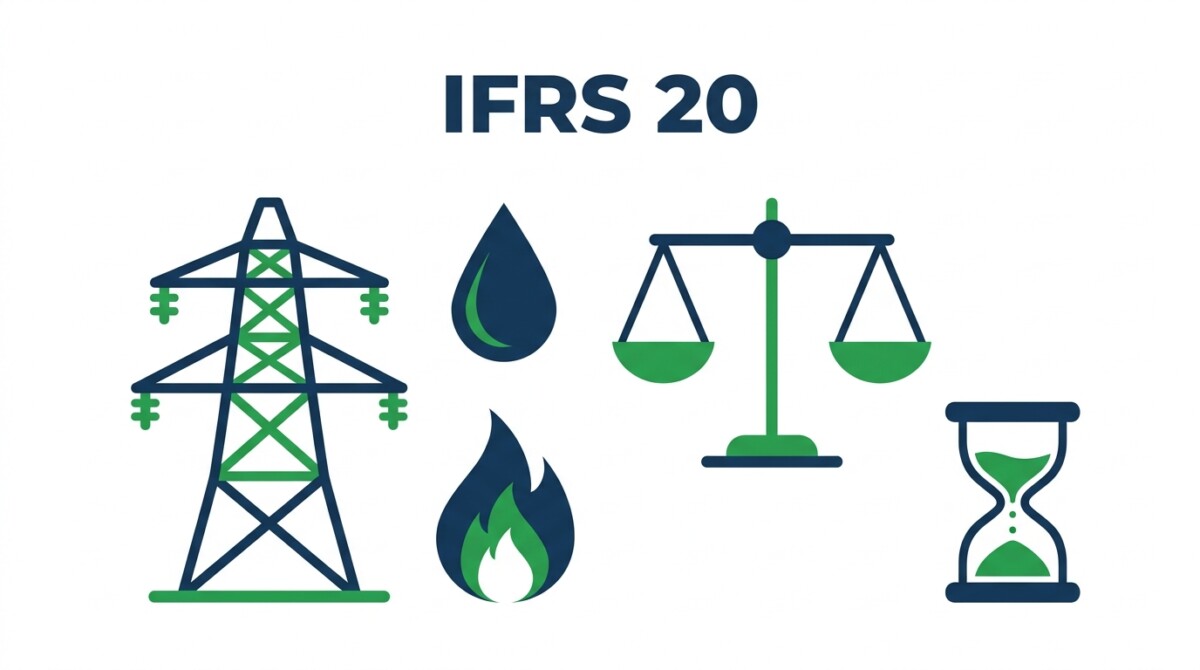
IFRS 20 applies to companies subject to a specific type of rate regulation — where a regulator determines how much a company can charge customers and when it can charge them. This most commonly covers utilities supplying vital services: electricity, water, and gas.
The core concept: “difference in timing” ⏳
When there’s a difference between when a company supplies regulated goods and services and when it charges customers for them, reported revenue may not fully reflect the company’s performance in the period. IFRS 20 calls this a “difference in timing” and requires companies to account for its effects.
| Item | What it represents |
|---|---|
| Regulatory asset | A present right to add an amount in determining a future regulated rate — because the company has already supplied goods/services it hasn’t yet been allowed to fully charge for |
| Regulatory liability | A present obligation to deduct an amount in determining a future regulated rate — because the company has charged for goods/services it hasn’t yet supplied |
Recognizing these brings the timing differences onto the financial statements, so performance is reported in the period it’s earned rather than the period it happens to be billed.
Imagine you do work in Year 1 but the regulator only lets you bill customers for it in Year 3. Without IFRS 20, Year 1 looks weak and Year 3 looks inflated. IFRS 20 records a regulatory asset in Year 1 (you’ve earned a right to future rates) and unwinds it as you bill — so each year’s results reflect what actually happened that year.
Why did the IASB issue it? 🎯
- Better information for investors — more complete, transparent information about companies in critical rate-regulated industries, including their financial performance, position, and prospects for future cash flows.
- Less diversity, more comparability — IFRS 20 is expected to reduce diversity in accounting practices across regulated industries.
- Built on broad consultation — developed with over 300 comment letters, more than 200 stakeholder meetings, and two rounds of fieldwork across 22 jurisdictions.
Effective date & related standards 📅
- Effective — annual reporting periods beginning on or after January 1, 2029; early adoption permitted.
- Supplements IFRS 15 — Revenue from Contracts with Customers; IFRS 20 addresses the timing differences IFRS 15 alone doesn’t capture.
- Replaces IFRS 14 — Regulatory Deferral Accounts, the interim standard that allowed first-time adopters to carry forward existing regulatory balances.
How does it compare to U.S. GAAP? 🇺🇸
U.S. GAAP has long had ASC 980, Regulated Operations, which lets qualifying rate-regulated entities recognize regulatory assets and liabilities. IFRS previously lacked a comprehensive equivalent (IFRS 14 was only an interim measure). IFRS 20 closes that gap.
Why it matters for U.S. companies: if you’re a U.S. entity with an IFRS-reporting parent, a multinational utility, or an investor comparing rate-regulated companies across frameworks, IFRS 20 changes the comparability picture. The concepts rhyme with ASC 980, but the models are not identical — confirm the specifics before assuming the numbers line up.
Frequently asked questions
Companies reporting under IFRS that are subject to a specific type of rate regulation — typically electricity, water, and gas utilities whose regulator controls how much and when they can charge customers.
A mismatch between when a company supplies regulated goods/services and when it’s allowed to charge for them. IFRS 20 records regulatory assets and liabilities so reported revenue reflects performance in the right period.
Annual reporting periods beginning on or after January 1, 2029, with early adoption permitted. It supplements IFRS 15 and replaces IFRS 14.
They address the same economic issue — regulatory assets and liabilities for rate-regulated entities — but the models differ. Don’t assume IFRS 20 and ASC 980 produce identical results; analyze both if you report or compare across frameworks.
How can SW Accounting help? 💼
At SW Accounting & Consulting Corp, we help companies that report under — or alongside — IFRS prepare for IFRS 20: identifying differences in timing, modeling regulatory assets and liabilities, and reconciling the IFRS 20 view with U.S. GAAP’s ASC 980 for groups and investors that need both. If rate regulation touches your financials, we’ll map the impact well ahead of 2029.
📩 Schedule an IFRS 20 readiness review
Disclaimer: This article is for informational purposes only and is not accounting, tax, or legal advice. Always consult a qualified professional regarding your specific facts. Primary sources: IASB / IFRS Foundation — IFRS 20, Regulatory Assets and Regulatory Liabilities (effective annual periods beginning on or after January 1, 2029; supplements IFRS 15; replaces IFRS 14); U.S. GAAP comparison: FASB ASC 980, Regulated Operations.