
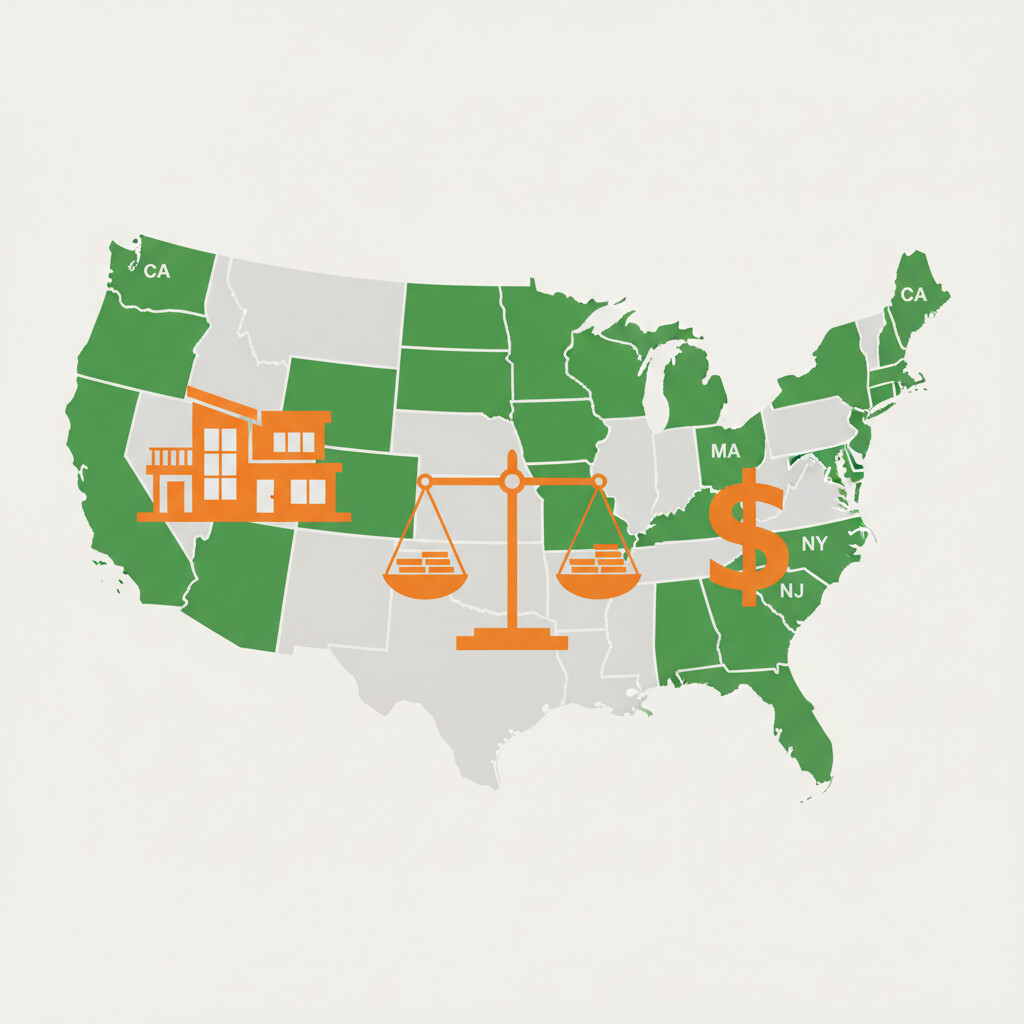
State Wealth Tax 2026: Billionaire and Millionaire Proposals Spreading
High-net-worth individuals and family offices face a rapidly shifting state tax landscape. The state wealth tax 2026 wave is no longer theoretical — multiple measures have qualified for ballots, passed state legislatures, or moved through committee. For HNW clients with multistate exposure (or planning a move), the policy direction varies dramatically across states. This guide breaks down what’s active, what’s proposed, and what to watch.
At SW Accounting & Consulting Corp, we work with HNW individuals, founders, and family offices navigating state residency planning, exit-tax exposure, and multistate income tax strategies. Below: a complete inventory of 2026 state wealth tax moves with the practical takeaway for affected taxpayers.
Which states have proposed or enacted wealth tax measures in 2026? 🗺
At least a dozen states have proposed millionaire or billionaire-targeted tax measures in 2026, with California’s billionaire ballot initiative and New York City’s pied-à-terre proposal drawing the most attention.
| State / City | 2026 Measure | Status |
|---|---|---|
| California | One-time 5% tax on net worth > $1B (ballot initiative) | Signatures qualified; Gov. Newsom opposing |
| New York City | Pied-à-terre tax on $5M+ homes (non-primary residence) | Proposed by Mayor Mamdani & Gov. Hochul; Comptroller skeptical of revenue forecast |
| Massachusetts | 4% Fair Share surtax on income > $1M | Enacted 2022 — $6B raised; ongoing migration debate |
| New Jersey | 10.75% top income tax rate + mansion tax | Existing — top rate among states |
| Illinois | Wealth tax proposal targeting top earners | In committee |
| Minnesota | High-net-worth surtax proposal | In committee |
| Rhode Island | Top-earner tax proposal | In committee |
| Virginia | Top-earner tax proposal | In committee |
| Maine | Wealth tax measure | House vote pending |
What does the California $1B billionaire ballot initiative do? 🌴
The California ballot initiative — signatures qualified in April 2026 — would impose a one-time 5% tax on net worth exceeding $1 billion. Gov. Gavin Newsom has publicly opposed it, citing migration risk and the existing wealthy taxpayer concentration in California revenue.
Key design features:
- One-time levy, not annual — narrower mark-to-market mechanics than ongoing wealth taxes.
- 5% on net worth above $1B — affects an estimated 150–200 California residents.
- Constitutional challenges likely — direct wealth taxation at state level invites litigation under California’s tax-uniformity doctrine.
- Valuation complexity — illiquid assets (private equity, founder shares, real estate, collectibles) raise valuation disputes that have plagued every state-level wealth tax pilot.
A one-time billionaire levy creates a powerful incentive for affected residents to change state residency before the effective date. California already enforces some of the most aggressive residency-audit standards in the country (under R&TC §§ 17014-17016 and the “closest connections” test). Pre-effective-date moves face heightened scrutiny. Document residency facts now and coordinate with counsel.
How does NYC’s pied-à-terre tax work? 🏙
Mayor Zohran Mamdani and Gov. Kathy Hochul jointly proposed a new pied-à-terre tax on homes valued above $5 million where the owner maintains a separate primary residence outside New York City — but the NYC Comptroller has flagged that revenue may fall far short of the $500 million headline goal.
Mechanical questions to watch:
- Valuation threshold — $5M is an assessed market threshold; valuation methodology will be contested.
- Primary residence definition — owners with multi-state homes may face fact-intensive determinations.
- Trust/entity ownership — homes owned through LLCs, family trusts, or corporate vehicles raise look-through questions.
- Comptroller’s revenue skepticism — projected $500M may not materialize due to behavioral response, valuation appeals, and ownership restructuring.
What does Massachusetts’s 4% Fair Share surtax track record show? 💰
Voters approved Massachusetts’s Fair Share Amendment in 2022 (4% surtax on income above $1M). Through 2026, it has raised approximately $6 billion for transportation and education — but Massachusetts lost over 33,000 residents to other states last year, fueling debate over the surtax’s long-term impact.
Lessons from the MA experience:
- One-time events trigger the surtax. Per Pioneer Institute, taxpayers reporting a one-time business sale or large home sale can hit the $1M threshold even if normal income is far lower. Capital gains, RSU vests, and inherited income create irregular exposure.
- Migration is real but mixed. 33K+ residents left for other states; overall population grew via foreign immigration. Whether the wealthy-tax base shrunk is contested.
- Revenue meets headline but budget gaps persist. $6B is meaningful but state lawmakers still face balanced-budget challenges.
- Political precedent. Other states (CA, NY, IL) cite MA as proof-of-concept; opponents cite migration data as warning.
What’s driving the 2026 state wealth tax surge? 📊
Three forces are converging: rising wealth inequality, OBBBA-driven federal safety-net cuts pushing pressure to state budgets, and a fiscal divergence between blue and red states.
The underlying inequality data:
- Top 0.1% wealth gain: ~$40M per household in recent decades (Oxfam America analysis).
- Top 1% income share: doubled between 1980 and 2022.
- Bottom 50% income share: fell by one-third over the same period.
The OBBBA federal context — slashed funds for SNAP, Medicaid, and other safety-net programs while delivering tax cuts skewed to higher earners — has shifted the cost of those services to states. Progressive advocates argue this justifies state-level revenue measures targeting the wealthy; conservatives counter that the resulting tax migration ultimately erodes state revenue bases.
For HNW clients, the strategic question isn’t just “will the tax pass?” — it’s “what’s the optionality value of state residency flexibility?” Florida, Texas, Nevada, Tennessee, Wyoming, and South Dakota offer zero state income tax. The cost-benefit of a 12-month residency change is increasingly favorable as blue-state wealth tax pressure builds. But execution matters: residency must be substantive, not paper-only, to survive audit.
Tax Foundation vs. ITEP — what’s the policy debate? ⚖
| Position | Argument |
|---|---|
| Tax Foundation (conservative) | High top rates push wealthy individuals and employers to low-tax states. The U.S. is bifurcating into a low-tax majority and a small high-rate cluster. |
| ITEP (left-leaning) | 40 states have tax systems that favor the wealthiest earners. State revenue gaps require progressive corrections to balance the burden. |
| State Revenue Alliance | Federal cuts to safety-net programs require state-level revenue measures to backfill. Wealthy “paying their fair share” benefits broad economic activity. |
| Pioneer Institute (libertarian-leaning) | One-time-income events trigger the surtax inequitably; long-term migration effect outweighs short-term revenue. |
What should HNW taxpayers and advisors do in 2026? ✅
- Map your state exposure. Inventory residency, real property, business interests, and trust assets by state. Identify which 2026 wealth tax proposals would apply.
- Model the one-time event risk. Business sales, RSU vests, large capital gains, and estate distributions can push a single year over thresholds. Run pro forma calculations under MA, NY, NJ, and prospective CA rules.
- Document substantive residency facts. If considering a move, build the residency factors now (homestead, drivers license, voter registration, family/business presence, days of physical presence). State audits look at substance, not paperwork.
- Trust and entity structuring. Pied-à-terre and one-time wealth tax measures interact with LLC, trust, and entity ownership in unsettled ways. Review your title and beneficial ownership before any law passes.
- Stay current on legislation. California’s billionaire ballot initiative votes in November 2026. NYC pied-à-terre is in early legislative phase. Several states will see committee action through summer 2026.
- Watch federal interactions. Federal estate tax thresholds and OBBBA provisions interact with state wealth measures (deduction stacking, basis step-up timing). Multi-state HNW returns require coordinated federal-state-international analysis.
Frequently Asked Questions 🗂
For state tax legislative tracking, see Tax Foundation and the Institute on Taxation and Economic Policy. For California ballot measures, the California Secretary of State’s elections page tracks qualification status and ballot text.
Need help with multistate residency planning, exit-tax exposure analysis, or HNW client trust and entity structuring? SW Accounting & Consulting Corp’s tax planning team supports families and individuals across LA, NYC, MA, and zero-tax states — book a consultation.