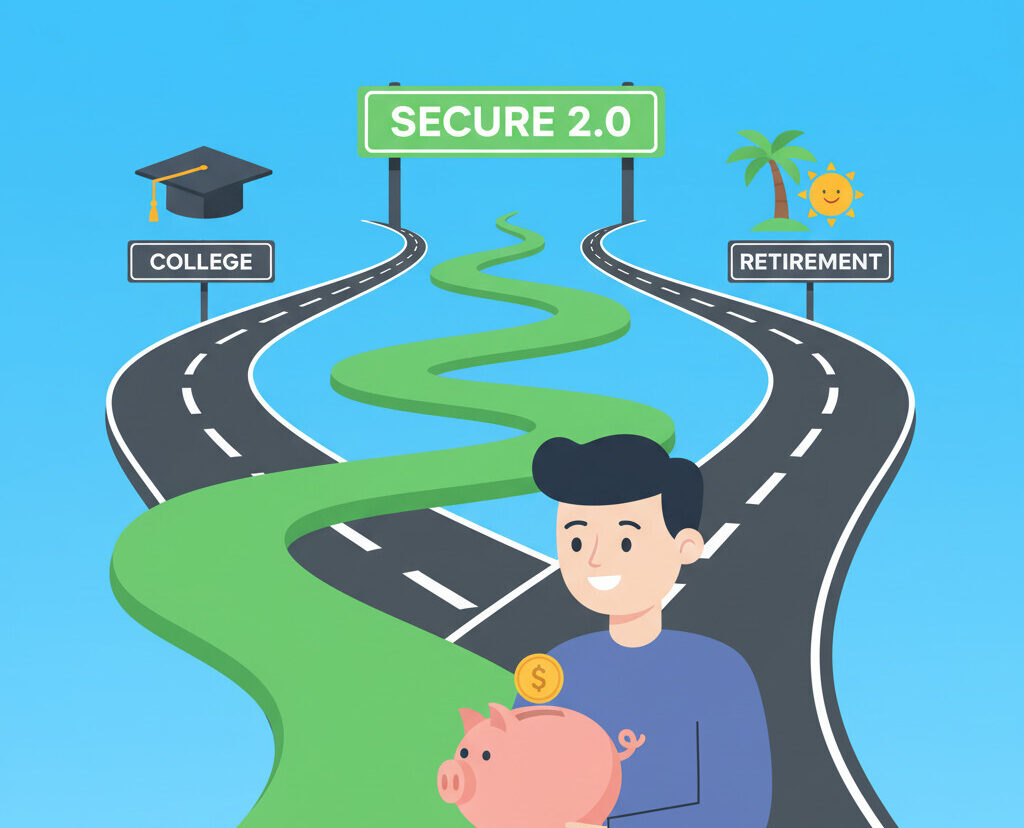
529 College Savings vs FAFSA: How to Solve the Complexities
Let’s talk about something that causes a *ton* of stress for parents. It’s that constant financial tug of war: trying to responsibly save for your own retirement while also staring down the giant, looming mountain of college tuition for your kids. It feels like you have to choose, right? Every dollar you put into your 401(k) feels like a dollar you *can’t* put into a college fund. And then that little voice of doubt creeps in, “What if saving for my future actually penalizes my kid’s chances for financial aid?”
I get it. It’s a confusing and high-stakes dilemma. But what if I told you a recent change in the law has created a brilliant new way to tackle *both*? A new strategy that could turn this “either/or” problem into a “both/and” solution. Let’s break down exactly how it works. 😊
First: Will My Retirement Savings Hurt My Child’s Financial Aid? 🤔
Okay, let’s get this big, scary question out of the way first. You’ve worked so hard to build that nest egg in your IRA or 401(k). Is all this responsible saving going to come back and bite you when your child applies for college aid?
I’m going to give you the short, simple, and wonderful answer right up front: No.
That’s right. For the most part, your qualified retirement savings are not going to hurt your child’s federal financial aid eligibility. You can take a deep breath. To understand why, we need to talk about the FAFSA.
The FAFSA (Free Application for Federal Student Aid) is the form that nearly all colleges use to determine how much financial aid a student qualifies for. It looks at the student’s and parents’ finances to calculate an “Expected Family Contribution” (EFC), which is now being replaced by the “Student Aid Index” (SAI). A lower SAI/EFC can lead to more aid. The FAFSA looks at two main things: your **assets** and your **income**.
Here’s the most important rule to remember: The FAFSA does not count the balance of your qualified retirement accounts as parental assets. This includes your:
- 401(k)
- 403(b)
- Traditional IRA
- Roth IRA
- Pension plans
When you think about it, this makes total sense. The government *wants* you to save for your own retirement. They want you to be self-sufficient later in life. The last thing they want to do is create a system that forces you to choose between your own financial security and your child’s education. That would be a mess for everyone.
But—and this is a really important “but”—there’s a key distinction. The FAFSA protects your retirement *assets* (the total pile of money in the account), but it is very interested in your *income*.
Any money you *withdraw* from a retirement account gets treated as income. For example, if you pull $20,000 out of a Traditional IRA during the year your child’s aid is being calculated, that $20,000 gets added to your income on the FAFSA. A higher income can absolutely reduce the amount of aid your child gets. So, the balance is safe, but withdrawals are not.
What About College-Specific Savings? The 529 Plan 📊
“Okay,” you might be thinking, “so my IRA is safe. But what about the account that’s *literally designed* for college, the 529 plan? How does the FAFSA see that?”
This is where it gets different. A 529 plan, when owned by a parent, is considered a parental asset on the FAFSA.
Now, don’t panic! The good news is that parental assets are calculated at a much lower rate than student assets. The impact on your financial aid is typically pretty small (it can reduce aid by a maximum of 5.64% of its value). But yes, it *is* on the books.
Thing is, that small asset hit wasn’t even the biggest worry parents used to have with 529 plans. The *real* hang-up, the thing that made so many parents hesitate, was that big, scary “what if” question…
“What if my kid gets a full-ride scholarship? What if they decide not to go to college at all? What on earth happens to all this money I’ve saved if it doesn’t get used for school?”
And that, my friends, was the old trap. If you had leftover money in a 529 and took it out for anything other than qualified education expenses, you got hit with income tax on the earnings *plus* a nasty 10% penalty. This created a very real fear of over-saving. But that has all changed.
The Game-Changer: The SECURE 2.0 Act 🧮
This is the part of the story where the hero arrives. A piece of legislation called the SECURE 2.0 Act came along and completely rewrote the rulebook for 529 plans. Seriously, this is a total game-changer.
So what did it do? It introduced something absolutely incredible: the 529-to-Roth IRA Rollover.
This means you can now take that leftover, unused money from your child’s 529 plan and roll it *directly* into a Roth IRA in their name. And get this: you do it with zero taxes and zero penalties. The money just moves from one great, tax-advantaged account to another.
Of course, there are some rules. You can’t just do it willy-nilly. Here are the key conditions:
📝 Key Conditions for the 529-to-Roth IRA Rollover
- The 15-Year Rule: The 529 plan account must have been open for at least 15 years. This encourages long-term saving.
- The 5-Year Rule: Any money you roll over must have been sitting in the account for at least 5 years. (This prevents people from dumping money in and rolling it right back out.)
- Annual Limits Apply: The amount you can roll over each year is subject to the beneficiary’s annual Roth IRA contribution limit for that year (e.g., $7,000 in 2024).
- The Lifetime Max: This is the big one. There is a lifetime maximum of $35,000 that can be rolled over per beneficiary.
I know, $35,000 might not sound like winning the lottery, but think about what that means. For a 22-year-old just starting their career, $35,000 in a Roth IRA is a massive head start on their retirement. Thanks to the power of compound growth, that $35k could easily grow to hundreds of thousands of dollars by the time they retire, all completely tax-free.
Your New “Two-in-One” Savings Strategy 👩💼👨💻
So, let’s be really clear here. This isn’t just some minor tweak to the tax code. This fundamentally changes the entire strategy. It unlocks a powerful new way of thinking—a kind of “two-for-one” deal for your savings.
The 529 plan is no longer just a college fund. You have to think of it now as a Hybrid Asset. Its first job, its main job, is to pay for school. But it now has a fantastic backup plan: to become the seed money for your child’s tax-free retirement fund.
This leads us to a brand new, much simpler game plan. Here’s how you can now approach this without all the stress:
- Step 1: Prioritize You. Take care of yourself first. You confidently max out your IRA and 401(k) contributions, knowing that this money is shielded from the FAFSA. Remember the golden rule: you can get a loan for college, but you cannot get a loan for retirement.
- Step 2: Fund Their Future. After you’ve secured your own retirement contributions, you fund your child’s 529 plan. But now, you do it *without* that old fear of over-saving. You can save confidently, knowing that if your child gets a scholarship or your college costs end up being lower, those leftover funds have an amazing new home to go to—your child’s Roth IRA.
This is why this is such a big deal. It completely removes that old conflict, that tug of war. You can now save for both goals without fear. You’re not just saving for their school; you’re potentially giving them an incredible, tax-advantaged head start on their own financial life. It’s a win-win.
Key Takeaways: A Quick Recap 📝
That was a lot, I know. Let’s boil it all down into a simple comparison table so you can see the whole picture at a glance.
College & Retirement Savings: FAFSA Rules
| Account Type | Is it a FAFSA Asset? | How Withdrawals/Use is Treated |
|---|---|---|
| IRA / 401(k) / 403(b) | No. The balance is “invisible” to the FAFSA. | Counted as Income. This is the part that can hurt aid eligibility. |
| 529 Plan (Parent-owned) | Yes. It’s counted as a parental asset, but the impact is minimal. | Leftover funds can roll to a Roth IRA (tax & penalty-free, up to $35k). |
The New College Savings Playbook
Frequently Asked Questions ❓
This new flexibility really changes the conversation. That old “tug of war” doesn’t have to be a conflict anymore. You can confidently prioritize your own retirement (which you *must* do) and then use the 529 plan as this amazing, flexible tool to give your child a head start on both their education and their future financial independence.
What do you think of this new 529 rule? Does it change your savings strategy? Let me know in the comments! 😊