Business Interest Deduction 2026: OBBBA Changes
Most companies with any debt on the books already know Section 163(j) — the limitation that caps how much business interest you can deduct in a year. What most companies do not know is that the IRS refreshed its guidance on the business interest deduction on August 19, 2026 (Fact Sheet FS-2026-14), and several of the moving parts got friendlier while a couple got tighter. If you have a large depreciation base, a floor-plan financing line, or CFC income flowing into your U.S. return, the update almost certainly changes your number.
At SW Accounting & Consulting Corp, we prepare returns for Los Angeles businesses that carry real debt — restaurant groups, dental and medical practices, franchisors, and manufacturers. Section 163(j) is the quiet driver behind many of the projections we run for those clients. Here is what actually changed under the One, Big, Beautiful Bill Act (P.L. 119-21), and what to check on your 2025 return before you file.
What is the Section 163(j) business interest deduction limit? 📉
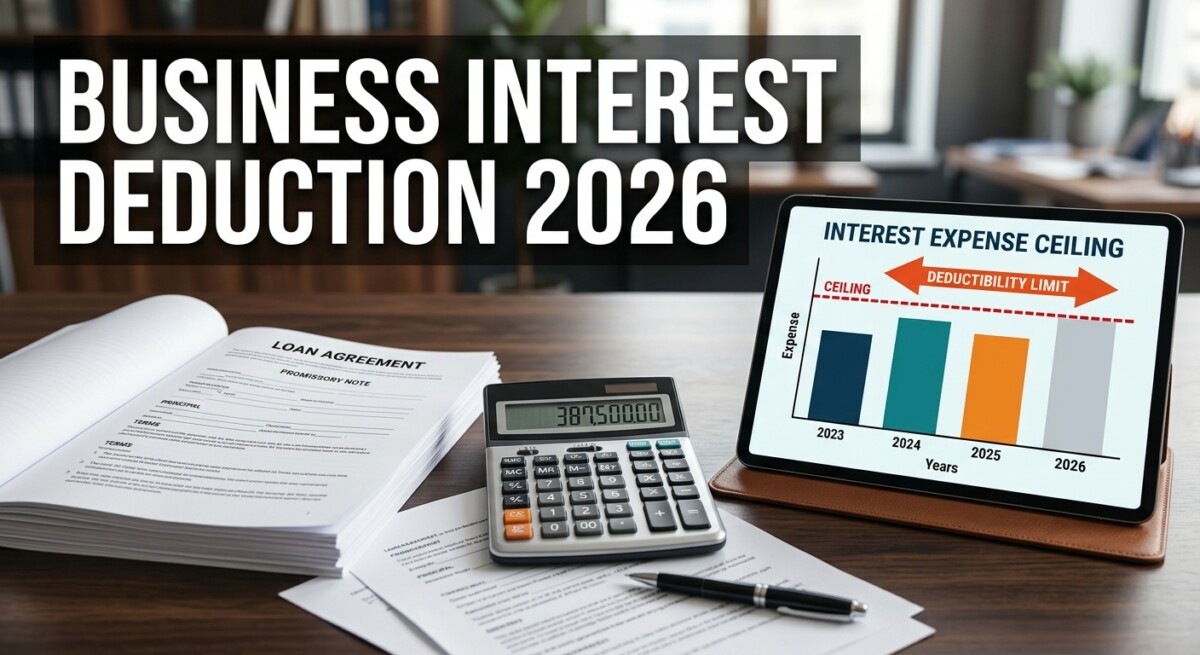
Business interest expense is deductible only up to the sum of business interest income, 30% of adjusted taxable income (ATI), and floor-plan financing interest.
Under IRC §163(j), a taxpayer’s deductible business interest cannot exceed the sum of (1) business interest income, (2) 30% of ATI, and (3) floor-plan financing interest expense. Any interest disallowed under the cap carries forward indefinitely at the taxpayer level (with special rules for partnerships and S corporations). Small businesses that meet the §448(c) gross receipts test are exempt from the limitation entirely.
The business interest deduction mechanics look simple on paper, but the four numbers in that formula — business interest expense, business interest income, ATI, and floor-plan interest — each have their own definitions, elections, and traps. The August 2026 IRS update rewrote the definitions that matter most.
What did the One, Big, Beautiful Bill Act change? 📜
Four discrete changes and clarifications, effective at different dates — the biggest is the ATI depreciation add-back, back for tax years beginning after December 31, 2024.
- ATI depreciation add-back restored (2025+). For tax years beginning after December 31, 2024, depreciation, amortization, and depletion are added back to taxable income when computing ATI. For 2022–2024, those items were not addable — a change that had pushed many capital-intensive taxpayers into the cap. Restoring the add-back generally increases ATI and therefore raises the 30%-of-ATI ceiling.
- Motor vehicle definition expanded (2025+). For floor-plan financing purposes, a “motor vehicle” now includes any trailer or camper designed to provide temporary living quarters and designed to be towed by or affixed to a motor vehicle. RV and travel-trailer dealers should confirm that inventory-secured financing lines now qualify as floor-plan financing interest.
- Capitalized interest clarification. Except for interest capitalized under §263(g) or §263A(f), §163(j) applies to all business interest expense regardless of any mandatory or elective capitalization. The IRS notes this is a clarification, not a change in position.
- CFC income removed from ATI (2026+). For tax years beginning after December 31, 2025, a U.S. shareholder no longer includes §951(a), §951A(a), and §78 inclusions (and their associated deductions) in ATI. U.S. shareholders can no longer bump their ATI with CFC income — often lowering the 163(j) ceiling for multinationals. The 2020 proposed regulations at Treas. Reg. §1.163(j)-7(j) cannot be relied on for tax years beginning after December 31, 2025.
Who is exempt from the business interest deduction cap in 2026? 🏢
Small businesses that meet the §448(c) gross receipts test — average annual gross receipts of $32 million or less for 2026 — are exempt from Section 163(j).
The gross receipts threshold is indexed for inflation each year. The IRS confirmed the following amounts:
- 2024 tax year: $30 million
- 2025 tax year: $31 million
- 2026 tax year: $32 million
The test looks back at the prior three years’ average. So a company measuring its 2026 exemption uses average gross receipts for 2023–2025 against the $32 million threshold. A business that fell into the cap in an earlier year can drop out again when its trailing three-year average falls back below the current-year threshold — and any disallowed interest carried forward is no longer limited in the year the exemption returns.
How do partnerships and S corporations apply the limitation? 🤝
Partnerships compute the limit at the entity level and allocate disallowed interest to partners as excess business interest expense (EBIE); S corporations compute at the entity level but carry disallowed interest forward at the corporation, not to shareholders.
At the partnership level, deductible business interest expense flows into non-separately stated income. Any disallowed amount becomes EBIE, allocated to partners in the same manner as non-separately stated income. A partner can only deduct EBIE in a later year to the extent it is allocated excess taxable income or excess business interest income from the same partnership. Treasury Regulation §1.163(j)-6 provides the full sequencing, and §1.163(j)-6(h) sets out a separate §704(d) loss class for business interest expense.
S corporations apply §163(j) at the corporate level. Disallowed business interest is not pushed out to shareholders — it stays at the S corporation and carries forward. Excess taxable income and excess business interest income, however, do pass through pro rata.
What should CFOs and tax teams do right now? ✅
Recompute ATI under the new depreciation add-back rule, reopen any prior §163(j) elections in light of Rev. Proc. 2026-17, and re-model any CFC-heavy structures for the 2026 ATI change.
- Recompute ATI for 2025. Depreciation, amortization, and depletion are add-backs again. Compare the new cap to actual interest expense to see whether any prior carryforward becomes deductible.
- Reconsider an excepted trade or business election. An electing real property or farming business must depreciate certain assets on ADS and forfeits bonus depreciation. Rev. Proc. 2026-17 provides transition rules for withdrawing an election in light of the OBBBA changes to §§163(j)(8) and 168(k).
- Check floor-plan financing definitions. If you finance RVs, campers, or towable inventory, the expanded motor-vehicle definition may re-classify your interest as floor-plan financing interest — which drops out of the cap.
- Re-model CFC groups for 2026. For tax years beginning after December 31, 2025, CFC income inclusions no longer boost ATI. U.S. shareholders of CFCs — especially those relying on the 2020 proposed regulations under §1.163(j)-7(j) — need a fresh projection before year-end tax planning locks in.
Section 163(j) at a glance 📊
| Item | Rule after OBBBA | Effective |
|---|---|---|
| ATI depreciation add-back | Depreciation, amortization, depletion added back | Tax years beginning after 12/31/2024 |
| Motor vehicle definition | Includes towable trailers and campers | Tax years beginning after 12/31/2024 |
| Capitalized interest | §163(j) applies to all business interest (except §263(g)/§263A(f)) | Clarification, no change in position |
| CFC income in ATI | §951(a), §951A(a), §78 inclusions removed from ATI | Tax years beginning after 12/31/2025 |
| Small-business threshold | $32 million (3-year average gross receipts) | 2026 tax year |
📌 Key Takeaways
- The business interest deduction is still capped at business interest income + 30% of ATI + floor-plan interest.
- For 2025+, depreciation, amortization, and depletion are added back in ATI — the cap moved higher for capital-heavy taxpayers.
- For 2026+, CFC income (§951(a), §951A(a), §78) is excluded from ATI — the cap moved lower for many multinationals.
- The 2026 small-business exemption applies to average gross receipts of $32 million or less.
Frequently Asked Questions ❓
Q. What is the Section 163(j) business interest deduction limit?
A taxpayer’s deductible business interest expense cannot exceed the sum of business interest income, 30% of adjusted taxable income (ATI), and floor-plan financing interest. Any excess is carried forward.
Q. Did the OBBBA change how I calculate ATI?
Yes. For tax years beginning after December 31, 2024, depreciation, amortization, and depletion are added back to taxable income in computing ATI. For 2025 and later, that generally raises the 30%-of-ATI ceiling.
Q. What is the small-business exemption threshold for 2026?
A business meeting the §448(c) gross receipts test with average annual gross receipts of $32 million or less for the three prior years is exempt from §163(j) for the 2026 tax year. The threshold was $31 million for 2025 and $30 million for 2024.
Q. How does the CFC income change affect my 163(j) calculation?
For tax years beginning after December 31, 2025, a U.S. shareholder no longer includes §951(a), §951A(a), or §78 inclusions in ATI. Multinationals that previously bumped their ATI with CFC income will typically see a lower business interest deduction ceiling.
Q. Are trailers and campers now considered motor vehicles for floor-plan financing?
Yes. For tax years beginning after December 31, 2024, a trailer or camper designed for temporary living quarters and designed to be towed by or affixed to a motor vehicle counts as a motor vehicle. Interest on inventory-secured financing for these vehicles is floor-plan financing interest, which is not subject to the §163(j) cap.
Q. Can I still rely on the 2020 proposed CFC regulations?
No. The IRS states that the proposed regulations under Treas. Reg. §1.163(j)-7(j) issued in September 2020 are no longer consistent with current law and cannot be relied on for tax years beginning after December 31, 2025.
Section 163(j) is one of the tax code’s quiet compounding rules — one shift in the ATI formula can turn a full deduction into a multi-year carryforward, or vice versa. If you would like a fresh 2025 model of your business interest deduction that reflects the depreciation add-back and any CFC exposure, contact SW Accounting & Consulting Corp. Primary sources: the One, Big, Beautiful Bill Act (P.L. 119-21), IRC §163, Treasury Regulation §1.163(j), and the IRS Newsroom Fact Sheet FS-2026-14 (Aug. 19, 2026).