Who can use the IRS Business Tax Account (2026)?
For a long time, most small businesses could not do the basic things online that individual taxpayers had been doing for years. A partnership could not see its own IRS account balance without either a paper transcript or a call. A church or a public school district could not download EIN verification when a bank asked for it. The business tax account — the IRS’s online self-service platform for entities — has changed that in 2026, first by opening to millions of new entities in April, and then by adding features throughout the year. This post explains who qualifies now, which notices and payments the account handles, and how to set it up so that the first time you sign in is not the same afternoon you actually need it.
What is the IRS Business Tax Account and what does it cover in 2026? 🏛️
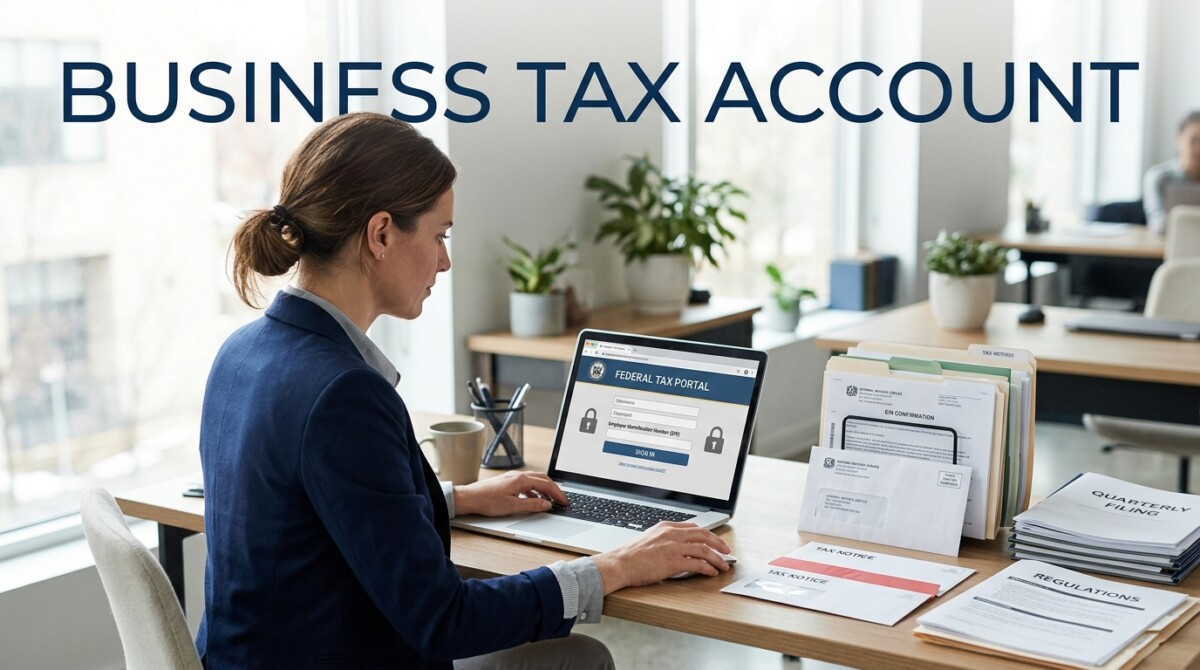
The IRS Business Tax Account is a secure online portal that lets authorized users at an eligible entity view IRS records, review notices, manage payments, and download certain letters and verifications for the entity.
The IRS Business Tax Account page describes the account as an online self-service platform for authorized users at an eligible business or organization. In practice, what you can do inside falls into three buckets: read notices, make and manage payments, and pull documents you would otherwise have to request. Each of those buckets has moved in 2026.
For read access, the IRS has added several notices that were previously only mailed. You can now view CP081B (“We May Have a Refund for You”), CP211A (“Application to File Extension of Time Approved”), and CP134R (“Federal Tax Deposits Discrepancy — Due a Refund”). Reading these in the account, rather than waiting for the paper copy to reach the address on file, is not a small change when the notice concerns a refund with a claim-window deadline.
For payments, the account now shows the balance and details of an existing installment agreement and accepts a payment against it. It also accepts payments toward an offer in compromise, which is the IRS process that lets a taxpayer settle a tax debt for less than the full amount when eligibility conditions are met. See the IRS payment plans page for the underlying plan types.
For documents, a designated official at the entity can now download a CP575 verification of the entity’s employer identification number. Historically, when a bank or a payment processor asked for EIN verification, the business had to request Letter 147C by phone and wait for a mailed or faxed reply. A downloadable CP575 collapses that process into a login.
Who is now eligible to use the Business Tax Account? 🧾
As of the April 2026 expansion, sole proprietors, S corporations, C corporations, partnerships, tax-exempt organizations, Indian tribal governments, and federal, state, and local governments can all use the account. Additional entity types are planned for future releases.
The eligibility change was substantial. Before April, the account was largely limited to the entities most closely tied to individual identity — sole proprietors and closely-held corporations that had adopted the online option. A partnership that filed Form 1065 for twenty years could not sign in to its own account. That is no longer true.
| Entity type | Access before April 2026 | Access after April 2026 |
|---|---|---|
| Sole proprietors | Yes | Yes |
| C corporations | Yes | Yes |
| S corporations | Yes | Yes |
| Partnerships (Form 1065 filers) | No | Yes |
| Tax-exempt organizations (Form 990 filers) | No | Yes |
| Indian tribal governments | No | Yes |
| Federal, state, and local governments | No | Yes |
| Other entity types | No | Planned in future releases |
The practical effect is that entities that historically only communicated with the IRS on paper — because the online option simply did not exist for them — can now handle a large share of that work through the portal. That is especially useful for tax-exempt organizations that lose track of their EIN letter every time a new treasurer takes over, and for governmental units that maintain their own separate finance operations.
Which IRS notices can I now read inside the Business Tax Account? 📩
The account currently surfaces CP081B, CP211A, CP134R, and CP575, among others. Each is an IRS-generated notice or letter you would otherwise receive by mail, and each has a deadline or a downstream use that is easier to hit when you can read it the same day it is issued.
- CP081B — We May Have a Refund for You. The IRS sends this when records show a potential refund but no return has been filed for the period. Refund claims are barred after the statute of limitations closes (generally three years from the return due date or two years from payment, whichever is later). Reading CP081B digitally in the account gives you a head start on the filing.
- CP211A — Application to File Extension of Time Approved. Confirms the IRS accepted a request for additional time to file a business return. The digital copy is the paper trail you keep with the return file.
- CP134R — Federal Tax Deposits Discrepancy, Due a Refund. The IRS sends this when its records show more deposits than the return reflects, so the balance owed is lower than expected or a refund is due. Catching CP134R early avoids the awkwardness of a client thinking there is a shortfall when there is not.
- CP575 — Notice of New Employer Identification Number. The original assignment letter for the entity’s EIN. Downloading a fresh copy from the account replaces the older process of requesting Letter 147C by phone.
From our practice: the CP575 change is the one clients feel first
In our practice, the change that gets the most attention from clients is not the notice viewer — it is CP575 on demand. Nearly every new business banking relationship, every merchant processor, and every state licensing office asks for EIN verification. Under the old process, that request triggered a phone call to the IRS Business & Specialty Tax Line, a wait, and a mailed letter. A designated official who can log in and download the CP575 the same afternoon avoids all of that. We now walk every new business client through account setup during onboarding for exactly this reason.
What can I actually pay from the Business Tax Account? 💳
You can pay a current tax deposit, make a payment against an existing installment agreement, or send a payment toward a pending offer in compromise. The account does not create the plan or accept the offer for you — it manages the payment side once one exists.
This distinction matters. The account is a payment channel, not an application. If a business owes tax it cannot pay in full, the underlying request still runs through the IRS payment plans process (short-term extension, guaranteed installment agreement, streamlined installment agreement, or a routine installment agreement, depending on the balance). Once the agreement is in place, the account is where you view the balance, see the next scheduled payment, and add a lump-sum payment if cash flow allows one.
The offer in compromise process is the same idea one level up. The offer itself is submitted and evaluated through the normal Form 656 package with the required financial disclosures. What the account adds is a way to route the required periodic payments during evaluation and any lump-sum payment on acceptance, without paper checks that could be misapplied to a different tax period.
The account cannot restructure a plan for you
A common misconception among newly enrolled users is that the payment features will negotiate or restructure the underlying agreement. They will not. If your installment agreement is defaulting because your revenue dropped, or if your offer in compromise needs to be revised because your financial condition changed, the fix is outside the account — through a Form 9465 amendment, a new Form 656, or a call to Collections, depending on the situation. Do not let a green payment button convince you that the underlying agreement is healthy.
How should a CPA or business owner set up the Business Tax Account? 🛠️
Set it up in a quiet week, not the day the bank asks for EIN verification or the day a CP-series notice arrives. The setup itself is straightforward if the entity’s identifying information matches what the IRS has on file.
- Confirm the entity name and EIN as they appear on the IRS record. The account matches on both. If the entity has legally changed its name and the IRS still shows the old name, resolve that first — otherwise identity verification will fail without a clear reason.
- Decide who inside the entity will be a designated official. This is the person who can act for the entity in the account: view notices, download CP575, and submit payments. Choose someone with real authority, not the newest bookkeeper.
- Complete identity verification through the IRS credential provider. You will need a government-issued ID and, in most cases, a live selfie step. Do this at a desk, on a good connection, with the ID in hand. Rushing it is the single most common reason a first login fails.
- Log in once to confirm the account resolves to the right EIN. If an owner has multiple entities, the account is per-entity, not per-owner — verify you landed in the correct one before you file anything.
- Download a CP575 while you are there. Save it in the entity’s permanent records. The next time a bank, a state licensing office, or a payment processor asks for EIN verification, you will not need the IRS to send it again.
How does the Business Tax Account fit alongside a CPA relationship? 🤝
The account handles direct, entity-owned work — reading your own notices, making payments, downloading verification letters. A CPA handles what requires professional representation, judgment, or a Power of Attorney. The two are complementary; the account does not replace representation.
The clearest way to see it is by asking who has to speak with the IRS. When a business reads its own CP211A extension approval or pays its own installment agreement balance, no one has to speak with the IRS at all — the record answers the question. When a business receives an examination notice, needs an appeal, or has a lien or levy in motion, someone has to speak with the IRS, and that someone is usually a CPA or enrolled agent working with a Power of Attorney on file. The account reduces the volume of the first category so the CPA relationship can focus on the second.
Summary: IRS Business Tax Account in 2026
- The IRS Business Tax Account now covers partnerships, tax-exempt organizations, tribal and government entities in addition to sole proprietors and corporations.
- You can view CP081B refund notices, CP211A extension approvals, and CP134R deposit discrepancies inside the account, rather than waiting for paper.
- Designated officials can download CP575 EIN verification and use it in place of Letter 147C at banks and payment processors.
- The account accepts payments toward existing installment agreements and pending offers in compromise, but does not create or restructure the underlying plan.
- Do the setup in a quiet week, verify the account resolves to the right EIN, and download a CP575 while you are there so the file is ready.
Frequently asked questions about the IRS Business Tax Account ❓
Q. Who can now sign in to the IRS Business Tax Account in 2026?
The IRS Business Tax Account now covers a much wider set of entities than it did a year ago. Sole proprietors, S corporations, and C corporations were the original users. In April 2026, the IRS expanded access to partnerships, tax-exempt organizations, Indian tribal governments, governmental bodies, and federal, state, and local governments. The IRS has said additional entity types will follow, so an entity that does not qualify today may qualify in a later release.
Q. What is CP081B and why did I get one in my Business Tax Account?
CP081B is an IRS notice that says the agency may have a refund for you but has not received a return for that tax period. If you never filed and the statute of limitations to claim a refund is about to close, CP081B is a prompt to file so the credit is not lost. Inside the Business Tax Account you can now view CP081B digitally instead of waiting for the paper copy, which matters when the deadline is only weeks away.
Q. Can I use the CP575 from my Business Tax Account instead of Letter 147C at the bank?
Yes, that is the point of the change. A designated official on the Business Tax Account can download a CP575 EIN verification. Banks and other institutions accept CP575 for the same purpose they used to require Letter 147C — verifying the EIN on file. That removes a common friction point when opening business accounts or setting up merchant processing, because Letter 147C historically required a phone request and a mailed or faxed reply.
Q. Can I pay a payment plan or an offer in compromise through the Business Tax Account?
Yes. Recent updates let a business view the balance and other details of an existing payment plan and make a payment against that plan directly inside the account. The account also accepts payments toward an offer in compromise, which lets a taxpayer settle a tax debt for less than the full amount when eligibility is established. The account itself does not create the payment plan or approve the offer — you still apply through the standard IRS processes — but once one exists, it can be managed online.
Q. Does the Business Tax Account replace calling the IRS Practitioner Priority Service?
No. The account gives owners and designated officials direct online access to their own records, notices, and payment options, which cuts down on many routine calls. It does not replace representation. If a matter requires a Power of Attorney, appeals contact, examination correspondence, or transcripts a client cannot pull for themselves, a CPA or enrolled agent still works through the practitioner channels. Think of the account as reducing the volume of calls that were only ever about lookups and payments.
Q. What should I do to get set up before I actually need the Business Tax Account?
The setup step is what causes most of the pain later, so do it in a quiet week, not during an audit. Confirm the entity name and EIN as they appear on the IRS record, decide who inside the entity will be a designated official, complete identity verification through the IRS credential provider, and then log in once to confirm the account resolves to the right EIN. Download a CP575 while you are there. If a new bank asks for EIN verification six months from now, you will have it in the file.
This article is general information, not tax or legal advice for your situation. Enrollment paths, notice codes, and payment options can change as the IRS rolls out additional features. If your entity is new to the Business Tax Account or you would like help walking through setup, contact SW Accounting & Consulting Corp for a confidential review.