The #1 Tax Mistake New Entrepreneurs Make: Is Your Schedule C an Audit Risk?
So, you’re starting your own business! That’s fantastic. Your head is probably spinning with a million things: finding clients, marketing your services, perfecting your product, and, of course, getting paid. But what if I told you the single biggest threat to your new venture isn’t a competitor or a bad market, but a simple tax form?
It sounds crazy, but it’s a really common mistake that tons of new entrepreneurs make. We’re all focused on *making* money, but we rarely think about how the *way* we report that money could put a giant, flashing target on our back for the IRS. Today, we’re diving into this hidden risk and, more importantly, how to avoid it right from the start. 😊
An Entrepreneur’s First Questions (Case Study: Golf Coach) 🤔
To make this real, let’s look at it through the eyes of a real person. We’ll use a case study of a golf coach who is just starting out and going solo. They’re trying to do everything by the book, but they’re about to step right into a huge trap without even knowing it.
Here are the questions they’re asking. And look, these are smart questions! They are exactly what you *should* be thinking about:
📝 Case Study: The New Golf Coach’s Questions
- Question 1: “Should I get an Employer Identification Number (EIN) even though I don’t have any employees?”
Short Answer: Yes, absolutely. It’s a great idea so you don’t have to use your personal Social Security Number on all your business forms. - Question 2: “How do I make sure I’m reporting my income correctly so I can get benefits like Social Security later on?”
Short Answer: Yes, this is crucial. You have to report your income to qualify for those future benefits. - Question 3: “Can I deduct my car expenses for business use?”
Short Answer: Yes, you can deduct the business portion of your car (like driving to different golf courses to meet clients), but you can’t deduct your daily commute from home to your primary place of work.
Now, here’s the twist, and it’s a big one. Even if our golf coach answers all those questions perfectly and follows the rules, they are *still* missing the single most important piece of advice they could possibly get.
The Real Twist: It’s Not Your Answers, It’s Your Form ⚠️
The real issue isn’t *what* our golf coach is asking. It’s the business structure they’ve chosen—or rather, fallen into by default—that’s making them ask these questions in this specific, risky way.
When you just start working for yourself without setting up a formal company, you are automatically a **sole proprietor**. And this is where the danger lies.
If I could give this golf coach one piece of advice, it would be this: “I would advise this person not to operate their business as a sole proprietor if possible.” The risk is simply too high, and it’s a risk most new business owners don’t even know they’re taking.
So, why is being a sole proprietor so risky? It all comes down to one little form.
The Schedule C: An Audit Magnet for the IRS 🧲
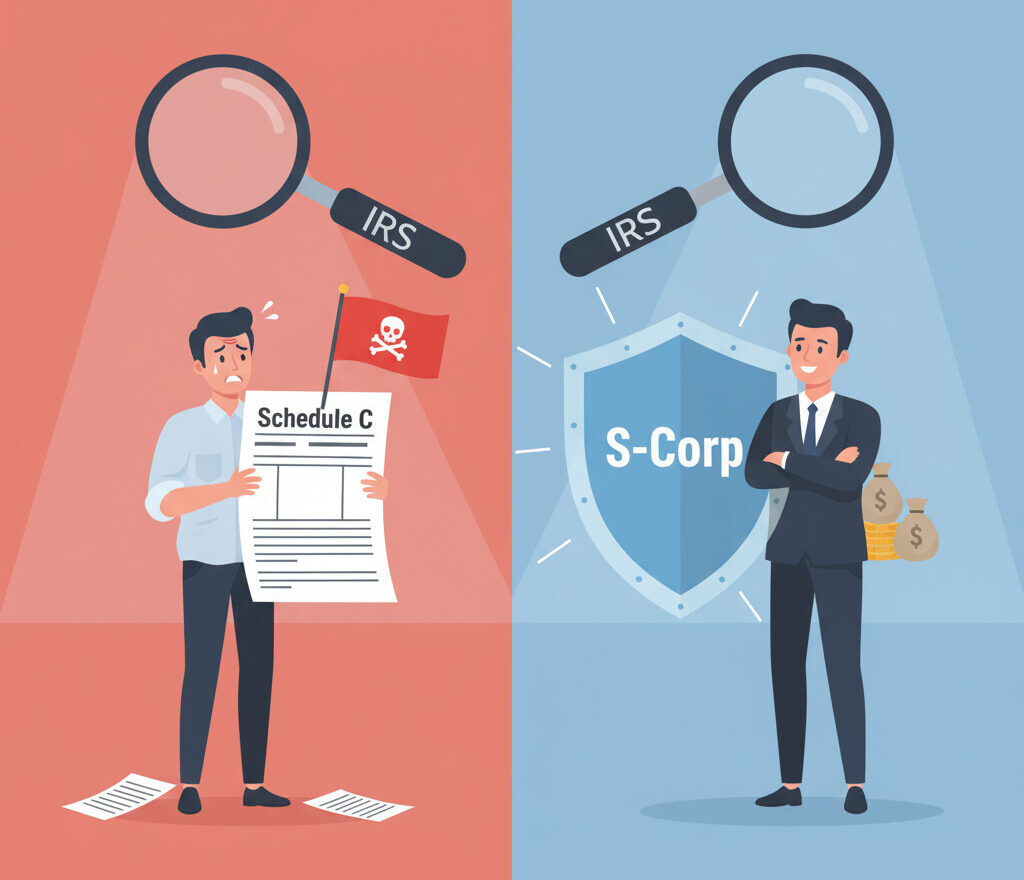
When you’re a sole proprietor, you have to file a tax form called **Schedule C, “Profit or Loss from Business.”** This form gets attached, or “bolted on,” to your personal 1040 tax return. And for the IRS, this form is a giant red flag. Statistically, sole proprietors who file a Schedule C get audited *way* more often than other types of businesses.
Let’s compare this to a safer alternative: the **S-Corporation (S-Corp)**. An S-Corp is a formal legal entity. It files its *own, separate business tax return*. This simple act of separation creates a legal distinction between you and your business. It’s a shield.
Here’s a quick breakdown of the difference:
| Business Structure | How It’s Filed | Audit Risk Level |
|---|---|---|
| Sole Proprietor | Attaches a Schedule C to your personal 1040 return. Your business and personal finances are mixed. | High. The IRS sees this as a major red flag and a magnet for audits. |
| S-Corporation | Files its own separate business tax return. You are a legal entity, separate from your business. | Dramatically Lower. This structure acts as a “shield” and lowers your audit profile significantly. |
The 7 Red Flags That Trigger an IRS Audit 🚩
You have to think of the IRS’s system as a massive computer that’s just looking for patterns. It’s been trained for decades to spot things that don’t look right. Many of these red flags are tied directly to that dangerous Schedule C.
Let’s walk through the 7 biggest red flags the IRS looks for.
Red Flags 1 & 2: Your Income and Pay Structure 💰
- Flag 1: High Schedule C Income. This one is almost painfully simple. The more money you report on a Schedule C, the higher your chance of an audit becomes. It’s a numbers game. The more successful your little sole proprietorship is, the more of a target it automatically becomes.
- Flag 2: Low/Zero S-Corp Salary. Now, even if you do the right thing and set up an S-Corp, you can still get in trouble. A common temptation is to pay yourself a tiny (or $0) salary and take all the company’s profits as a “distribution.” Why? Because those distributions aren’t subject to the 15.3% payroll tax. Well, the IRS is all over this. They expect you to pay yourself a “reasonable salary” for the work you do. Playing games with this is one of the biggest red flags you can wave.
Red Flags 3, 4, & 5: Your Expenses and Deductions 🧾
- Flag 3: Deductions That Are “Abnormal.” The IRS computers have data on what’s “normal” for every single industry. If you’re a golf coach, and your deductions for meals, entertainment, or car expenses are wildly different from the average golf coach, that’s a red flag.
- Flag 4: 100% Business Use of a Car. This is a classic one. Claiming you use your one and only car 100% for business is a huge trigger. The IRS knows you probably use it for personal trips, too. It’s all about what’s reasonable and what you can actually prove.
- Flag 5: Showing a Loss Year After Year. Look, it’s normal for a new business to have a bad year and post a loss. But if your Schedule C shows a loss year after year after year, the IRS starts to get suspicious. They’ll start to think, “Hey, is this a real business, or is this just a hobby that you’re using to write off expenses against your other income?” If they decide it’s a hobby, poof—those loss deductions are gone.
Red Flags 6 & 7: Your Day-to-Day Operations 🏃♂️
- Flag 6: Misclassifying Employees as Contractors. This is a huge audit trigger. Calling someone a “contractor” when they really function as an employee (you set their hours, control their work, etc.) just to dodge paying payroll taxes is a major no-no.
- Flag 7: Being a Cash Business or Taking PPP Loans. Running a mostly cash business just screams “unreported income” to an auditor. And more recently, if you took any of those pandemic relief funds, like a PPP loan, you can bet the IRS is taking a much closer look to make sure everything was on the level.
Your Strongest Defense: How to Be Proactive, Not Reactive 🛡️
Okay, so after hearing about all those landmines, the big question is: how do you *actually* protect yourself? How do you build a business that’s not just profitable, but *safe*?
It all comes down to being **proactive instead of reactive.** You want to build your business from the ground up to avoid trouble, not just hope you can handle it when it comes.
It really boils down to these three simple steps:
- Get Advice First. Talk to a qualified tax professional *before* you start, not after you’re already in trouble. This is the most critical step.
- Choose the Right Structure. Seriously think about a structure like an S-Corporation. The whole point is to get off that dangerous Schedule C and create a real, legal separation between you and your business.
- Keep Spotless Records. This is your best defense. If you have a receipt and a valid business reason for every single dollar you spend, an audit is nothing to be afraid of.
1. Consult a Pro: Don’t wait for a problem. Get professional tax advice from day one.
2. Separate Yourself: Use a formal structure like an S-Corp to build a “shield” between your personal finances and your business.
3. Document Everything: Keep clean, detailed records to justify every single number on your tax return.
Conclusion: Are You Built to Avoid Trouble, or Just Handle It? 📝
I’ll leave you with this one question to think about: “Are you building a business that’s designed from the ground up to avoid trouble, or are you just hoping you’ll be able to handle it when it comes?”
Making that choice right at the beginning—choosing the right, safe structure—might just be the most important business decision you ever make.
Key Defenses Against IRS Audits
Frequently Asked Questions ❓
I hope this breakdown helps you see the hidden risks in starting a business. It’s not just about what you earn, but how you structure it. If you have any questions, feel free to ask in the comments~ 😊