Securing Your Legacy: A Complete Guide to Buy-Sell Agreements
If you’re a business owner, you know the feeling. You’ve poured your heart, your soul, and countless sleepless nights into building something that truly matters. It’s more than just a job; it’s a huge part of your life’s work. But have you ever stopped to ask the one question that’s guaranteed to happen? What happens to it all when you’re not in the picture anymore?
I’m not just talking about the distant future. What happens if you want to retire, become disabled, or… well, the one we don’t like to talk about: when you pass away? Without a plan, the answer is often chaos. It can mean chaos for your partners, your employees, and especially for your family. Today, we’re going to unpack one of the most powerful tools to prevent that chaos: the Buy-Sell Agreement, or as I like to call it, the “Business Pre-nup.” 😊
The Million-Dollar Question: A Tale of Two Partners 🤔
To make this real, let’s talk about Alex and Ben. Picture this: they’ve been 50/50 partners for two decades, building an amazing company from the ground up. They’re not just colleagues; they’re friends.
But Alex is getting close to retirement. He’s ready to travel and spend time with his grandkids. The problem? Neither of his kids has any interest in taking over the business. This leaves Alex with a huge, stressful question mark hanging over his head: “How do I get the value of my half of the business out, without sinking the ship that Ben still needs to sail?”
This is such a classic, common scenario. If Alex suddenly passes away, does his family (who knows nothing about the business) suddenly become Ben’s new 50/50 partner? Does Ben have to scramble to find a loan to buy them out? What’s a “fair” price? This is the exact situation that can destroy both a business and a friendship.
The “Business Pre-nup”: Your Plan for the Inevitable 📝
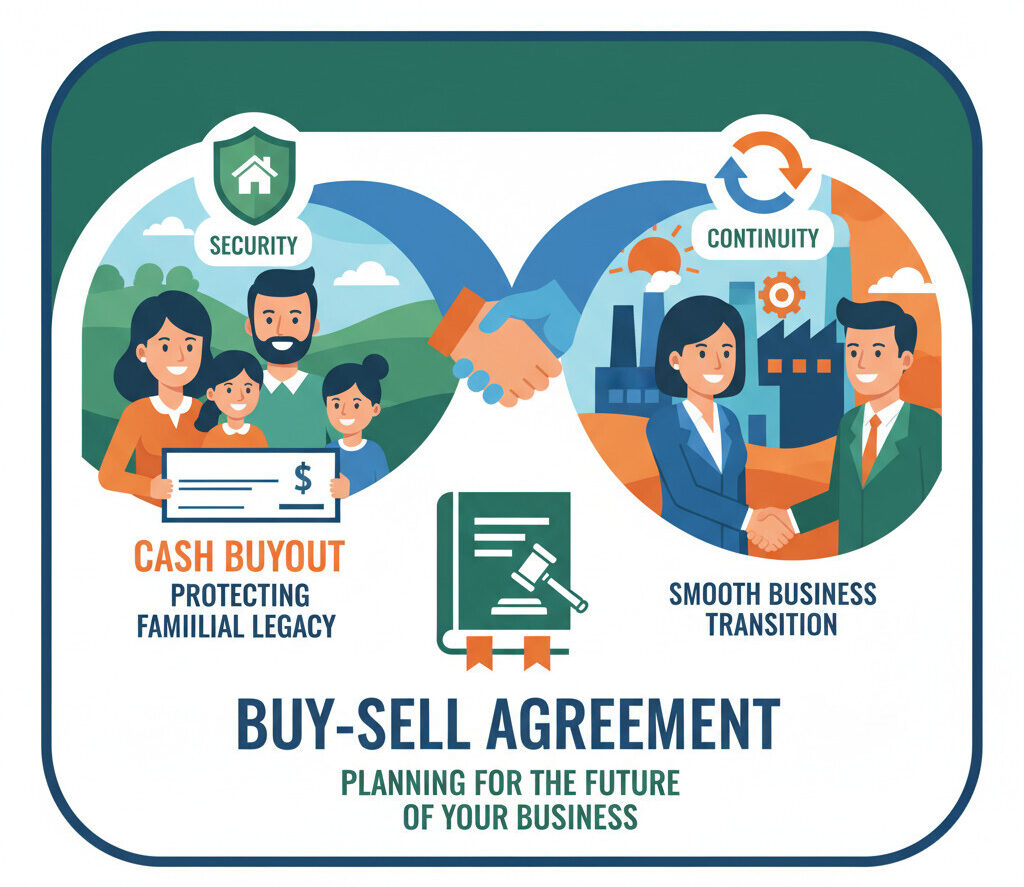
The solution to this whole dilemma is the Buy-Sell Agreement. I call it a “business pre-nup” because the analogy is spot on. It’s a plan you and your partners make during the good times, so you can navigate the difficult times smoothly and fairly.
At its core, a buy-sell agreement is a legally binding contract. It sets the rules of the game *ahead of time*. It clearly states what happens if a co-owner leaves, whether due to a specific “trigger event” like retirement, disability, or death.
This contract answers all the hard questions *before* they become emergencies:
- Who is allowed to buy a departing partner’s shares?
- What specific events (like death, disability, or retirement) will trigger a buyout?
- What is the exact price of the shares, or what formula will be used to determine the price?
Right here, this is the magic. You and your partners agree on the price, the terms, and the whole process while you’re all friends and on the same page. This is how you prevent those stressful last-minute negotiations, potential lawsuits, and protect your relationships when emotions and money could otherwise tear everything apart.
Funding the Future: Where Does the Buyout Money Come From? 💰
Okay, so signing an agreement is one thing. That’s the easy part. But having the actual cash on hand to make the buyout happen is a whole other story. This brings us to the most critical piece of the entire puzzle: funding the agreement.
This is the million-dollar question—sometimes literally. If Alex’s share of the business is valued at $1 million, does Ben just have that lying around in a bank account? Probably not, right? So how in the world do you make sure the money is there when it’s needed most, without crippling the very business you’re trying to save?
For so many businesses, the answer is surprisingly simple and just… elegant. It’s life insurance.
This is the financial engine that makes the whole buy-sell agreement actually *work*. It’s the mechanism that guarantees—and I mean *guarantees*—the funds will be available at the exact moment they are needed.
How the Insurance Solution Works (Step-by-Step) ⚙️
Let’s walk through the play-by-play. It’s a really clean, 5-step process:
- Step 1: Premiums
The owners or the company pay relatively small insurance premiums over time. This is a predictable, manageable operating expense. - Step 2: Trigger
A specified trigger event happens. Let’s say our partner Alex passes away unexpectedly. - Step 3: Payout
This is the magic part. The insurance policy pays out a lump-sum, and generally tax-free, death benefit. - Step 4: Buyout
That cash is immediately used to buy Alex’s shares from his family (his estate) at the price you *all already agreed on* years ago in the buy-sell agreement. - Step 5: Transfer
The transaction is complete. Alex’s family gets the full, fair value of his life’s work in liquid cash. Ben gets full control of the business.
The Result: A Perfect Win-Win 🏆
Look at that result! Ben gets to continue running the business without taking on massive debt or, even worse, being forced to partner with Alex’s family. And Alex’s family gets liquid cash—something they can use—instead of a complex, illiquid share in a small business they have no idea how to run. It’s a clean break and the perfect solution where everyone wins.
Two Paths to a Buyout: Cross-Purchase vs. Entity-Purchase 📊
Okay, we’ve got the “what” (the agreement) and the “how” (the funding). Now let’s quickly look at the two main ways you can structure these agreements. The best one for you really just depends on your company’s setup.
Comparison of Buy-Sell Agreement Structures
| Feature | Cross-Purchase Plan | Entity-Purchase Plan |
|---|---|---|
| Who buys the policy? | The partners buy policies on each other. (Ben buys a policy on Alex, Alex buys one on Ben). | The company (the “entity”) buys one policy on each partner. |
| Who gets the payout? | The surviving partner(s) get the payout directly to buy the shares. | The company gets the cash and uses it to buy back (or “redeem”) the shares. |
| Best for… | Fewer partners (2-3). It can offer some valuable tax benefits for the surviving partners. | More partners (4+). It’s much simpler to manage. Imagine 5 partners—a cross-purchase would require 20 policies! An entity plan only needs 5. |
The Real Payoff: Peace of Mind for Everyone 🧘
We’ve talked a lot about the mechanics—contracts, funding, structures. But honestly, that’s not the real story here. The real story is about what this whole thing prevents. It prevents the messy arguments, the fractured families, and the businesses that get destroyed overnight.
The real payoff is the peace of mind. When you have this in place, you’ve created a win for everyone:
- A Guaranteed Buyer: You have a buyer for your share of the business, at a fair price that you helped set.
- Business Continuity: Your business gets to keep going without a hitch, which protects your employees and your customers.
- Family Security: Your family gets the full financial value of your life’s work in clean, simple cash, and avoids awful fights over a company they can’t run anyway.
- Predictability: You are creating predictability in a future that is, by its very nature, completely uncertain. That alone is priceless.
A Quick Heads-Up: What to Consider ⚠️
Of course, look, this isn’t a silver bullet for every single situation. You’ve got to be realistic. There are a few key things to keep in mind.
- Ongoing Costs: You have to budget for the insurance premiums. It’s an expense, but one that pales in comparison to the cost of *not* having a plan.
- Valuation is Tricky: Setting a “fair valuation” for a buyout that might be decades away can be tough. You have to plan for growth or downturns and agree to update the valuation regularly.
- The “Key Person” Problem: If the business’s value is almost entirely tied to one person’s unique talent (like a solo consultant or artist), this model might not be the right fit. Without them, there’s not much left to sell.
Securing Your Legacy: Key Takeaways
Conclusion: Is Your Business Ready for Its Next Chapter? 📝
Ultimately, a buy-sell agreement is about protecting your legacy. It’s about having the tough, important conversations *now*—not during a crisis—to ensure the business you poured your life into continues to thrive and that your family is taken care of, no matter what happens.
So, I’ll just leave you with that one question: Is your business ready for its next chapter? If you have any questions or have your own story about this, feel free to ask in the comments~ 😊
Frequently Asked Questions ❓
- Set a fixed price (but you *must* update it annually).
- Use a formula (e.g., 5x average profits + assets).
- Agree to get a professional valuation from a third-party appraiser at the time of the trigger event.