U.S. Business Tax Credits A to Z
I’ve got a serious question for every business owner out there: are you *sure* you’re not overpaying on your taxes? It’s a scenario I see all the time—hard-working entrepreneurs focusing so much on generating revenue that they miss out on the massive financial rewards the government *wants* to give them. We’re talking about U.S. business tax credits, and they are so much more powerful than simple deductions. In the next few minutes, I’m going to show you exactly where this money is and how you can get your hands on it. 😊
What Are Business Tax Credits, Really? 🤔
Alright, let’s lay the foundation. What are these things? Simply put, business tax credits are the government’s way of saying, “Hey, we love that you’re doing this… please do more of it!” They are direct incentives to encourage specific business activities that benefit the economy, the environment, or society.
This isn’t some boring line item. A tax credit is a direct, dollar-for-dollar reduction of the income tax you owe. It’s pretty much the closest thing to the government handing you cash you’ll ever find in the tax code.
This is the single most important concept to get.
- A Tax Deduction (like for office supplies) just *lowers your taxable income*. If you’re in the 21% tax bracket, a $100 deduction saves you $21.
- A Tax Credit is a direct cash benefit. A $100 credit saves you $100. It wipes out your tax bill, dollar for dollar.
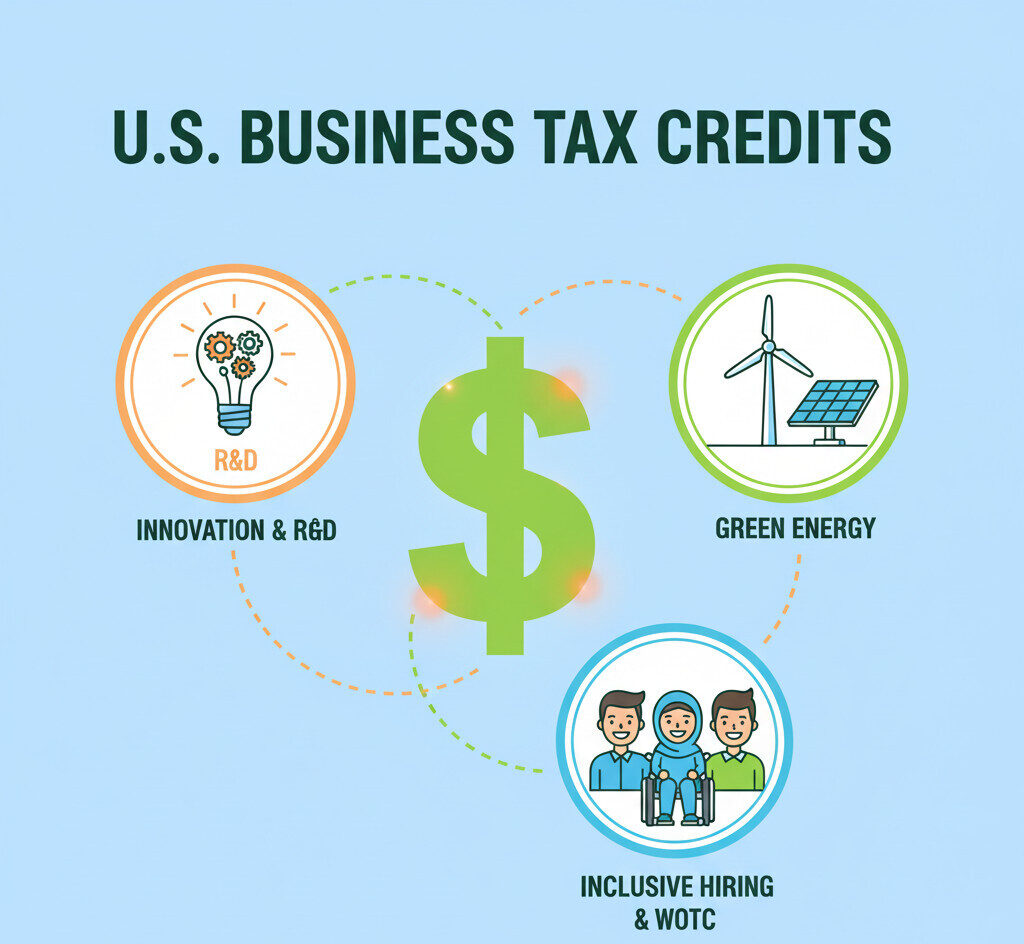
Think of the tax code as a map of the government’s priorities. By offering credits, they’re guiding businesses like yours to invest in key areas. The big three right now? Innovation (like R&D), Green Energy, and Inclusive Hiring. It’s a partnership where your smart business decisions can lead to some serious financial rewards.
Credits for Future Investment: Innovation & Green Energy 💡
Next up, let’s look at how the government rewards you for thinking long-term. These credits are all about encouraging businesses to invest in the future, especially when it comes to innovation and clean, sustainable energy.
You’ve probably heard of the Inflation Reduction Act (IRA). Honestly, it was a complete game-changer. It didn’t just tweak the rules; it massively expanded existing credits and poured a historic amount of money into clean energy and American manufacturing. This has opened up huge opportunities for all kinds of businesses.
Green Energy Credits: ITC vs. PTC
The IRA supercharged two main credits for businesses moving into the green space. This table boils it down:
| Credit | Full Name | What It’s For |
|---|---|---|
| ITC / AM-ITC | Investment Tax Credit | Rewards you for the “build-out”—the upfront cost of investing in renewable energy facilities and manufacturing equipment. |
| PTC / AM-PTC | Production Tax Credit | Rewards you for the “output”—the actual clean energy you produce or the clean energy components you manufacture. |
Oh, and that “AM” you see? That stands for Advanced Manufacturing. This is huge because it extends these powerful credits to the *entire supply chain*, not just the company at the very end. If you make components that go into solar panels or wind turbines, you could qualify.
Demystifying the R&D Tax Credit 🔬
Let’s shift gears to another powerful innovation tool: the Research & Development (R&D) Tax Credit. Right off the bat, I want to bust a huge myth: this is NOT just for tech giants or scientists in lab coats. The tax definition of R&D is way, way broader than you’d probably think.
Here’s a perfect real-world example: trying to develop a cell phone case that better absorbs shock. That involves trying different materials, fiddling with the design, and testing prototypes. That’s a process of experimentation to eliminate technical uncertainty, and it can absolutely qualify for the R&D credit.
The R&D Four-Part Test
To qualify, your project basically has to pass this four-part test:
- Permitted Purpose: You must be trying to create a new or improved product, process, or software.
- Eliminate Uncertainty: You have to be trying to resolve a *technical* uncertainty. If you already know exactly how it’s going to turn out, it’s not R&D.
- Process of Experimentation: You must use a systematic process of evaluation—like modeling, simulation, or building and testing prototypes.
- Technological in Nature: Your work must rely on the principles of hard sciences, like engineering, physics, computer science, or biology.
So many everyday activities—like developing new software, improving a manufacturing process, or even testing new recipes for a food product—can fall under this umbrella. Don’t assume you don’t qualify!
Credits for Your Team: The WOTC Program 👩💼👨💻
Now let’s talk about getting rewarded for *who* you hire. The Work Opportunity Tax Credit (WOTC) is a fantastic federal program that gives businesses an incentive to hire people from specific groups who have faced significant barriers to employment.
The program is really focused on bringing certain people into the workforce. We’re talking about:
- Military veterans (especially those receiving SNAP/food stamps or with service-connected disabilities)
- Individuals who were formerly incarcerated
- Recipients of certain types of government assistance (like SNAP or TANF)
- Residents of specific, economically challenged areas (like Empowerment Zones or Rural Renewal Counties)
- Individuals with disabilities receiving vocational rehabilitation
The money here is no joke. You can claim a tax credit of up to $9,600 per eligible employee you hire. And the best part? The WOTC program was just extended and is fully active through the end of 2025. This is a very real, very valuable tool for any business that’s hiring right now.
CRITICAL UPDATE: What Changed with ERC & R&D ⚠️
Okay, I need everyone to lean in for this next section. Seriously. The landscape for two of the biggest tax programs has changed dramatically. What was true a year or two ago is NOT true today, and you absolutely have to know the difference.
The ERC (Employee Retention Credit): The Door is Closed
You’ll remember the ERC. This thing was an absolute lifeline for so many businesses during the pandemic, rewarding them for keeping people on payroll. For a while, it was one of the most generous credits you could find, and “ERC mill” companies popped up everywhere telling you to apply.
Here’s the hard reality: The old advice to “hurry up and apply” is now dangerously outdated. On September 14, 2023, the IRS halted processing all new ERC claims. Why? They were hit with a tidal wave of fraudulent applications from aggressive promoters. To protect taxpayers, they slammed on the brakes.
The takeaway is simple: If you haven’t already applied for the ERC, you’ve missed the boat. The door is closed for new applications, and the IRS is now focusing on processing the backlog and auditing questionable claims.
The R&D *Expense Deduction*: Amazing News!
After that bit of bad news, let me pivot to some incredibly good news that affects a lot of the same innovative businesses. This is *not* about the R&D *credit* we just discussed, but about how you *deduct* your R&D expenses.
There was a very unpopular rule that started in 2022 which forced companies to spread out (amortize) their R&D expense deductions over five long years. It was a major headache and terrible for cash flow. Well, after a lot of lobbying… the 100% immediate deduction is back!
New legislation didn’t just fix this going forward; it made the 100% immediate deduction retroactive to 2022 and 2023. This means you can (and absolutely should) talk to your tax professional about amending your past tax returns. You could potentially get a significant refund from the taxes you paid in those years. This is a huge win!
Don’t Forget State & Local Credits! 🗺️
While all the federal credits get the big headlines, please don’t make the mistake of ignoring what’s happening in your own backyard. Many states offer their own really robust incentives that can be just as valuable.
For example, Georgia has a powerful job creation credit. Alabama gives you incentives for major capital investments. Texas has its own state-level R&D credit and enterprise zone programs. The best part? You can often “stack” a state credit right on top of a federal one, turning a pretty good deal into an absolute no-brainer.
Conclusion: Your Tax Credit Action Plan 📝
Phew, that was a lot of information! But I hope this guide helps you see that tax credits aren’t just about saving money. They’re a map, showing you the government’s economic priorities. When you align your business strategy with them, you can fuel your own growth while helping to achieve some bigger goals.
So, here’s your final action plan. Your checklist to take away from this post:
- Assess Your Innovation: Look hard at the Green Energy (IRA) credits if you’re in manufacturing or energy, and the R&D Credit for any process or product improvement.
- Review Your Hiring: Talk to your HR team or recruiters about the WOTC Program. Are you actively seeking out and screening for these eligible individuals?
- Forget New ERC: Acknowledge that the Employee Retention Credit door is closed for new applications and be wary of any promoter who tells you otherwise.
- Call Your CPA (Now!): This is the most urgent one. Ask them *immediately* about the retroactive R&D expense deduction. You may be owed a refund for 2022 and 2023.
- Go Local: Start an investigation into your specific state and local tax credits. You might be surprised at what you find.
U.S. Business Tax Credits
Frequently Asked Questions ❓
The only question left is… where is the map guiding your strategy? If you have any more questions about your own situation, drop them in the comments below. Let’s start a conversation! 😊