
8 Common LLC Mistakes (And How to Fix Them Before It’s Too Late)
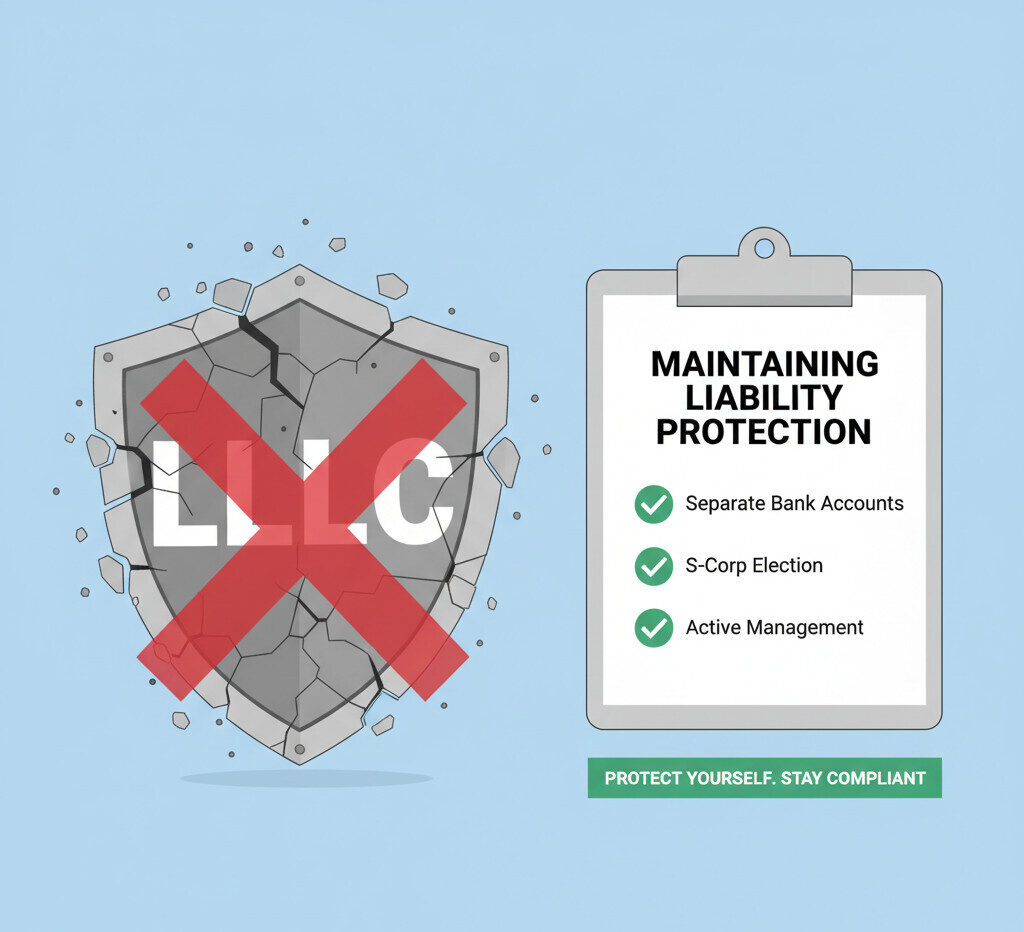
So, you did it! You went through all the trouble of forming a Limited Liability Company (LLC) for your business. You feel that sense of security, right? Like you’ve built this bulletproof shield around your personal assets—your house, your car, your savings. But here’s the thing… what if that shield is full of cracks?
It’s a scary thought, but a few simple, surprisingly common slip-ups can shatter that shield, leaving you totally exposed when you need it most. We’ve dug into the expert advice and boiled it down to the essentials. Let’s break down the 8 most dangerous mistakes so you can make sure your LLC is actually doing its job. 😊
Part 1: Fatal Early Setup Mistakes 🤔
The first set of mistakes happens right at the beginning, during formation. These foundational errors can sabotage your LLC before you’ve even made your first dollar. Getting these right is critical.
Mistake 1: Defaulting to “Member-Managed” Without Thinking
When you file your LLC, you’ll be asked if it’s “Member-Managed” or “Manager-Managed.” Most people, especially solo owners, just check “Member-Managed” and move on. This can be a mistake for two big reasons: privacy and speed.
- Privacy: In a “Member-Managed” LLC, the names of all members (the owners) are often listed on the public record. In a “Manager-Managed” LLC, only the manager’s name goes on the public record. This means you can appoint a manager (which can even be you, or a separate entity) and keep the actual owners’ names private. This is a huge layer of asset protection.
- Speed: If you have multiple members, being “Member-Managed” can mean you need a vote for every little decision. A “Manager-Managed” structure allows one person to make quick decisions, keeping the business nimble.
Mistake 2: Falling for the “Incorporate in Delaware” Myth
You’ve probably heard it, right? “Oh, you *have* to incorporate in Delaware or Nevada! It’s better for business!” Let’s be real: for most small businesses, this is just terrible advice that creates a ton of headaches and extra fees.
Here’s the bottom line: unless you’re a massive corporation trying to get huge venture capital funding, you are still going to have to register your business in the state where you *actually work*. This is called “foreign qualification.”
So, if you form in Delaware but live and work in Texas, you now have to:
- Pay filing fees in Delaware.
- Pay filing fees in Texas (as a “foreign LLC”).
- Pay annual report fees in Delaware.
- Pay annual report fees/franchise tax in Texas.
You’ve just doubled your paperwork and your annual costs for virtually no benefit. Just keep it simple and form your LLC in the state where you operate.
Mistake 3: Ignoring the S-Corp Tax Election
This one is huge, especially if your business is actually making good money. By default, a single-member LLC is taxed as a “disregarded entity” (just like a sole proprietorship) and a multi-member LLC is taxed as a partnership. This is fine, but it means you’re paying one particularly nasty tax on *all* your profits.
As a standard LLC owner, every single dollar of profit your business makes (not just what you pay yourself) gets hit with the 15.3% self-employment tax for Social Security and Medicare. This is on top of your regular federal and state income taxes.
An S-Corporation (S-Corp) is not a business structure, but a *tax election*. You can keep your LLC, but file a form with the IRS to be taxed *like* an S-Corp. Here’s the game-changing difference:
- You must pay yourself a “reasonable salary” as an employee (W-2). You pay the 15.3% tax (split between you and the company) only on this salary.
- Any other profits you take out of the business are called “distributions,” and these are NOT subject to the 15.3% self-employment tax.
LLC vs. S-Corp Tax Comparison
| Feature | Standard LLC (Default) | LLC taxed as S-Corp |
|---|---|---|
| Pass-Through Taxation | ✅ Yes | ✅ Yes |
| Self-Employment Tax (15.3%) | Paid on ALL profits | Paid only on salary |
| Owner Salary Required | ❌ No (Owners take “draws”) | ✅ Yes (Must be “reasonable”) |
Let’s put that in real numbers. If your business clears $100,000 in profit:
- As a standard LLC: You pay 15.3% on the full $100k. That’s $15,300 in self-employment tax.
- As an S-Corp: You pay yourself a $50,000 salary. You pay 15.3% on that $50k ($7,650). The other $50,000 in profit you take as a distribution is NOT subject to that tax. You just saved yourself over $7,600.
The rule of thumb is simple: if you’re netting over $40,000 – $50,000 a year, you need to be talking to your accountant about an S-Corp election yesterday.
Part 2: Dangerous Day-to-Day Operational Habits 📉
Okay, so let’s say you got the setup perfect. You’re safe now, right? Not so fast. Even with a perfect start, the wrong daily habits can make all that initial work totally worthless. How you *run* your LLC is just as important as how you *formed* it.
Mistake 4: The “Set It and Forget It” Mentality
This is so common. People think the LLC is a magic shield they can just put up and walk away from. No! You have to *constantly* prove with good records that you are running a real, legitimate business that is separate from you, the person.
When things go wrong and you end up in court, the other side’s lawyer will try to do one thing: prove your LLC is a sham. This leads to the most terrifying concept in business law…
“Piercing the corporate veil” is a legal term that is as scary as it sounds. It’s when a court decides that your LLC is just a “sham” or an “alter ego” for you personally. They disregard the LLC’s status, and suddenly, you are personally liable for the company’s debts. That business lawsuit is now *your* lawsuit, and your house, car, and personal savings are all on the table.
So, how do you protect your veil? You must actively manage your LLC.
- 1. Follow the Rules: Adhere to the rules you set in your own Operating Agreement.
- 2. Document Everything: Keep meticulous records of big decisions, meetings (even with yourself!), and major purchases. Create resolutions.
- 3. Separate Funds: This is the big one, which we’ll cover next. Never, ever mix personal and business finances.
Mistake 5: Using Generic, “Fill-in-the-Blank” Documents
I get it, those online services are cheap and easy. But using a generic, one-size-fits-all Operating Agreement is so risky. A real estate business needs totally different protections and rules than a consulting business or a manufacturing plant.
Your legal documents, especially your Operating Agreement, are the core rulebook for your company. If that rulebook is generic and doesn’t reflect how you *actually* run your business, it’s another piece of evidence for a lawyer to argue that your LLC isn’t a legitimate, separate entity.
Mistake 6: Commingling Funds (The Cardinal Sin! ☠️)
Honestly, this is it. This is the cardinal sin of running an LLC. Commingling funds means mixing your business and personal money. If a lawyer ever wants to pierce your corporate veil, this is the very first place they’re going to look, because it’s the easiest way to prove you’re not treating the company like a real business, but more like your personal piggy bank.
Think of your business and personal finances as a big, bright, uncrossable line.
- ❌ DON’T pay your personal rent or mortgage from the business account.
- ❌ DON’T buy groceries or coffee with the business debit card.
- ❌ DON’T pay for business inventory with your personal credit card.
Part 3: Flawed Asset Protection Beliefs 🛡️
The final category of mistakes comes from a fundamental misunderstanding of what an LLC is even for, and what its limitations are.
Mistake 7: Creating a Separate LLC for Every Single Asset
You see this all the time, especially with real estate investors. They get this idea to create a separate LLC for every single rental property they own. The idea—to separate the risk from each property—is good in theory. But in practice, it just creates an insane mountain of paperwork, filing fees, and administrative headaches.
For many investors, a better (and simpler) strategy might be to group properties into a few logical LLCs (a “series LLC” if your state allows it) and then get good insurance policies to cover the rest of the risk. Don’t drown yourself in paperwork for a level of protection that might be marginal at best.
Mistake 8: Misunderstanding What an LLC *Can’t* Do
An LLC is a powerful tool, but it is not a magical force field. It’s designed to protect your *personal* assets from *business* debts and liabilities (and vice-versa). It is NOT designed to protect you from your *own* professional negligence.
If you are a doctor, a lawyer, an accountant, or another licensed professional, your LLC will not protect you from a malpractice lawsuit. If *you* personally mess up and cause harm, you are personally liable. That’s where you need things like professional liability insurance (aka “Errors & Omissions” insurance) and perhaps more specialized trusts.
Conclusion: Your LLC is a Tool, Not Magic 📝
We’ve been through a lot—setup mistakes, daily habits, and big-picture strategy. When you boil it all down, what’s the one thing you absolutely have to remember?
It’s this: The piece of paper you get from the state doesn’t protect you. It’s the disciplined, consistent way you run your business every single day that does. As attorney John Chung said, becoming complacent is the same as having no LLC at all.
An LLC is an incredible tool, but only if you use it right. Treat it like a real, separate business, and it will protect you. Treat it like a personal piggy bank or a “set it and forget it” magic shield, and it will fail you when you need it most.
8 Common LLC Mistakes: Key Summary
Frequently Asked Questions ❓
What’s the one habit you can improve *today* to strengthen your LLC’s shield? If you have any more questions, feel free to ask in the comments~ 😊