Construction Revenue Recognition: PCM vs CCM Methods Explained
If you run a construction business, your financial statements tell a story — but are they telling it accurately, and at the right time? Construction revenue recognition methods are among the most consequential accounting decisions a contractor makes, shaping everything from tax liability to how lenders and bonding companies assess your financial health. The wrong choice (or an inconsistent application) can trigger compliance issues, distort your bonding capacity, and create costly tax-time surprises.
At SW Accounting & Consulting Corp, we work with contractors, subcontractors, and developers on revenue recognition, look-back interest, and bonding-optimized financial statements. This guide walks through PCM and CCM, the measurement approaches, when each is required or available, and the practical trade-offs we see in real contractor engagements.
Why is revenue recognition different for construction contractors? 🏗
Construction projects span multiple fiscal years, costs fluctuate as work progresses, and ultimate profitability often isn’t clear until completion — so contractors can’t simply recognize revenue at the point of sale like most businesses.
Most businesses recognize revenue when they sell a product or deliver a service. Construction is different: a single project can stretch across two, three, or more tax years. That makes the recognition method critical — not just for accuracy, but for compliance, tax timing, and lender/surety relationships. Both the IRS (under IRC § 460 for long-term contracts) and GAAP (under ASC 606 and the construction-specific guidance) impose specific rules that depend largely on company size and contract type.
How does the percentage of completion method (PCM) work? 📊
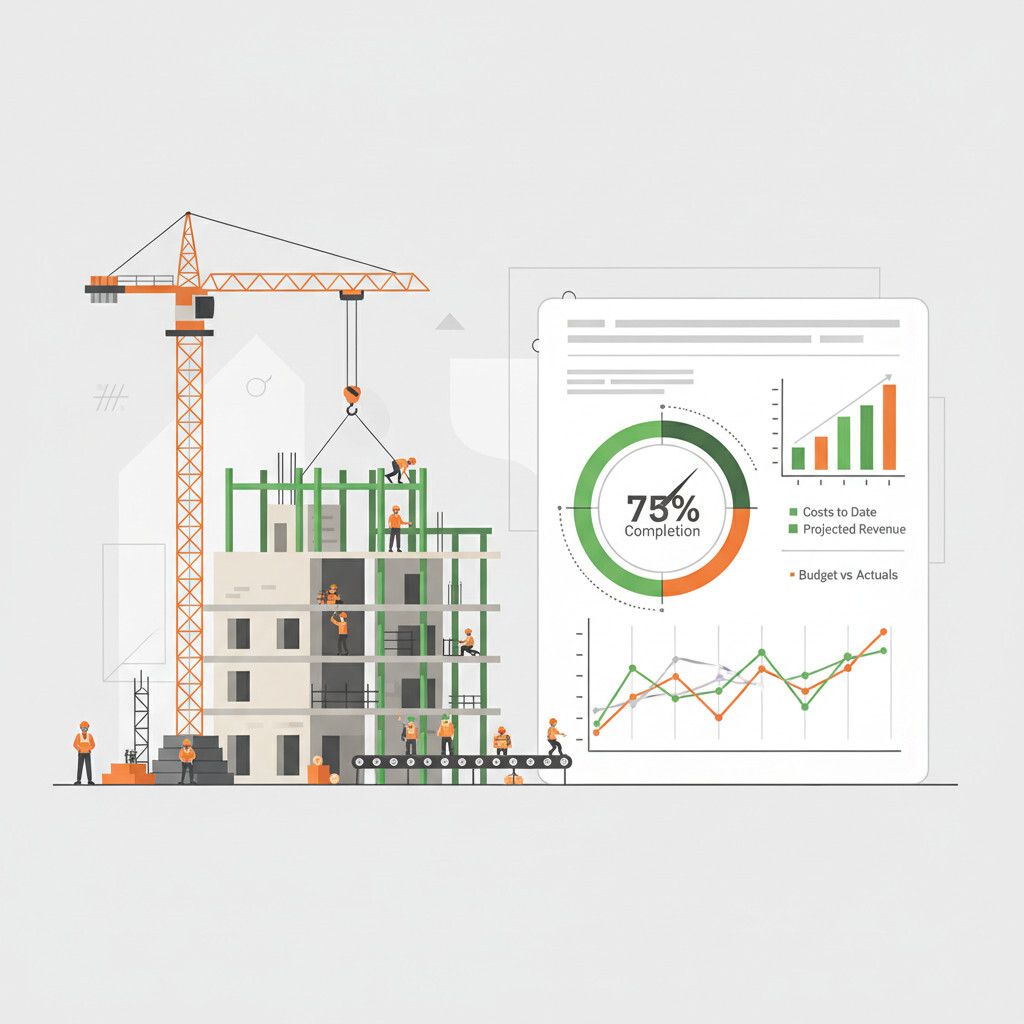
Under PCM, you recognize revenue and expenses proportionally as work on a project advances — measuring progress and booking a corresponding share of the contract’s revenue and profit each period.
There are three common ways to measure how far along a project is:
| Measurement Method | How It Works |
|---|---|
| Cost-to-cost | Actual costs incurred to date ÷ total estimated costs. Most widely used; accepted under GAAP and tax. |
| Efforts-expended | Measures labor hours, machine hours, or similar inputs to gauge progress. |
| Units-of-delivery | Tracks physical milestones (floors completed, miles of pipe installed). |
Whichever measure you use, consistency matters. Switching methods mid-project or between similar contracts creates compliance issues and distorts your financial picture.
When is PCM required? ⚖
For tax purposes, PCM is mandatory for long-term contracts held by companies with average annual gross receipts above $30 million (indexed for inflation). It is also the GAAP standard for most construction contracts.
If your company is in that revenue tier or produces audited financial statements, PCM is almost certainly your required method. The $30 million threshold is measured on a three-prior-year average and indexed annually, so contractors near the line should re-test each year.
PCM advantages:
- Smoother income recognition — revenue spread across periods, reducing swings in reported income.
- More useful financial statements — lenders and bonding companies prefer PCM financials because they reflect ongoing project economics.
- Earlier profit recognition — when projects go well, gains are recognized as work progresses, not deferred to completion.
PCM’s biggest operational risk: if your projected total costs are off, your revenue recognition is off — and those errors compound over the life of the contract. In our practice, the most common PCM problems we see come from optimistic cost estimates early in a job, followed by painful “catch-up” adjustments in later periods when reality sets in. Projects with frequent change orders or hard-to-measure milestones are especially vulnerable. Rigorous, regularly-updated cost estimating isn’t optional under PCM — it’s the foundation of accurate financials.
How does the completed contract method (CCM) work? 🔨
Under CCM, all revenue and expenses for a project are deferred until the contract is substantially complete — you recognize no income or losses from a job until you can close it out.
When CCM is available: The IRS limits CCM to specific situations:
- Small contractors — average annual gross receipts of $30 million or less (measured over the prior three tax years).
- Home construction contracts — qualify regardless of contractor size.
For eligible contractors, CCM can be a legitimate tax-planning tool — deferring income recognition (and tax) until the job closes. But there’s a critical caveat: CCM is not GAAP-compliant for most construction contracts. Companies that require audited financial statements generally cannot use CCM for financial reporting, even if they use it for tax reporting.
PCM vs CCM — which should your construction company use? 🤔
| Factor | PCM | CCM |
|---|---|---|
| Revenue timing | As work progresses | At substantial completion |
| GAAP-compliant? | Yes (standard) | No (most contracts) |
| Tax deferral benefit | Limited | Strong (defers income) |
| Bonding/lender preference | Preferred | Less useful |
| Available to whom | Required if >$30M / audited | ≤$30M or home construction |
The single most common dilemma we resolve for small-to-mid contractors: CCM minimizes current taxes, but bonding companies and lenders want PCM financials to assess your real-time job profitability and working capital. Many growing contractors run a dual system — CCM for tax (where eligible) and PCM-based “percentage of completion” work-in-progress (WIP) schedules for bonding and management. The WIP schedule becomes your most important internal financial document. If you’re chasing larger bonded jobs, expect your surety to require PCM-quality reporting regardless of your tax method.
What other construction accounting issues should contractors watch? 🔍
- Look-back interest (IRC § 460(b)(2)). PCM contractors must perform a look-back calculation at contract completion — comparing estimated vs. actual profit and computing interest owed to (or from) the IRS on the timing difference. This is frequently overlooked and can generate IRS notices.
- AMT considerations. Even CCM-eligible small contractors may face PCM-based adjustments for Alternative Minimum Tax purposes on certain long-term contracts.
- Change in accounting method. Switching between PCM and CCM (or between measurement methods) generally requires IRS consent via Form 3115. Don’t switch unilaterally.
- WIP schedule discipline. Whether for PCM financials or internal management, an accurate work-in-progress schedule (costs to date, estimated costs to complete, billings vs. earned revenue) is the backbone of construction accounting.
- Over/under billings. Track costs and estimated earnings in excess of billings (an asset) and billings in excess of costs (a liability). These are scrutinized by sureties and lenders.
Frequently Asked Questions 🗂
For the IRS rules on long-term contracts and PCM, see IRC § 460 guidance on IRS.gov and the instructions for Form 3115 (Change in Accounting Method). GAAP revenue recognition for construction follows FASB ASC 606.
Need help selecting a revenue recognition method, building a bonding-ready WIP schedule, computing look-back interest, or filing Form 3115? SW Accounting & Consulting Corp’s construction accounting team works with contractors and developers — book a consultation.