Charitable Donation Records 2026: IRS Rules to Know
Most taxpayers give more than they realize during the year — a check to a church, a Venmo to a food bank, a bag of clothes to Goodwill. When April arrives, the giving is easy to remember but the charitable donation records are usually not. That is when a real deduction quietly disappears, because the IRS will not accept “I know I gave” as proof.
At SW Accounting & Consulting Corp, we prepare individual returns for Los Angeles taxpayers every filing season and see this happen every year. The rules are not complicated once you know them, and 2026 brings a new opportunity for households that take the standard deduction. Here is exactly what the IRS expects, what changed under the One Big Beautiful Bill Act (OBBBA, P.L. 119-21), and a simple record-keeping habit you can start today.
Who can actually deduct a charitable donation in 2026? ❤️
Two groups can claim charitable donation records as a deduction: itemizers using Schedule A, and — new for 2026 — non-itemizers claiming a limited above-the-line cash deduction under OBBBA.
For years, only itemizers benefited from charitable contributions. If you took the standard deduction, your generosity had no federal tax value. That changes for tax years beginning after December 31, 2025. Under Section 70424 of the OBBBA, individuals who do not itemize may deduct up to $1,000 in qualified cash contributions (or $2,000 for a married couple filing jointly) directly against their adjusted gross income. Itemizers continue to claim contributions on Schedule A (Form 1040), subject to the usual percentage-of-AGI limits.
This is a meaningful shift. A retired couple who gives $1,500 a year to their local food bank and has never itemized will now get a real tax benefit for the first time — if they can substantiate it.
What charitable donation records does the IRS require for cash gifts? 🧾
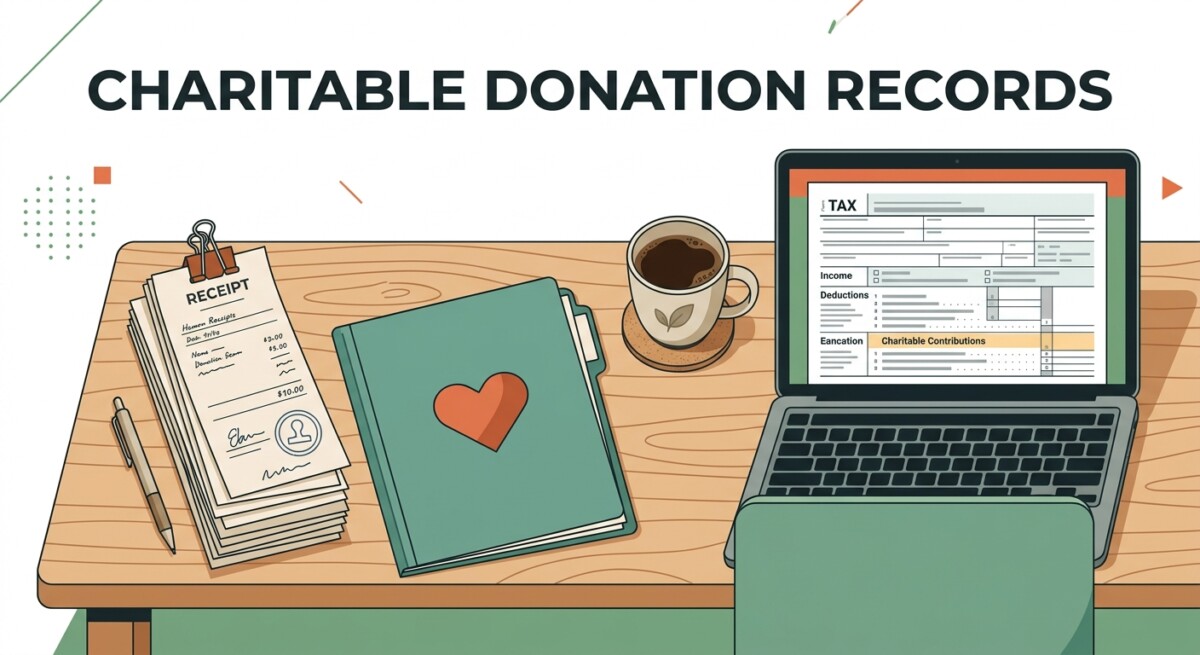
Every cash gift needs either a bank record or a written communication from the charity — no exceptions, no matter how small.
The IRS is direct about this in Publication 526: for a cash, check, or other monetary gift to be deductible, you must keep either a bank record (a cancelled check, a bank statement showing the payment, or a credit card statement) or a written communication from the recipient showing the organization’s name, the date, and the amount. A canceled Venmo, Zelle, or PayPal transaction to the charity’s verified account counts as a bank record if the statement shows the charity’s name.
For a single contribution of $250 or more, the bank record alone is not enough. You must also obtain a contemporaneous written acknowledgment from the charity before you file the return (or, if earlier, before the return’s due date including extensions). The acknowledgment must state the amount and whether the organization provided any goods or services in exchange, and if so, describe them and provide a good-faith estimate of their value.
How do I document noncash donations and Form 8283? 📦
Noncash gifts need a description and fair market value; anything over $500 requires Form 8283, and anything over $5,000 generally requires a qualified appraisal.
Whether you drop off clothing at a thrift store or donate a used vehicle, the IRS wants to see a record of what you gave, its condition, how you valued it, and when. The thresholds stack:
- Under $250: a receipt from the charity showing its name, the date, and a description of the property (the charity does not need to value it — that is on you).
- $250 or more: a contemporaneous written acknowledgment, same substantiation rule as cash.
- Over $500: file Form 8283, Noncash Charitable Contributions, Section A with the return.
- Over $5,000 (per item or group of similar items): Form 8283 Section B, signed by the donee organization, plus a qualified appraisal. Publicly traded stock is one of the few exceptions.
The valuation rules themselves live in Publication 561, Determining the Value of Donated Property. Read it before you claim a high-value item; the IRS scrutinizes noncash valuations closely, especially artwork, collectibles, and vehicles.
How do I know if a charity is actually qualified? ✅
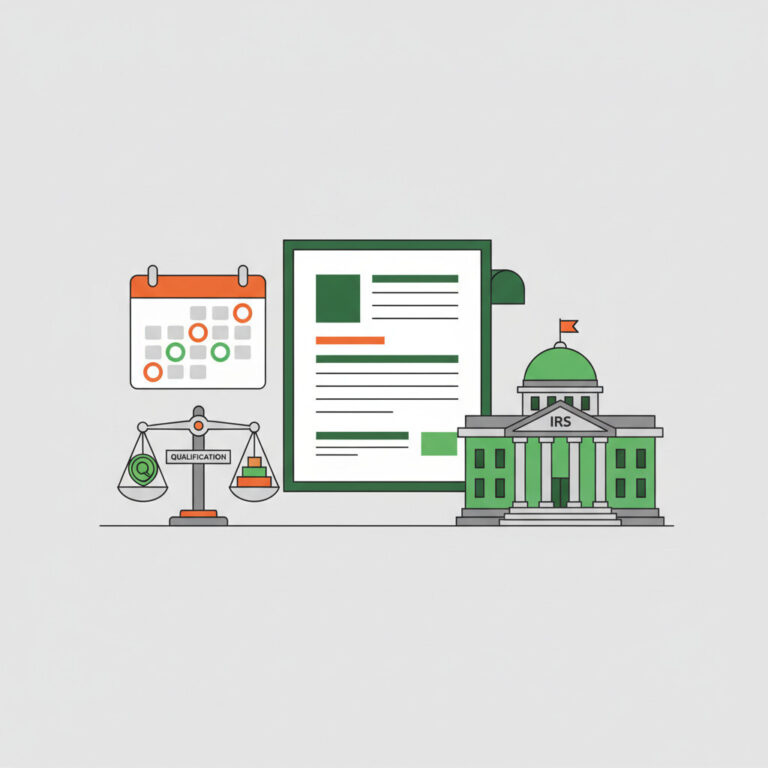
Use the IRS’s Tax Exempt Organization Search tool — donations to individuals or unrecognized groups are never deductible, no matter how good the cause.
A GoFundMe for a neighbor’s medical bills is generous. It is also not a tax-deductible contribution — because the recipient is an individual, not a qualified 501(c)(3) organization. The same is true for many crowdfunding pages, foreign charities, political campaigns, and homeowner associations. Before you claim the deduction, verify the organization at the IRS Tax Exempt Organization Search. It takes about ten seconds, and it is the only source that reflects real-time revocations. Certain churches, synagogues, temples, and mosques may be qualified even without appearing in the tool — but if you have any doubt, ask the organization for its determination letter.
Charitable donation records at a glance 📊
| Gift type & amount | What the IRS requires | Where it goes |
|---|---|---|
| Cash under $250 | Bank record OR written communication from the charity | Schedule A (itemizers) or new AGI deduction (non-itemizers) |
| Cash $250 or more | Bank record + contemporaneous written acknowledgment | Schedule A or new AGI deduction (cash only) |
| Noncash under $250 | Receipt describing the property + your FMV records | Schedule A |
| Noncash over $500 | Form 8283 Section A with the return | Schedule A + Form 8283 |
| Noncash over $5,000 | Form 8283 Section B + qualified appraisal (see Pub. 561) | Schedule A + Form 8283 Section B |
📌 Key Takeaways
- Beginning in 2026, non-itemizers can deduct up to $1,000 ($2,000 MFJ) in cash gifts.
- Every cash gift needs a bank record or written communication from the charity.
- Any single gift of $250 or more needs a contemporaneous written acknowledgment.
- Noncash gifts over $500 require Form 8283; over $5,000 generally requires a qualified appraisal.
- Verify the organization at the IRS Tax Exempt Organization Search before you give.
Frequently Asked Questions ❓
Q. Can I deduct charitable donations if I take the standard deduction in 2026?
Yes, for the first time in years. Under the OBBBA, non-itemizers may deduct up to $1,000 in qualified cash contributions ($2,000 for married filing jointly) beginning with tax years after December 31, 2025. The deduction applies only to cash gifts to qualified organizations — not to noncash donations or contributions to donor-advised funds.
Q. What counts as a “bank record” for a charitable donation?
A cancelled check, a bank or credit-union statement showing the payment to the charity, or a credit card statement identifying the charity. Digital-wallet statements (Venmo, Zelle, PayPal) work if the charity’s name appears; a plain screenshot of a payment confirmation generally does not.
Q. Do I need a written acknowledgment for every donation?
Only for single contributions of $250 or more (cash or property). Under that threshold, a bank record or basic receipt is enough, though a written acknowledgment is still helpful if you are ever asked to substantiate.
Q. Are donations to individuals or GoFundMe campaigns deductible?
No. Gifts to individuals — no matter how sympathetic the cause — are never tax-deductible. Only contributions to organizations recognized by the IRS as qualified charities are deductible. Verify the recipient using the IRS Tax Exempt Organization Search before claiming the deduction.
Q. What if the charity never sends me a written acknowledgment?
Request one before you file. The acknowledgment must be contemporaneous, meaning received by the earlier of the date you file or the due date (including extensions). A letter obtained after that point will not save the deduction if the IRS challenges it.
Q. How do I value donated clothing and household items?
Fair market value — generally what a willing buyer would pay a willing seller. Clothing and household items must also be in at least good used condition. IRS Publication 561 walks through valuation for most common categories, and Form 8283 is required if the total exceeds $500.
Charitable giving is one of the few areas where the paperwork is easier than the giving itself — provided you keep the records in real time. If you would like help setting up a clean substantiation system before year-end, or want to model the new above-the-line deduction against itemizing, contact SW Accounting & Consulting Corp. Primary sources: IRS Publication 526, Publication 561, Form 8283, the IRS Tax Exempt Organization Search, and the One Big Beautiful Bill Act (P.L. 119-21).