Do I need to report my Korean bank accounts on FBAR? (Toss & KakaoBank)
If you carry a U.S. passport or a green card, your FBAR Korean accounts question is not really about your Korean bank — it is about a U.S. Treasury filing that has nothing to do with the IRS deposit slip you drop off in April. Every year we see Korean-American clients discover the rule after their first big transfer home, after a Kookmin CD matures, or after the kids’ 세뱃돈 quietly grows in a KakaoBank sub-account they forgot about. The penalties are severe, but the filing itself is a free online form. This guide walks through the 2026 rules using only IRS and FinCEN sources.
Do Toss and KakaoBank accounts trigger FBAR reporting?
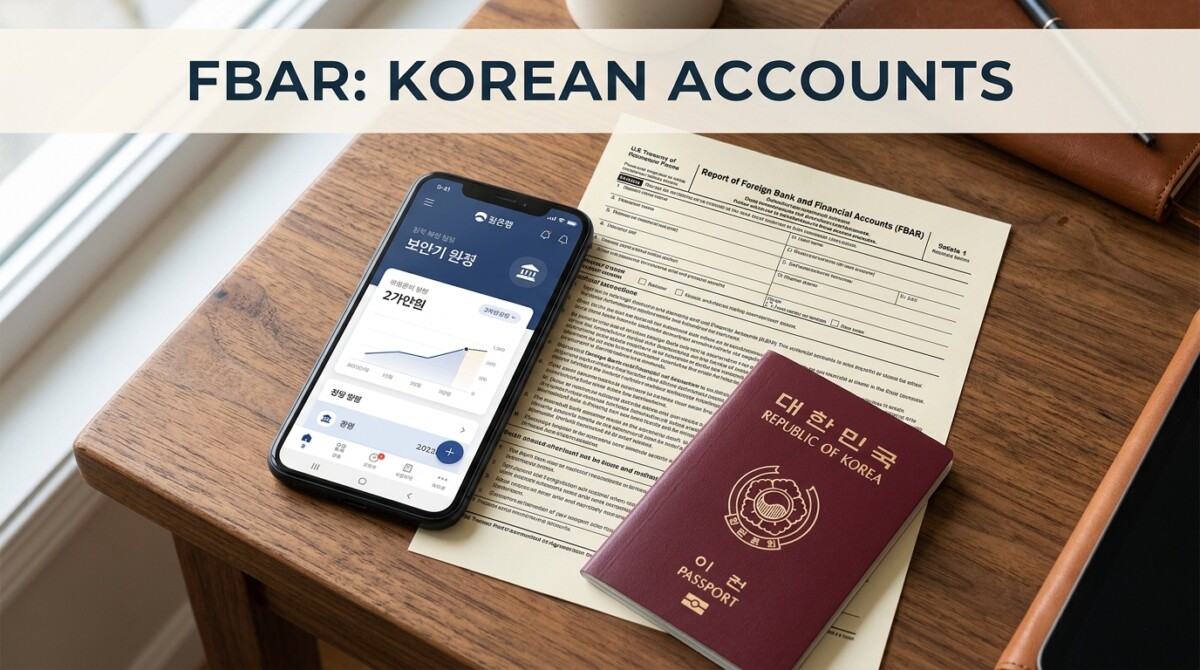
Yes. Both are financial institutions located outside the United States, so a U.S. person’s accounts at Toss Bank or KakaoBank count toward the FBAR $10,000 threshold in exactly the same way as a traditional Korean bank account.
The IRS is unambiguous: “An account at a financial institution located outside the United States is a foreign financial account.” Toss Bank (토스뱅크) and KakaoBank (카카오뱅크) are chartered internet-only banks supervised by the Korean Financial Services Commission, and Toss Securities is a licensed broker-dealer. Whether the app looks like a fintech wallet on your phone does not change the answer — what matters is that the deposits sit at a Korean-licensed institution, which makes them FBAR Korean accounts for U.S. reporting purposes.
Two common misconceptions:
- “It is just a phone app, not a real bank.” Toss Bank and KakaoBank are Bank of Korea-registered commercial banks. A digital-only license is still a banking license.
- “I only used it briefly.” The FBAR threshold is measured at any time during the year. A one-day balance is enough — even if you closed the account before December 31.
What is the FBAR filing threshold and who counts as a U.S. person?
A U.S. person must file FBAR when the aggregate value of all foreign financial accounts exceeds $10,000 at any time during the calendar year. “U.S. person” includes citizens, green-card holders, and U.S. tax residents under the substantial presence test.
Per IRS guidance on FBAR filing: “A U.S. person, including a citizen, resident, corporation, partnership, limited liability company, trust and estate, must file an FBAR to report… foreign financial accounts… if the aggregate value… exceeded $10,000 at any time during the calendar year reported.” There is no married-vs-single split at the $10,000 line, and no separate threshold for people living overseas — the number is the same whether you live in Los Angeles or Seongnam.
How to test the threshold. Pull the highest balance each account reached during the year (in KRW), convert each to USD using the Treasury year-end exchange rate for that currency, and add them up. If the total ever crossed $10,000 — even for a day — every account must be reported, including the ones that stayed at zero.
Expert insight — the “aggregate” trap
In our practice we see clients cross the threshold because of the combined total, not because any single account was large. A ₩8 million Kookmin main account, a ₩4 million Toss savings pocket, a ₩1 million KakaoBank card float, and a small Korean brokerage together clear $10,000 easily at 2026 exchange rates. Once you cross, every foreign account gets reported for that year — including the modest ones that would have been exempt on their own.
Which Korean accounts count, and which are excluded?
Deposit accounts, savings accounts, checking, CDs, brokerage accounts, and mutual fund positions at a Korean institution are all reportable. Certain U.S.-recognized retirement accounts and governmental accounts are excluded — but Korean pension and insurance products often are not.
The IRS lists “bank accounts, brokerage accounts and mutual funds” as reportable and excludes “IRAs, retirement plans where filer is participant/beneficiary,” U.S. military banking facilities, correspondent accounts, and certain governmental and international-financial-institution accounts. For a Korean-American reader that translates roughly as follows:
| Korean account type | FBAR reportable? | Notes |
|---|---|---|
| 보통예금 / 저축예금 (checking & savings) | Yes | Kookmin, Shinhan, Woori, KEB Hana, Toss Bank, KakaoBank all count. |
| 정기예금 / 적금 (time deposits, CDs) | Yes | Use the highest KRW balance during the year, converted to USD. |
| 증권계좌 (Korean brokerage — Toss Securities, KB Securities) | Yes | Reported as a securities account; PFIC rules on Korean funds are a separate 1040 issue. |
| 국민연금 (National Pension Service — NPS) | Generally no | Social-security-type pensions with no participant-controlled account are outside the FBAR account definition. |
| 퇴직연금 (DC/DB employer retirement) | Often yes | If you have a defined-contribution account you can direct, treat it as a reportable foreign financial account absent a specific exclusion. |
| 저축성 보험 (cash-value insurance / endowment) | Yes | A Korean savings-type insurance policy with a cash surrender value is a foreign financial account on FBAR. |
| 전세보증금 (jeonse deposit held by landlord) | Fact-specific | Not a “financial account” in the ordinary case, but talk to a CPA if the deposit sits in a bank account in your name. |
| Real estate held directly in Korea | No | The IRS confirms directly held foreign real estate is not FBAR-reportable — but the rental account it flows through is. |
| Domestic Korean crypto exchange (Upbit, Bithumb) KRW wallet | Track FinCEN guidance | FinCEN has signaled that virtual-currency accounts will become reportable; a fiat wallet at a Korean exchange is already a foreign financial account. |
Two situations Korean-American families keep tripping over: signature authority over a parent’s account in Korea, and joint accounts. Both trigger FBAR even if the money is not yours — signature authority alone is enough, and each U.S. person on a joint account is treated as owning the whole account for threshold purposes.
How and when do I file the FBAR for tax year 2025?
File FinCEN Form 114 electronically through the BSA E-Filing System. The 2025 FBAR is due April 15, 2026, with an automatic extension to October 15, 2026 — no request needed.
The FBAR is not attached to your 1040. It is filed separately with the Financial Crimes Enforcement Network. Per the IRS: “You must file the FBAR electronically through FinCEN’s BSA E-Filing System.” Deadline: “The FBAR is an annual report, due April 15 following the calendar year reported.” And the automatic relief: “You’re allowed an automatic extension to October 15 if you fail to meet the FBAR annual due date of April 15. You don’t need to request an extension to file the FBAR.”
For each Korean account you will need:
- Full institution name (e.g., “KakaoBank” / “Kookmin Bank”) and the branch address in Korea.
- Account number.
- Account type — bank, securities, or other.
- Maximum value during the year, in USD, using the U.S. Treasury year-end exchange rate.
- Whether the account is jointly held, and — if you only have signature authority — the account owner’s information.
Records must be kept for “five years from the due date of the FBAR” — that means bank statements or year-end balance letters (잔액증명서) for each Korean account. Korean banks issue these free in-branch or through their online banking portals.
What happens if I miss the FBAR filing or under-report?
Non-willful violations carry a maximum civil penalty of $16,536 per report (2025 inflation adjustment); willful violations reach the greater of $165,353 or 50% of the account balance. Criminal exposure is possible for willful conduct. But the Supreme Court’s 2023 Bittner decision limits non-willful stacking, and the IRS Streamlined Procedures still offer a low-friction cleanup path for the honest late filer.
The current inflation-adjusted maximums under 31 CFR § 1010.821 are $16,536 for a non-willful violation of 31 U.S.C. § 5321(a)(5)(B)(i) and $165,353 (or 50% of the balance, whichever is greater) for a willful violation under § 5321(a)(5)(C)(i)(I), both effective January 17, 2025.
The Supreme Court in Bittner v. United States held that a non-willful FBAR penalty is per-report, not per-account: “The BSA treats the failure to file a legally compliant report as one violation carrying a maximum penalty of $10,000, not a cascade of such penalties calculated on a per-account basis.” That ruling matters if you have many Korean accounts — five KakaoBank sub-accounts, one Kookmin, one Toss Securities — because the IRS can no longer multiply the non-willful penalty by seven for a single missed year.
Warning — do not “quiet-disclose”
Filing prior-year FBARs late with no explanation is a well-known enforcement red flag. If you are catching up on missed years, use the Delinquent FBAR Submission Procedures (if you owe no additional U.S. tax on the accounts) or the Streamlined Filing Compliance Procedures (if you do). Both are IRS-sanctioned; a silent late file is not.
How does FBAR differ from IRS Form 8938 for a Korean-American family?
FBAR is a FinCEN report with a flat $10,000 threshold for every U.S. person. Form 8938 is an IRS form attached to your 1040 with thresholds that vary by filing status and residence. Many Korean-American clients must file both — they overlap but do not replace each other.
| Feature | FBAR (FinCEN 114) | Form 8938 (IRS) |
|---|---|---|
| Threshold (single, US resident) | Aggregate > $10,000 at any time | > $50,000 year-end or > $75,000 anytime |
| Threshold (married joint, US resident) | $10,000 (same) | > $100,000 year-end or > $150,000 anytime |
| Threshold (single, living abroad) | $10,000 (same) | > $200,000 year-end or > $300,000 anytime |
| Foreign stock held directly (not in an account) | No | Yes |
| Real estate held directly | No | No |
| Non-willful civil penalty (max) | $16,536 per report | $10,000 + $10,000 per 30 days after notice |
Practically, a Korean-American couple with $60,000 in a Kookmin savings account plus a Toss brokerage in only one spouse’s name will typically file FBAR (both spouses over $10,000 with signature authority considered) but skip Form 8938 (below $100,000 MFJ year-end). Add a Korean apartment sale that lands in the account mid-year and both may be required.
Quick summary
- Toss Bank and KakaoBank are Korean financial institutions — their accounts count for FBAR just like Kookmin or Shinhan.
- The $10,000 test is aggregate, calendar-year, and any-time-during-the-year. One high-balance day triggers full-year reporting for every foreign account.
- File FinCEN Form 114 through the BSA E-Filing System by April 15, with an automatic extension to October 15.
- Current maximum civil penalties: $16,536 non-willful per report; $165,353 (or 50% of balance) willful. Bittner stops per-account stacking of non-willful penalties.
- Never quiet-disclose late filings — use IRS Delinquent Submission or Streamlined Procedures instead.
FBAR Korean accounts — Frequently asked questions
Q1. My KakaoBank balance never exceeded $2,000. Do I still need to file?
Only if the aggregate of all your foreign accounts crossed $10,000 at any point in the year. If KakaoBank is the only one and it stayed under $2,000, no FBAR is due for that year. Keep a screenshot of the highest balance in your records for five years.
Q2. My parents opened a Korean bank account in my name years ago and I only have signature authority. FBAR?
Yes. FBAR reports both a financial interest and signature or other authority. If your name is on the account or you can direct disposition of the funds, the account is reportable on your FBAR even if the money is not economically yours.
Q3. I filed my 1040 on time but forgot the FBAR. Am I already in trouble?
Not necessarily. The FBAR has an automatic extension to October 15 without any filing. If you miss even that, and no additional U.S. tax is owed on the accounts, the IRS Delinquent FBAR Submission Procedures let you file late with a reasonable-cause statement — no penalty in the typical honest-oversight case.
Q4. Does the U.S. actually see my Korean bank data?
Under the U.S.–Korea FATCA Intergovernmental Agreement, Korean financial institutions report U.S. account holders to Korea’s National Tax Service, which shares the data with the IRS. Assume your accounts are visible.
Q5. If I close every Korean account before December 31, do I still file?
Yes, if the aggregate crossed $10,000 at any time during the year. The FBAR looks at peak balances during the calendar year, not year-end balances.
Q6. Do I report a Korean crypto exchange (Upbit, Bithumb) balance?
FinCEN has proposed treating virtual-currency accounts as reportable foreign financial accounts. As of 2026 that regulation is not yet final, but the KRW cash-wallet side of a Korean crypto exchange is already a foreign financial account. When in doubt, report — the reporting itself carries no tax cost.