The IRS & a Government Shutdown: What’s Working and What’s Not
Let’s be real for a second: seeing the words “government shutdown” flash across the news is super stressful, right? It feels like the whole country is about to hit the pause button. And in the middle of all that chaos, you’ve probably had that nagging thought… “Wait, what about my taxes?”
It’s a perfectly logical question! If the government can’t agree on funding, do your financial deadlines just… stop? Do you get a pass on filing or paying? Unfortunately, the answer is a lot more complicated than a simple “yes” or “no.” The short version? Your obligations are still rolling. So, what in the world are you supposed to do? Don’t worry, I’ve dug into the details from past shutdowns, and I’m here to give you a clear, no-nonsense guide. Let’s break down exactly what’s working at the IRS, and more importantly, what isn’t. 😊
First: The IRS Impact (What a Shutdown *Actually* Means) 🤔
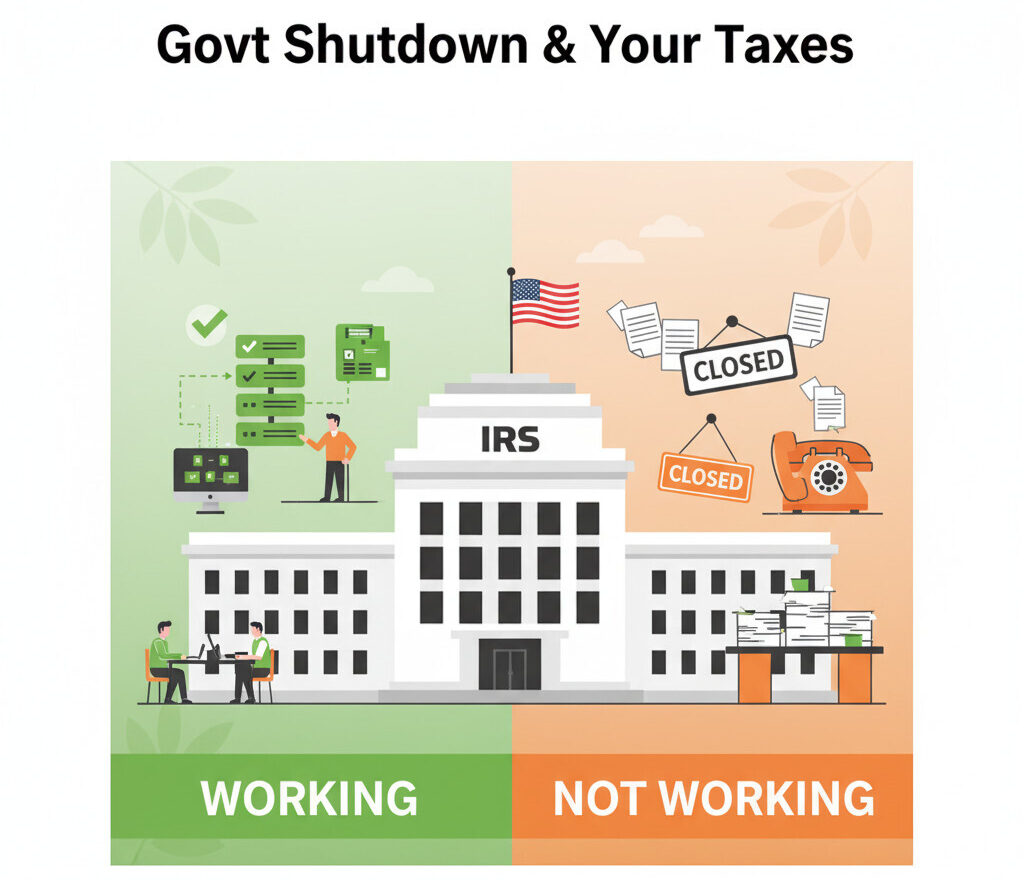
First, you might be picturing the IRS as a total ghost town, with cobwebs on the computers. It’s not *quite* like that, but it’s not fully operational either. Here’s the deal: during a shutdown, the IRS has to furlough (send home) a huge chunk of its staff.
Based on contingency plans from recent years, roughly 54% of the IRS workforce is still on the job. But here’s the massive catch: they are only allowed to perform “essential” duties. And what the government considers “essential” might be very different from what *you* consider essential (like, say, answering your urgent question on the phone).
“Essential” work mostly means anything that protects government property or involves processing and securing the money the government is *already* receiving. This includes automated systems, basic security, and processing payments. What’s *not* essential? A lot. Think live customer service, processing paper returns, issuing non-automated refunds, and all in-person help. This leads us to the single most important rule of all…
This is the most important thing to remember: A government shutdown does NOT shut down the tax law. The U.S. tax code is still 100% in effect. The shutdown is a funding dispute; it doesn’t change the laws that are already on the books. And that means your responsibilities as a taxpayer are completely unchanged.
File and Pay? Your Core Obligations 📬
This brings us to the two biggest questions on everyone’s mind. With the government in chaos and deadlines getting closer, let’s just tackle them head-on.
Do I *really* still have to file my taxes?
Yes. A big, clear, unambiguous yes. All those deadlines—for individuals, for businesses, for employers—are still in effect. The government shutdown does not grant you an extension. If your tax return is due on April 15th (or any other deadline), the IRS still expects to receive it (or an extension request) by that date.
Okay… but do I still have to *pay* my tax bill?
You’d think, “Hey, if they can’t pay their own bills, surely I get a break, right?” I wish I had better news, but the answer here is another hard yes.
Believe it or not, the IRS is totally set up to accept and process your payments. Remember that “essential” work? Protecting and securing government funds is at the top of the list. Their automated systems for online payments are still running, and they still have staff processing mailed-in checks. There is no grace period for paying what you owe. If you pay late, you can (and likely will) still be charged interest and penalties.
The Big Question: Will I Still Get My Refund? 💰
Alright, so you still have to file and pay. But what about when the tables are turned? What if the IRS owes *you* money? This, my friends, is where things get really complicated and… well, unfair.
The IRS *is* still sending out refunds, but there’s a massive “but” here. During a shutdown, it’s like there are two different highways for taxpayers, and the one you’re on depends entirely on *how* you filed.
- The Express Lane 🚀: If you are in this lane, you’re in the best possible shape. This lane is for people who filed electronically (e-file) AND set up direct deposit for their refund. Because this process is almost entirely automated, it’s considered “essential” (it uses computer systems, not people) and your refund should process as normal.
- The Massive Traffic Jam 🐌: This lane is for… pretty much everyone else. If you filed by paper, your return is going to land in a mailroom bin and sit there. If your return (even an e-filed one) gets flagged for manual review—maybe there’s a typo, an error, or it needs an identity check—it’s going to be sent to a queue… where no one is working. You will be stuck in a serious traffic jam until the government reopens and furloughed employees return to sort through the backlog.
The key takeaway is that how you file matters more than ever during a shutdown. Going digital is your only real protection against major delays.
Getting Help: Can Anyone Answer the Phone? ☎️
So, what if you hit a snag? Or you just have a simple question? Is there *anyone* at all who can help you? This is where the “essential vs. non-essential” thing really hits home. You’ll see a pattern pretty quick: **Digital is on, human is off.**
I’ve put together a table based on the IRS contingency plans. This really tells the whole story.
Table: IRS Service Status During a Shutdown
| Service | Status | Key Details |
|---|---|---|
| Website & Apps | AVAILABLE | IRS.gov and tools like “Where’s My Refund” are automated and working. |
| Phone Lines | LIMITED | Automated lines will work, but live help from a real person will be almost non-existent. |
| In-Person Help | CLOSED | All Taxpayer Assistance Centers (TACs) are closed. |
| DELAYED | Mail is received, and payments are deposited (that’s “essential”!). But replies or processing of paper returns are stopped. | |
| Appointments | CANCELLED | All in-person appointments are cancelled and will be rescheduled when the IRS reopens. |
And if you want to see just how serious the “no help” situation is, check this out…
The Taxpayer Advocate Service (TAS) is literally the *one* office designed to be your last line of defense when you have a problem with the IRS you can’t solve. Their official notice during a shutdown? All TAS offices are closed. No staff will be available to assist you. You are, in effect, on your own.
A Look Back: The 2018 Shutdown’s Long Shadow ⏳
To really understand the damage a shutdown can do, we don’t have to guess. We can just look back at what happened during the 35-day shutdown in 2018-2019. The scary part isn’t just the shutdown itself; it’s the ripple effect that lasts for years.
When the IRS finally reopened in January 2019, they were buried under a backlog of 5 million pieces of unanswered mail. Think about that. 5 million letters, paper returns, and inquiries that just… sat there.
But the real story is how long it took to recover. This timeline is staggering:
📝 Case Study: The 2018 Shutdown Recovery Timeline
- December 2018: The 35-day shutdown begins.
- January 2019: The shutdown ends, leaving a 5 million mail backlog.
- January 2020: A full year later, the IRS was *still* trying to catch up and dig out from under that mountain of mail.
The National Taxpayer Advocate at the time stated that it would take “at least a year” for the agency to get back to business as usual. This is the real danger: the disruption doesn’t last for a few weeks. It creates an echo of chaos that can delay your refund or your tax case for years.
Conclusion: Your 4-Point Shutdown Survival Guide 📝
Okay, I know that was a lot of information, and most of it is pretty frustrating. It’s easy to feel overwhelmed. So, let’s just boil it all down to what you *absolutely* need to do. If you remember nothing else from this article, remember these four points.
- File & Pay On Time: I’m going to say it one last time because it’s that important. Your legal tax obligations are completely unchanged. Do not expect extensions or grace periods for filing or paying.
- Go Digital (The Express Lane): This is your single best defense. Use e-file and sign up for direct deposit. This puts you in the automated “Express Lane” that is most likely to process your return and get your refund to you with minimal delays.
- Use Automated Tools: Since you can’t get a human on the phone, the IRS.gov website, their official mobile apps, and the “Where’s My Refund” online tool are your best bet for reliable information.
- Expect Delays: Just set your expectations now. If you’re a paper filer or you need live help for *anything*, it’s going to be slow. Very, very slow. Patience isn’t just a virtue here; it’s a necessity.
Your Tax Shutdown Cheat Sheet
Frequently Asked Questions ❓
Honestly, all of this really leaves us with a much bigger question, doesn’t it? As we all scramble to figure out our own tax situations, it’s worth asking: as these shutdowns seem to happen more and more, how can we protect these essential services from getting caught in the crossfire of political gridlock?
I know this is a confusing and stressful topic. If you have any other questions or want to share your own experience from a past shutdown, feel free to ask in the comments~ 😊