U.S. Samsung Sued Over ‘This’! What Companies Expanding to the U.S. Must Know: Differences in Labor Law Between the U.S. and Korea
Have you ever found yourself in a work situation that just felt… off? Maybe you saw a decision made that didn’t just seem unfair, but fundamentally wrong? I was scrolling through some business news recently when I stumbled upon a high-stakes lawsuit against a global tech giant, Samsung, that perfectly captures this feeling. It’s a story all about what happens when workplace cultures, specifically Korean and American, collide in a U.S. courtroom. 🏛️
This isn’t just some abstract legal drama; it’s a critical, real-world lesson for *any* international company operating in the United States. It highlights a massive blind spot that can, and does, cost companies millions. Let’s get into it, because understanding this could honestly save your business. 😊
The Spark: A Shocking Allegation 😲
So, what started this whole legal firestorm? It all began with a truly shocking alleged comment. According to the lawsuit, a visiting top executive from Korea was at Samsung Research America and allegedly told other employees to “Tell the employees with dark skin to stay in the car.”
I mean, wow. In today’s world, it’s hard to believe, but that’s the allegation at the heart of the case. As you can imagine, this didn’t just get brushed under the rug. A senior engineer at the company heard about this comment and, thinking he was doing the right thing and following company policy, reported it.
What he *expected* was for the company to investigate and take action. What he *claims* happened was the exact opposite: the company, he alleges, turned on him. This is where the story shifts from a discrimination incident to a classic retaliation claim.
How the Lawsuit Unfolded (A Classic Retaliation Claim) ⚖️
According to the engineer’s lawsuit, the timeline of events after his report looks suspiciously like a case of payback. Here’s the play-by-play he alleges:
- The Event: The discriminatory comment is allegedly made by the Korean VP.
- The Report: The senior engineer formally reports the incident, citing company policy.
- The (Alleged) Retaliation: Almost immediately, things start to go south for the engineer. He claims that just a week later, there’s a major organizational “reshuffle.” Then, his pre-approved paid leave suddenly gets put under an internal audit. It felt, to him, like the company was suddenly targeting him.
- The Termination: The final blow. The engineer is fired, with the company citing “role elimination.” But here’s the kicker: he disputes this entirely, claiming the company just turned around and hired someone else to fill the very same role.
This sequence of events—a protected complaint followed by negative actions and a questionable termination—is the textbook definition of what a retaliation lawsuit looks like. And it all hinges on a fundamental, and very expensive, misunderstanding of U.S. labor law.
A retaliation claim argues that an employer punished an employee (e.g., by firing, demoting, or harassing them) for engaging in a “legally protected activity.” Reporting discrimination or harassment is one of the most common protected activities.
The $1,000,000 Misunderstanding: What is “At-Will Employment”? 🤔
This entire case, and so many others like it, boils down to a concept that baffles many leaders from outside the U.S.: “at-will employment.”
You’ve probably heard the term. In almost every U.S. state (except Montana, you’re special!), at-will is the standard. In simple terms, it means an employer can fire an employee for any reason, or for no reason at all. Seriously. Your boss can fire you because they (gasp) don’t like your favorite football team, or because it’s a Wednesday and they feel like it. It’s harsh, but it’s the default.
This flexibility, however, is a two-way street. It also means *you* can quit for any reason, or no reason, right on the spot. No two-weeks notice required (though it’s still professional courtesy!).
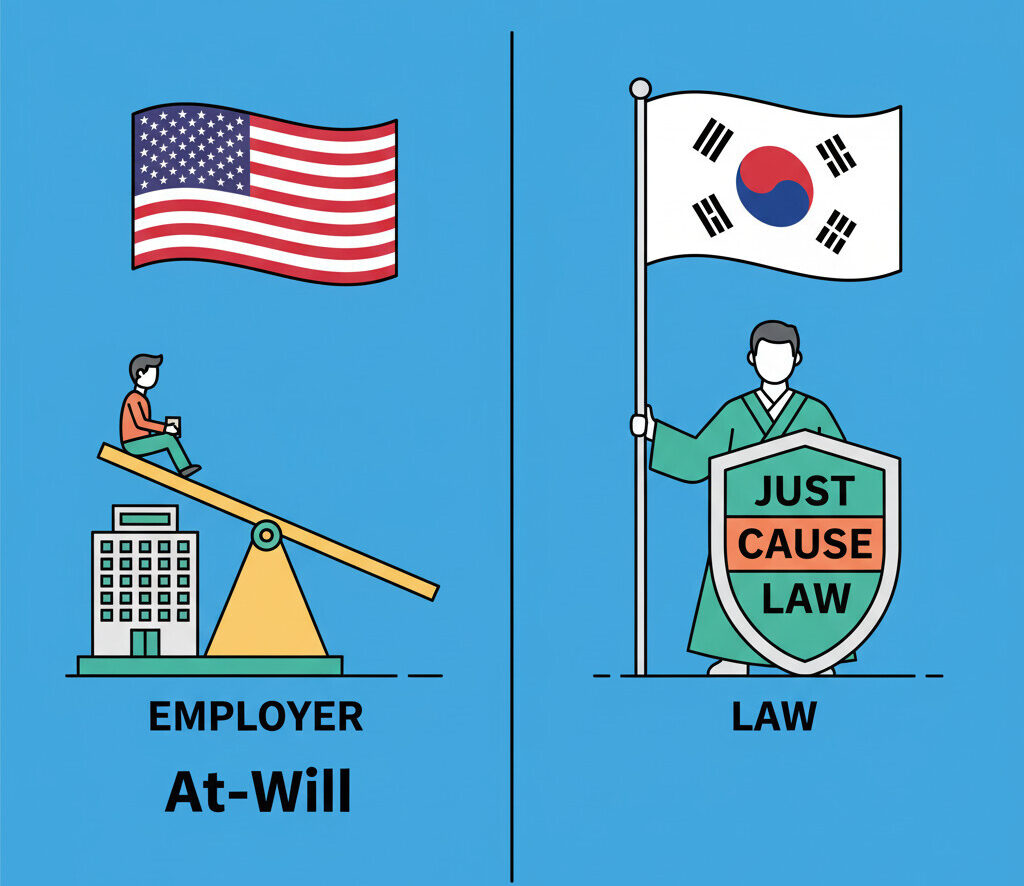
Now, compare this to the system in many other countries, like South Korea. The culture clash becomes immediately obvious.
At-Will vs. Just Cause: A Quick Comparison
| Legal Concept | Where It’s Common | What It Means |
|---|---|---|
| At-Will Employment | United States (most states) | An employer can fire an employee for any reason or no reason, as long as it’s not illegal. |
| Just Cause | South Korea, Canada, many European countries | An employer needs a legitimate, valid, and proven reason to fire an employee (e.g., misconduct, poor performance). |
In Korea, employees have significant job security. Managers can’t just fire someone on a whim; they need what’s called “just cause.” This means when Korean managers come to the U.S., they are operating from a completely different playbook.
The “At-Will” Golden Ticket… That Isn’t Golden 🎟️
Here it is. This is the multi-million dollar mistake so many foreign companies make. They hear “at-will employment” and think it’s a golden ticket—a “get out of jail free” card that lets them fire *anyone* for *any reason* with no consequences. And that is absolutely, 100% NOT true.
You can fire an employee for a bad reason (like not liking their hat). You CANNOT fire an employee for an illegal reason. This is the line that gets companies sued, and it’s a line many foreign executives don’t even know exists.
So, what’s an “illegal reason”? There are many, but they generally fall into two massive categories that are exceptions to at-will employment:
Exception 1: Discrimination
You cannot fire someone based on their membership in a “protected class.” This includes, but isn’t limited to:
- Race or Color (the core of the Samsung allegation)
- Gender (including pregnancy)
- Religion
- National Origin
- Age (over 40)
- Disability
Exception 2: Retaliation (The Big One)
This is the big one in the Samsung case. You cannot fire someone as “payback” for them engaging in a legally protected activity. This is to protect employees from being punished for exercising their rights.
Legally protected activities include:
- Reporting discrimination or harassment (Exactly what the engineer claims he did!)
- Acting as a “whistleblower” by reporting other illegal activities.
- Filing for worker’s compensation after an injury.
- Taking legally protected medical or family leave (FMLA).
- Participating in an official investigation into the company.
The moment an employee like the Samsung engineer makes a credible claim of discrimination, the whole “at-will” defense pretty much goes out the window. The tables turn, and the burden of proof is suddenly on the *company* to prove, with evidence, that they had a legitimate, non-illegal reason for the termination.
The Culture Clash: Why This Keeps Happening 🌍
This Samsung case isn’t just some random, one-off event. As more and more amazing Korean companies expand into the U.S. market, they are increasingly getting tangled in these legal webs. The trend is clear: the number of Korean firms setting up shop in the U.S. goes up, and right alongside it, the number of employment lawsuits climbs, too.
Why? A U.S. labor attorney in the video hit the nail on the head. He said (and I’m paraphrasing), “The people making the final calls, often executives sent over from headquarters in Korea, are judging situations using Korean corporate rules and norms.” But those rules don’t just “not apply” in the U.S.—they can get you into serious legal trouble.
They operate from a “just cause” mindset, which ironically makes them *less* careful about documentation for “at-will” terminations, leaving them completely exposed when an illegal reason is alleged.
How to Protect Your Company: A 3-Step Defense Strategy 🛡️
So, if you’re an international company operating in the U.S. (or even a U.S. company that needs a refresher), what’s the game plan? How do you avoid these devastatingly expensive lawsuits? Experts say it comes down to a clear, 3-step strategy.
- Document, Document, Document!
This is number one for a reason. If you ever have to let someone go, you *must* have a solid paper trail of legitimate, performance-based, non-discriminatory reasons that started *way* before any complaint was ever filed. Document performance reviews, warnings, and any policy violations clearly and objectively. - Train Your Leaders.
This is not optional. Every single manager, and *especially* any leader coming from abroad, MUST be trained on U.S. anti-discrimination and anti-retaliation laws. They need to understand the cultural nuances and, more importantly, the legal lines they cannot cross. - Get Insured.
Let’s be real: you can’t always stop someone from suing you, even if you did everything right. That’s why having the right insurance is critical. It’s called Employment Practices Liability Insurance (EPLI), and it’s designed specifically to cover the astronomical legal costs of fighting exactly these kinds of lawsuits.
A good legal strategy isn’t just about winning in court; it’s about *staying out* of court in the first place. These three steps are your best defense.
At-Will vs. Just Cause: Key Summary
Conclusion: Key Summary 📝
As companies go global, it’s crystal clear that just understanding the *market* isn’t enough. You have to understand the *laws* and the *culture*. The Samsung case is a perfect, if painful, reminder that in today’s economy, a bad legal strategy (or no strategy at all) can completely wreck even the best market strategy.
This stuff is complex, but it’s not unmanageable. It just requires being proactive, respectful, and, let’s be honest, smart about protecting your business by documenting everything, training your people, and getting the right insurance.
What are your thoughts on this? Have you ever seen a culture clash like this play out in your workplace? Let me know in the comments! 😊