Health Savings Account (HSA): The Account with Triple Tax Benefits That Beats Your IRA
We all worry about the future, right? Aside from retirement, one of the biggest, scariest question marks is healthcare. We hear about the staggering costs of long-term care and the complexities of Medicaid. Many of us are diligently putting money into 401(k)s and IRAs, but let’s be honest, it’s confusing. What if I told you there’s one “secret weapon” account that can tackle three of your biggest financial worries at once: tax savings, medical bills, AND long-term care? It’s called a Health Savings Account (HSA), and it might just be the most powerful financial tool you’re not using. 😊
What is an HSA and How Do I Get One? 🤔
A Health Savings Account (HSA) is a tax-advantaged savings account you can use to pay for qualified medical expenses. Think of it like a personal savings account, but the money you put in, the growth it earns, and the money you take out are all tax-free. It’s an incredible deal. But there’s one big catch, and it’s a strict requirement.
You can *only* contribute to an HSA if you are enrolled in a **High Deductible Health Plan (HDHP)**. Not all health plans qualify. If you have a “gold” or “platinum” plan with low deductibles, you’re likely ineligible. Your plan must specifically be designated as “HSA-eligible.”
An HDHP is exactly what it sounds like: a health plan with a higher minimum deductible than traditional plans. This means you pay more out-of-pocket before your insurance kicks in. The trade-off for these higher initial costs is (usually) a lower monthly premium and, most importantly, the ability to open and fund a super-powered HSA.
The “Triple-Tax Advantage”: Why it Beats Your IRA 🏆
This is where the magic happens. The HSA is famous for its “triple-tax advantage,” something no other retirement account can claim. Let’s break it down by comparing it to the IRAs we all know.
HSA vs. IRA Comparison
| Account Type | 1. Contribution Tax-Deductible? | 2. Growth Tax-Free? | 3. Withdrawal Tax-Free? |
|---|---|---|---|
| HSA (Health Savings Account) | ✅ Yes | ✅ Yes | ✅ Yes (for medical) |
| Traditional IRA | ✅ Yes | ✅ Yes (Tax-Deferred) | ❌ No (Taxed as income) |
| Roth IRA | ❌ No | ✅ Yes | ✅ Yes |
As you can see, both IRAs give you two out of three benefits. The Traditional IRA lets you deduct contributions now but taxes you later. The Roth IRA taxes you now but is tax-free later. The HSA is the *only* account that gives you all three: a tax deduction now, tax-free growth, and tax-free withdrawals (as long as it’s for qualified medical expenses). It’s unbeatable.
The 3 Rabbits: What Can You *Do* With an HSA? 🐇
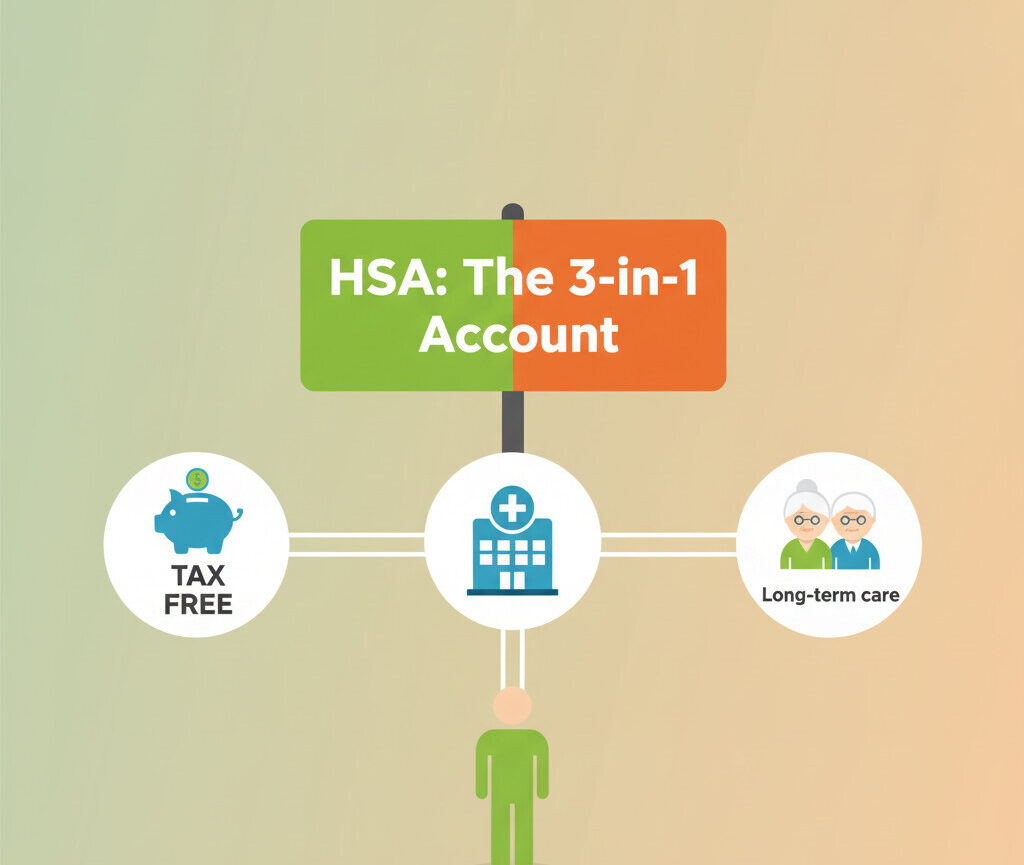
So, it’s a great tax shelter. But what’s it practically good for? This is where the “three rabbits” from the video title come in: medical bills, retirement, and long-term care.
1. Cover All Your Medical Bills (Now or Later)
The most obvious use is to pay for your current medical expenses: deductibles, copays, prescriptions, dental, vision, and more. But here’s a pro-tip: you don’t *have* to. Many savvy HSA users pay for their current medical bills out-of-pocket and let their HSA money stay invested and grow tax-free. You can save your medical receipts for *years* (or decades!) and reimburse yourself from your HSA at any time in the future. This turns it into a powerful investment vehicle.
2. Act as a “Secret” Retirement Account
What if you’re lucky and stay healthy? What happens to all that money? Once you turn 65, the HSA gets even more flexible. You can *still* pull money out tax-free for medical expenses. But if you want to use it for a vacation, a car, or just regular living expenses (non-medical), you can! You’ll simply pay ordinary income tax on the withdrawal, just like a Traditional IRA. The penalty for non-medical withdrawals disappears.
If you withdraw funds for **non-medical** expenses *before* age 65, you will face a double-whammy: you’ll pay both ordinary income tax *and* a steep penalty (typically 20%). This is why it’s best to save it for its intended purpose.
3. The Game-Changer: Pay for Long-Term Care Insurance
This is the part I find most brilliant. Many people fear that if they need long-term care, they’ll have to rely on Medicaid. The problem? Medicaid is for those with very low assets, and after you pass away, the government can (and often does) come to recover the costs from your estate. This is called “Medicaid Estate Recovery,” and it can mean the house you wanted to leave to your kids is sold to pay back the government.
A much better solution is to buy a private Long-Term Care (LTC) insurance policy. But those premiums can be expensive. Here’s the solution: **You can legally pay your Long-Term Care insurance premiums using your tax-free HSA funds.**
📝 The Perfect Strategy
Think about this workflow:
- You contribute money to your HSA, getting an immediate **tax deduction**.
- That money grows for years, completely **tax-free**.
- You use that tax-free money to pay the premiums on a Long-Term Care policy. This is a **tax-free withdrawal**.
- If you ever need long-term care, your insurance policy (which you paid for with tax-free money) covers the costs, and your other assets are completely protected from Medicaid recovery.
This is how you catch all three rabbits: maximum tax benefits, medical cost coverage, and a secure plan for long-term care.
HSA Rules & Common Questions 🧮
Here are a few other important details to know:
- Contribution Limits: These change annually. The video mentioned a 2023 family limit of $7,750, plus a $1,000 “catch-up” contribution for those 55 and older.
- Contribution Deadline: You have until the tax-filing deadline (usually April 15) of the *next* year to make contributions for the current year.
- Inheritance: What if you pass away with money in your HSA? If your spouse is the beneficiary, it rolls over to them as their own HSA (tax-free). If the beneficiary is a non-spouse (like your child), the account balance becomes taxable income to them in that year (but without penalty).
- Who *isn’t* this for? An HSA isn’t for everyone. If you have significant, chronic health conditions, you might be better off with a low-deductible “platinum” plan. The immediate, predictable coverage might be more valuable to you than the long-term tax savings of an HSA.
HSA: The Ultimate Financial Tool
Frequently Asked Questions ❓
The HSA is truly one of the most powerful, and often overlooked, financial accounts available. It’s a retirement account, a medical emergency fund, and a long-term care strategy all in one. If you have an HDHP, it’s definitely something to look into. What are your thoughts on HSAs? Let me know in the comments! 😊