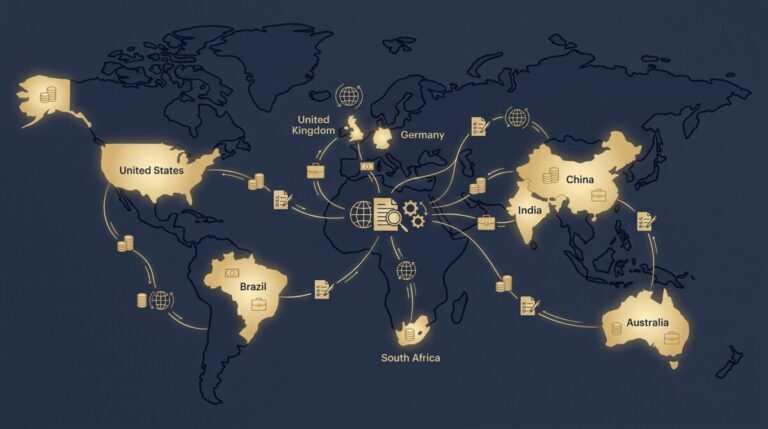

International Tax Updates May 8, 2026: Pillar Two, OECD Toolkit, Korea Filing
Pillar Two implementation is now operational reality, not future planning. Deloitte’s World Tax Advisor for 8 May 2026 captures ten international tax updates may 2026 — including the OECD’s just-published Global Minimum Tax Implementation Toolkit, Korea’s first-wave filing notices to 10,188 constituent entities, and a wave of jurisdiction-specific compliance changes affecting US MNEs and inbound investors.
At SW Accounting & Consulting Corp, we follow these monthly cross-border updates because they cumulate into materially different ETR, BEAT/GILTI, and FTC positions. Below: the most consequential items by jurisdiction with planning implications.
OECD: Global Minimum Tax Implementation Toolkit and Investment Incentive Guide 🌐
The OECD Forum on Tax Administration published the Global Minimum Tax Implementation Toolkit — designed to support jurisdictions and their tax authorities in implementing Pillar Two consistently — alongside an updated FAQ on the global minimum tax rules.
For US MNEs and tax directors, the toolkit signals two things:
- Convergence pressure — the toolkit aims to reduce divergent national implementations of the same Pillar Two model rules. Expect your home and host countries’ GMT mechanics to look more similar going forward.
- Filing software readiness — the OECD updated FAQ helps clarify ambiguous areas in the GloBE Information Return. Tax software vendors will need time to incorporate; expect filing-system updates through Q3 2026.
Separately, the OECD released A Practical Guide to Investment Tax Incentives, addressing design and implementation across the policy lifecycle — particularly relevant for emerging markets reforming their incentive regimes.
Korea: NTS Pillar Two filing notices reach 10,188 entities 🇰🇷
Korea’s National Tax Service announced GMT filing guidance notices for the 2024 fiscal year have been sent to 10,188 domestic constituent entities belonging to 2,547 multinational enterprise groups, with the first filing season running from May 1 to June 30, 2026.
| Korea Pillar Two First Filing Season | Detail |
|---|---|
| Notices sent | 10,188 domestic constituent entities |
| MNE groups covered | 2,547 groups |
| GMT effective date | Fiscal years beginning on or after January 1, 2024 |
| First filing window | May 1 – June 30, 2026 |
If your group has Korean constituent entities, confirm receipt of the NTS filing guidance notice. The June 30, 2026 deadline is firm. Coordinate with Korean tax counsel on the GMT computation, interaction with Korean domestic top-up tax (DMTT), and any country-by-country adjustments under Korean conformity rules.
New Zealand: Compliance simplification act + Pillar Two FAQs 🇳🇿
The Taxation (Annual Rates for 2025–26, Compliance Simplification, and Remedial Measures) Act 2026 contains taxpayer-favorable changes covering thin capitalization, investment boost rules, nonresident contractors tax, and global anti-base erosion provisions. NZ also published Pillar Two FAQs.
Notable NZ compliance simplifications:
- Thin capitalization adjustments — NZ continues iterating its thin-cap rules; check whether your structure qualifies for new exemptions.
- Investment boost rules — accelerated depreciation/expensing for qualifying investments.
- Nonresident contractors tax — administrative relief for cross-border contracting arrangements.
- GloBE remedials — refinements to NZ’s domestic implementation of Pillar Two.
Other jurisdictions worth tracking 🗺
| Jurisdiction | Update | Practical Impact |
|---|---|---|
| Australia 🇦🇺 | Treasury draft legislation: News Media Bargaining Incentive charge (consultation closes May 18) | Affects digital platforms; eligible expenditure with news businesses reduces the charge |
| Canada 🇨🇦 | CRA reverts CRS partnership residency guidance; Spring Economic Update 2026 (no major tax changes) | Re-evaluate partnership residency reporting under CRS; relatively quiet on tax policy |
| Germany 🇩🇪 | Annual reporting requirement on dividend WHT exemption certificates abolished | Past-distribution info now requested only at exemption certificate application |
| Thailand 🇹🇭 | 10% CIT rate (vs. 20% standard) for SEZ-located companies in targeted industries (effective retroactive 6/6/2025) | Halving CIT for qualifying inbound manufacturing/logistics |
What’s the Pillar Two operational picture for US MNEs in May 2026? 📊
Pillar Two has moved from policy debate to live filing — Korea is sending notices, NZ is finalizing remedials, OECD is publishing implementation guidance, and most major jurisdictions have at least DMTT in force or imminent.
For US MNEs, three priorities for May–June 2026:
- Confirm filing readiness in jurisdictions where the first filing season is open (Korea, EU member states with synchronized filing, others).
- Reconcile country-level data — ETR computations, GloBE rules adjustments, and DMTT credits across jurisdictions.
- Validate ASC 740 GMT disclosures against the OECD’s updated FAQ guidance — particularly transition-period and transitional safe harbor positions.
The Korea filing season (May 1 – June 30, 2026) is a useful operational test case for US MNEs. Patterns we’re seeing: (1) data-collection bottlenecks around country-level tax adjustments; (2) software vendors releasing GloBE Information Return modules with material gaps that require manual workarounds; (3) DMTT credit interaction with the home-jurisdiction IIR raising new audit-readiness questions. Use Korea as the dress rehearsal for your Q3 filings elsewhere.
Frequently Asked Questions 🗂
For Deloitte’s underlying analysis, see taxathand.com. The OECD GMT Implementation Toolkit and FAQ are at oecd.org/tax. Korean NTS GMT filing guidance is on the National Tax Service portal.
Need help with Pillar Two readiness, GloBE Information Return preparation, or cross-border structuring? SW Accounting & Consulting Corp’s international tax team supports US MNEs and inbound investors — book a consultation.