IRS Grants 2025 Penalty Relief for OBBBA Tip & Overtime Reporting (W2 and 1099)
If you’re an employer or payroll manager, you’ve probably been tracking the “One, Big, Beautiful Bill Act” (OBBBA) with a mix of curiosity and, let’s be honest, a little bit of dread. New tax laws mean new rules, new forms, and new systems. The OBBBA introduced some great new deductions for employees—specifically for qualified tips and overtime—but it also created new, detailed reporting requirements for employers. Well, I’ve got some good news that should feel like a huge sigh of relief for the upcoming tax season. The IRS just released Notice 2025-62, and it’s basically a “get out of jail free” card for 2025 penalties on this new reporting. Let’s dive into what this means for you. 😊
First, What’s This OBBBA Law All About? 🤔
The “One, Big, Beautiful Bill Act” (OBBBA), which was passed on July 4, 2025, brought in some major changes to the tax code. From an individual taxpayer’s perspective, two of the biggest perks were the creation of brand new income tax deductions:
- Deduction for Qualified Tips (New Section 224): This allows certain individuals to deduct the qualified cash tips they receive.
- Deduction for Qualified Overtime Compensation (New Section 225): This allows certain individuals to deduct the qualified overtime pay they earn.
This is fantastic news for employees, especially in the service and hourly-wage industries! But here’s the kicker: for an employee to claim these deductions, the amounts need to be properly reported by their employer (or by the individual on a Form 4137 for tips). This created a brand new set of detailed information reporting requirements for employers and other payors (like an independent contractor’s client or a TPSO). And as anyone in payroll knows, “new detailed reporting” is code for “headaches and system updates.”
The New Rules That Had Employers Worried 📊
Before this new relief, employers were scrambling to figure out how to comply with these new rules for the 2025 tax year (the returns you file in 2026). The OBBBA mandated that payors add very specific new details to their information returns (like Forms W-2, 1099-NEC, 1099-K, etc.).
For Qualified Tips
Employers and payors were suddenly required to provide a separate accounting of any amounts reasonably designated as cash tips. Not only that, but they also had to report the occupation of the person receiving those tips (e.g., “Server,” “Hairstylist”). This information was supposed to be on returns filed with the IRS/SSA (like Form W-2 or 1099) and on the statements furnished to the payee.
For Qualified Overtime
Similarly, employers and payors were required to provide a separate accounting of any “qualified overtime compensation.” This meant digging into payroll data and breaking out that specific pay type from regular wages.
The problem? Many payroll and accounting systems weren’t built to track or output this data, especially not the “occupation” part for tip reporting. To make matters worse, the IRS itself announced that the Forms W-2 and 1099 for tax year 2025 will not be updated to even include fields for this new information! This put employers in an impossible “catch-22.”
Failure to file correct information returns (Section 6721) or furnish correct payee statements (Section 6722) comes with stiff penalties. These are the penalties that employers were facing for being unable to comply with a rule that the forms themselves didn’t even support.
The Big News: IRS Notice 2025-62 Saves the Day! 🎉
This is where Notice 2025-62 comes in. The Treasury Department and the IRS recognized this difficult situation and have essentially declared tax year 2025 a “transition period.”
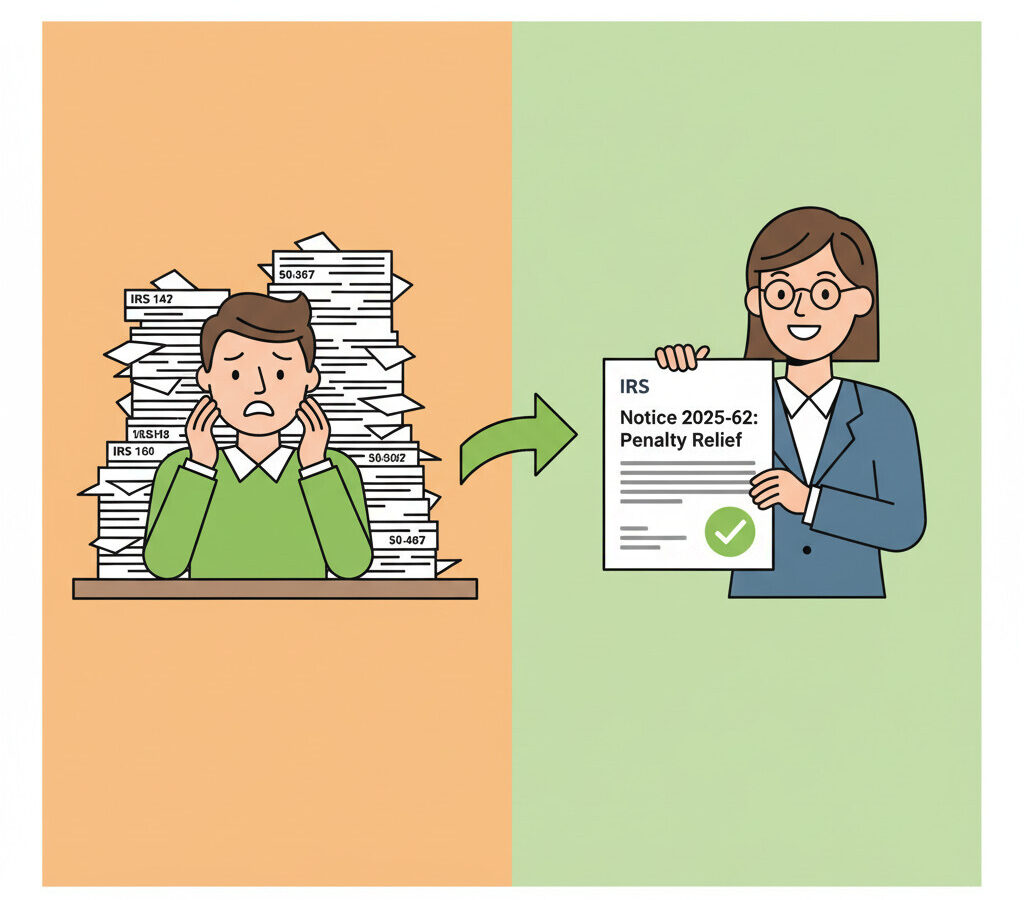
In simple terms, the notice states that for the 2025 tax year only, the IRS will not impose penalties under sections 6721 or 6722 on employers and payors who fail to include this *new* specific information about qualified tips, occupations, and qualified overtime on their returns.
This is a huge win for employers. It means you can use your existing systems to file your 2025 Forms W-2 and 1099 without fear of being penalized for not including data that you couldn’t track and the forms couldn’t capture.
This is the most important part: This penalty relief only applies to the new, separate breakout information. You are *still* required to file a complete and correct return in all other respects. This means you must still include the qualified tip and overtime amounts in the aggregate total (e.g., in Box 1 of Form W-2 as part of total wages). You just don’t have to break it out separately.
Who Gets Relief and For What? (A Quick Breakdown) 👩💼👨💻
This relief is broad and covers all the payors who were affected by the new rules. I’ve built a table to help visualize exactly what failures are being excused for 2025.
Specific Penalty Relief Granted by Notice 2025-62
| Reporting Type | Waived Requirement for 2025 | Affected Forms (Examples) |
|---|---|---|
| Qualified Tips | Failure to separately report cash tips and the employee’s/payee’s occupation. | Form W-2, Form 1099-NEC, Form 1099-K, etc. |
| Qualified Overtime | Failure to separately report qualified overtime compensation. | Form W-2, Form 1099-NEC, etc. |
I’m an Employee. What Does This Mean for Me? 🙋♀️
This is the other side of the coin, and it’s a critical question. If employers aren’t being required to report these numbers separately on your W-2 or 1099, how can *you* claim your deductions?
Here’s the good news: You are still eligible to claim the deductions for qualified tips and overtime! This notice doesn’t change that. The challenge is just in getting the numbers to prove it.
To solve this, the IRS is “encouraging” (but not *requiring* for penalty relief) employers to provide this information to their employees and payees through other methods. So, if you’re an employee, you’ll need to be proactive. Here’s where to look for that information:
📝 How to Find Your 2025 Tip & Overtime Info
Since this info might not be in a dedicated box on your W-2 or 1099, here’s what the IRS suggests your employer might do:
- Check Your Employee Portal: Your company’s payroll portal (like ADP, Paychex, Gusto, etc.) may have a detailed breakdown of your earnings.
- Look for an Additional Statement: Your employer might provide a separate, unofficial written statement along with your W-2 that lists your total qualified tips, occupation code, and/or qualified overtime.
- Check Box 14 on Form W-2: For overtime, the IRS specifically mentioned that employers are encouraged to use Box 14 (“Other”) on the W-2 to report the qualified overtime compensation amount.
- Contact HR or Payroll: When in doubt, reach out to your HR or payroll department directly and ask for a report of your 2025 qualified tip and overtime earnings.
The IRS has also stated that additional guidance for individual taxpayers on exactly *how* to claim these deductions on their 2025 tax returns is “forthcoming.” So, we’ll have to stay tuned for that final piece of the puzzle!
Conclusion: Key Summary 📝
This is a developing story, but the big takeaway from Notice 2025-62 is a positive one. Let’s recap the main points so it’s all crystal clear:
- OBBBA Created New Deductions: Starting in 2025, individuals can deduct qualified tips (Section 224) and qualified overtime (Section 225).
- …And New Employer Reporting Rules: This meant employers had to start separately reporting these amounts and, for tips, the employee’s occupation.
- IRS Grants 2025 Penalty Relief: Notice 2025-62 waives the penalties for employers/payors for tax year 2025 only for *failing to separately report* these new items.
- The Big Catch: Employers are NOT excused from reporting these amounts entirely. They must still include qualified tips and overtime in the total aggregate payments (like total wages in W-2, Box 1).
- Employees Can Still Claim: Individuals are still eligible for their deductions. They should look for this data from their employer via online portals, separate statements, or possibly W-2 Box 14.
2025 Tax Relief: Quick Facts
Frequently Asked Questions ❓
This is definitely welcome news for employers heading into a complex tax season. As always, tax law is complicated, so this post is for informational purposes only. I highly recommend consulting with a qualified tax professional about your specific situation.
What are your thoughts on this new relief? Does it clear things up for you? Let me know in the comments! 😊