IRS Letter Real or Scam? 2026 Verification Guide & Paper Check Phase-Out
If you’re a taxpayer expecting a refund and just received a letter purportedly from the IRS asking for your bank account information, you’re not alone in thinking “this has to be a scam.” Even seasoned tax professionals are double-taking on these letters. The reality: most are real, driven by the IRS’s accelerating paper check phase-out — but the design ambiguity creates a genuine fraud risk. This guide explains how to distinguish a real IRS letter real or scam, with practical verification steps for 2026 filers.
At SW Accounting & Consulting Corp, we work with clients facing the new wave of IRS direct deposit verification letters, refund delays, and tax-scam variants. Below: the warning signs, the verification process, and what to do if you suspect fraud.
Why is the IRS sending unfamiliar-looking letters in 2026? 📬
The IRS is in the middle of a multi-year paper check phase-out — meaning more than 1.4 million tax refund recipients are now being asked, via mailed letter, to provide direct deposit information that the IRS doesn’t have on file.
The dynamics:
- Paper checks are being phased out — the IRS is shifting refunds and other payments to electronic deposit. As of April 2026, 1.4 million filers face delays related to this transition.
- Banking info isn’t always on file — for first-time filers, those who paid balances due in prior years, or those who switched banks, the IRS lacks direct deposit info.
- Mailed verification letters — the IRS sends letters asking for routing and account numbers, often via standard mail with official letterhead.
- Refunds at stake — Miami accountant Marcell Hetenyi noted that 12 of his firm’s 700 clients received these letters, each connected to refunds of $50 to $120.
The IRS’s longstanding guidance has been: “The IRS never asks for bank account info via unsolicited communications.” But the paper-check phase-out has reversed that — they now do ask, via mailed letter. Scammers know this and are exploiting the ambiguity. Even a Miami CPA with 22 years of experience initially flagged a real letter as a likely scam. If pros are getting confused, regular taxpayers are at higher risk.
How can I verify if an IRS letter is real? ✅
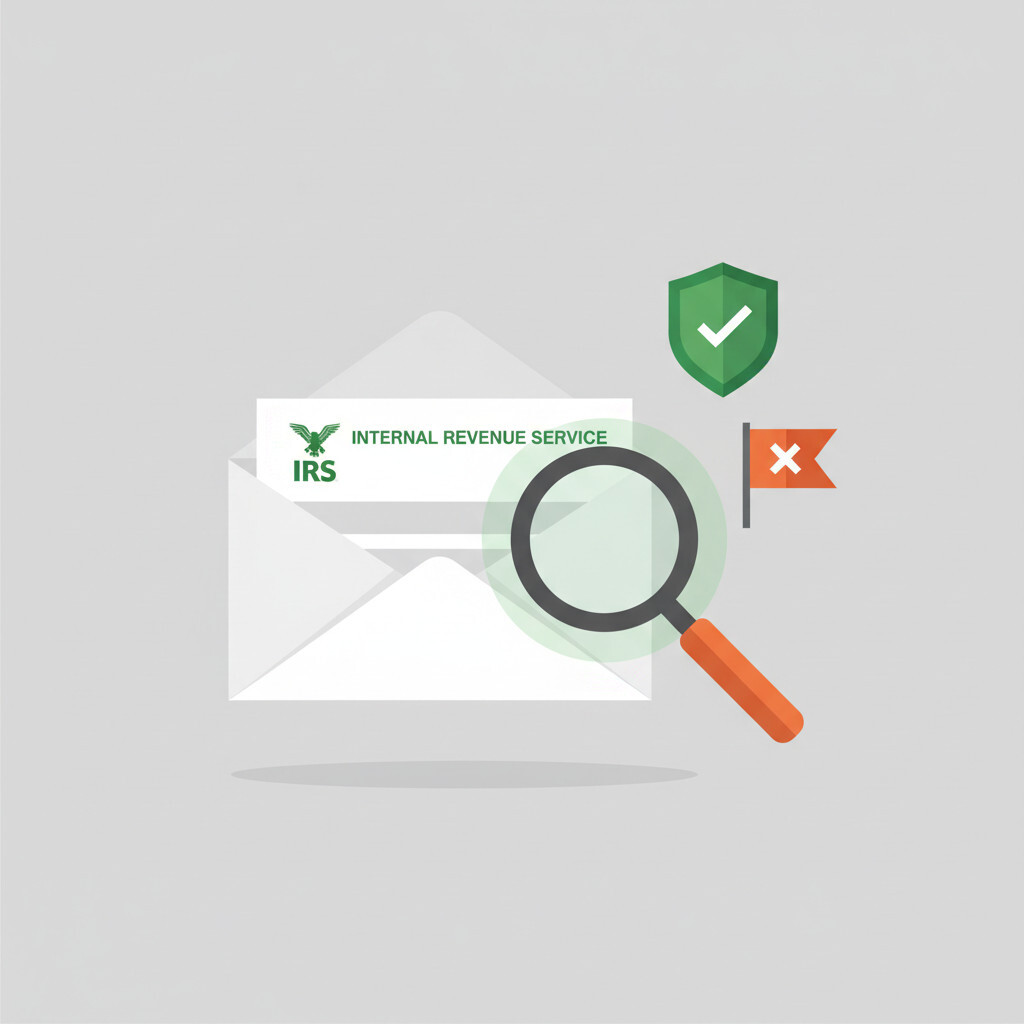
The most reliable verification: log into your IRS online account at IRS.gov, where every legitimate IRS notice is mirrored. If the letter exists in your account, it’s real. If it doesn’t, treat it as suspect.
Step-by-step verification process:
- Don’t act immediately. Don’t call the phone number or scan the QR code on the letter. Don’t reply with bank account info.
- Log into IRS Online Account. Go directly to irs.gov/payments/your-online-account (type the URL — don’t click from email). Check the “Notices and Letters” section.
- Match the letter. Real IRS letters have a specific Form/Notice number (e.g., CP14, CP2000, LT11) shown in your account. The letter you received should appear there.
- Cross-check with your CPA. If you have a power-of-attorney CPA, they should also see the notice in their IRS Tax Pro Account if it’s real. The Miami case noted: real letters typically recognize POA filings — scams don’t.
- Call the IRS directly. Use 1-800-829-1040 (individual) or 1-800-829-4933 (business). Never use the number on the letter without verifying it.
- Use IRS Identity Protection Specialized Unit if suspicious. If you suspect identity theft, IRS provides a dedicated line at 1-800-908-4490.
What are the red flags of a fake IRS letter? 🚩
| Red Flag | Real IRS Behavior |
|---|---|
| Demands immediate payment via gift card, crypto, or wire transfer | IRS never demands payment via gift cards or wire. Standard methods: Direct Pay, EFTPS, check, or installment. |
| Threatens arrest, deportation, or license revocation | IRS provides due process — never threatens immediate enforcement actions via first contact. |
| Demands urgency / “respond within 24 hours” | Real IRS notices include 30-day, 60-day, or 90-day response windows. Not hours. |
| Asks for full SSN, PIN, or password via phone/email | IRS never initiates contact via email, text, or social media. Verification is via Online Account or mail. |
| Generic salutation (“Dear Taxpayer”) | Real notices address you by name and reference your specific SSN/EIN and tax year. |
| Doesn’t appear in IRS Online Account | Every legitimate notice is mirrored in your IRS Online Account within days. |
| Calls from foreign accents or pressure tactics | IRS agents are US-based, professional, and provide written notice before calling for most matters. |
What about the 830,000 delayed refunds — was that scam-related? ⏳
Per IRS reports, over 830,000 tax refunds were delayed in March 2026 after filers missed a key step in providing direct deposit information — connected to the paper check phase-out. Most of these were legitimate IRS processing requirements, not scams.
Common reasons for delays in 2026:
- Missing direct deposit info — for filers who paid prior balances due and never set up refund deposit.
- Stale banking info — accounts closed, bank changed names, routing numbers wrong.
- Identity verification flags — the IRS holds refunds when red flags appear (e.g., multiple filings from same SSN).
- Math errors or schedule mismatches — the IRS automatically corrects but holds the refund until communicated.
- EITC/CTC review — fraud-prone credits go through manual review, delaying release.
In our practice, the safest workflow is: (1) every client checks IRS Online Account quarterly even when not expecting correspondence; (2) any letter — real or suspected — goes to the CPA first via secure portal; (3) we verify against IRS Tax Pro Account and respond on the client’s behalf. This filters scams before clients face the pressure of acting on a letter alone.
What should I do if I think I’ve been scammed? 🆘
Report immediately to multiple agencies and take protective action on financial accounts. Speed matters — most damage from tax scams happens within 48-72 hours.
Action steps:
- If you gave bank info: Contact your bank IMMEDIATELY. Freeze the account, change credentials, dispute any unauthorized transactions.
- If you gave SSN: Place a fraud alert with all three credit bureaus (Equifax, Experian, TransUnion). Consider a security freeze.
- Report to IRS: Forward suspicious emails to phishing@irs.gov. Report phone scams to the Treasury Inspector General for Tax Administration (TIGTA) at tigta.gov.
- Report to FTC: File at reportfraud.ftc.gov.
- File Form 14039: If you suspect tax identity theft, file Form 14039 (Identity Theft Affidavit) with the IRS.
- Get an IRS IP PIN: Set up an Identity Protection PIN at irs.gov/identity-theft. This is now available to all taxpayers, not just verified victims.
Frequently Asked Questions 🗂
For the official IRS tax scams and consumer alerts page, see irs.gov/newsroom/tax-scams-consumer-alerts. To report phishing, email phishing@irs.gov. For identity theft, file Form 14039 at irs.gov/forms-pubs/about-form-14039. The IRS Online Account is at irs.gov/payments/your-online-account.
Got an IRS letter and not sure if it’s real? SW Accounting & Consulting Corp’s tax controversy team can verify and respond on your behalf — protecting your refund and your identity. Book a consultation.
If you would rather have a professional confirm whether a letter is genuine and advise you on the right response, our tax services team can review it with you.