Pillar Two vs. GILTI: Surviving the New Global Minimum Tax Era
The global tax landscape is currently undergoing its most profound and arguably most complex shift in decades. If you are a tax professional, a multinational executive, or just someone keeping an eye on global economics, you’ve likely felt the tremors. We are moving away from the old days of unchecked tax competition and entering an era defined by a unified goal: ensuring that multinational groups pay a baseline level of tax, regardless of where they operate around the globe.
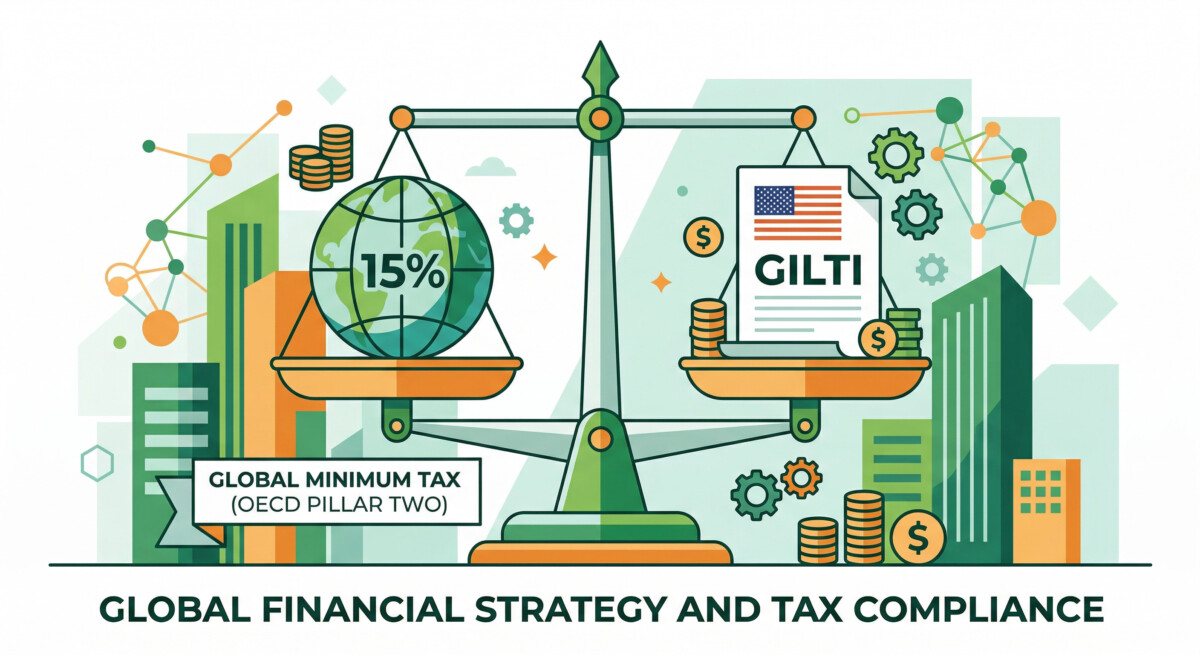
At the heart of this transformation are two heavyweights: the 15% global minimum tax (often referred to as Pillar Two of the Base Erosion and Profit Shifting or BEPS 2.0 framework) and the US’s Global Intangible Low-Taxed Income (GILTI) regime. On paper, they share the exact same noble purpose. However, when we dive into the political reality, the sheer economics of implementation, and the fiercely competing domestic priorities of major global economies, making these two systems align is far from simple. 😅
Recently, a pivotal decision was made to exempt the US GILTI regime from full compliance with the Pillar Two framework. This marks a massive turning point. It fundamentally reshapes the original, highly ambitious 2021 agreement and raises a mountain of new questions, particularly for EU-based groups that are already subject to the strict 15% rate. It brings us to a critical, long-term question that we really need to talk about: Can a global minimum tax truly survive and thrive if the world’s largest economy insists on applying its own version of the rules? In this new era of economic friction, is transfer pricing still just a clever optimization tool, or has it essentially become the primary weapon in a global war over tax revenue?
Differing Regimes: The OECD vs. The US ⚖️
To understand the conflict, we first need to break down the mechanics of the two systems. The OECD’s global minimum tax is a sweeping initiative that applies to multinational enterprise (MNE) groups with annual global revenues exceeding 750 million euros. It is a massive undertaking.
Its core mechanism relies on something called the Income Inclusion Rule (IIR) and a domestic top‑up tax. Simply put, this mechanism ensures that if a multinational’s profits in any given jurisdiction are taxed at an effective rate below 15%, another jurisdiction—usually the country where the parent company is headquartered—has the legal right to step in and collect the difference. The primary policy aims here are quite clear: to aggressively reduce the incentives for artificial profit shifting, to curb the “race to the bottom” tax competition between sovereign states, and to ultimately create a much more predictable and stable global financial system.
Back in 2021, this idea seemed unstoppable. More than 140 jurisdictions eagerly signed on to the agreement, officially committing to a coordinated, worldwide implementation starting in the 2024–2025 timeframe. However, there was a glaring issue from the start: the United States, undeniably one of the most critical major players in the global economy, was never fully aligned with the technical specifics of this OECD framework.
Instead, the US has GILTI. Introduced under the landmark 2017 Tax Cuts and Jobs Act (TCJA), GILTI’s underlying policy intent is remarkably similar to Pillar Two—it wants to tax foreign earnings that aren’t paying their fair share. But the mechanics? They differ substantially. Because GILTI doesn’t meet some of the core technical elements of Pillar Two—particularly regarding how income is blended across jurisdictions (global blending vs. jurisdictional blending) and the actual effective tax rate applied—it was originally widely expected that either US corporate groups would need to make massive, painful adjustments, or that the US Congress would need to fundamentally reform the GILTI rules. Spoiler alert: Neither of those things happened.
Faced with a standoff, the Organization for Economic Cooperation and Development (OECD) accepted a temporary safe harbor that essentially recognized the US GILTI regime as “broadly equivalent” for a transition period. Why? Because sweeping tax reform requires a level of bipartisan congressional support that simply doesn’t exist in the current US political environment. The OECD realized that maintaining forward momentum was far more critical than enforcing strict, inflexible conformity. A “perfect” deal was deemed less important than a functioning one!
Long-Term Viability and Structural Risks 🌍
We have to be realistic here. The global minimum tax framework is only as durable as the breadth, depth, and stability of its worldwide adoption. By granting the US an exemption and recognizing GILTI as “broadly equivalent,” the OECD has inadvertently introduced three major structural vulnerabilities into the system that we cannot ignore.
- The Risk of Global Fragmentation: This is a big one. It significantly increases the likelihood of a heavily fragmented global tax landscape. Seeing the US get a pass, other countries may now decide to pursue their own tailored, “Pillar Two lite” systems rather than strictly adhering to a uniform, harmonized global rule set.
- Exposure to US Political Volatility: The exemption directly exposes the entire Pillar Two framework to the wild swings of US political volatility. Because GILTI is entirely a domestic legislative provision subject to the shifting tides of congressional control, any future weakening, modification, or outright reversal of GILTI would immediately reverberate across the global financial system. It fundamentally undermines the coherence of a framework that desperately relies on the active participation of US-parented multinationals.
- Erosion of Legitimacy: This is perhaps the most consequential risk. Countries that have already committed massive amounts of political capital and heavy compliance resources to implement the strict 15% minimum rate may slowly begin questioning the fundamental fairness of the regime. Why should they bear the full brunt of compliance when the world’s largest economy operates under a different, arguably looser, set of rules? If frustration builds among these compliant jurisdictions, the collective global willingness to maintain Pillar Two could seriously erode over time.
Together, these interconnected risks suggest something crucial: unless the OECD can somehow reinforce global alignment and assure long-term US policy stability, the survival of the global minimum tax framework may soon depend far less on clever technical design and much more on raw geopolitical credibility.
The original Pillar Two agreement was beautifully built on the premise of full global consistency—every jurisdiction applying the same rules. The US exemption breaks that uniformity. It introduces a new philosophy where achieving a baseline outcome is viewed as more important than adhering to a strict rule. This shift fundamentally changes the DNA of the 2021 deal!
Once the US successfully secured the flexibility to preserve its own minimum tax architecture, it effectively kicked the door wide open for other sovereign nations to argue that they, too, should be allowed customized approaches. Jurisdictions with very strong instincts for tax sovereignty, such as China and India, now have the perfect political cover to negotiate hybrid systems that integrate their own domestic policies (though practically, they were already given de facto flexibility via administrative guidance and timing).
Even countries with well-established minimum tax regimes, like Canada and Australia, might eventually seek recognition of their own domestic rules rather than wholesale adopting the full Pillar Two rulebook, though both currently remain committed members of the Inclusive Framework. Furthermore, highly competitive financial hubs like Singapore, Hong Kong, and Ireland could start experimenting with modified corporate structures or alternative economic incentives. They can now do this confident in the knowledge that strict, unbending uniformity is no longer an absolute global expectation. They will likely experiment at the margins—designing more refined domestic incentives, introducing substance-based reliefs, or cleverly leveraging safe harbors to preserve their undeniable attractiveness for foreign multinational investment.
Implications for Businesses: The Compliance Divide 📊
So, what does all this high-level political maneuvering actually mean for companies on the ground? It’s creating a massive divide, particularly between the EU and the US. EU member countries—including economic powerhouses like Germany, France, Italy, and the Netherlands—are implementing the strict OECD rules by the book, completely without the flexibility that was granted to the United States. This divergence creates several severe, immediate consequences.
| Business Impact Area | EU-Based Multinationals (Pillar Two) | US-Based Multinationals (GILTI) |
|---|---|---|
| Effective Tax Rate | Face a hard, unyielding 15% minimum rate globally. | May continue operating at effective rates closer to 10.5% due to GILTI’s global blending rules. |
| Compliance Burden | Exceptionally heavy. Must perform full global anti-base erosion calculations, file detailed GloBE returns, and do complex deferred tax accounting. | Significantly lighter. Not required to duplicate the OECD reporting levels or align with the complex GloBE administrative framework. |
| Competitive Advantage | Disadvantaged in highly mobile, IP-heavy sectors (tech, pharma, digital services). | Maintains a notable competitive edge in global tax optimization. |
| Investment Strategy | Must aggressively reassess investments in traditionally low-tax member states as incentives are neutralized. | More flexibility in maintaining existing global supply chain footprints. |
Furthermore, there are emerging, deeply concerning risks regarding EU State Aid. If certain EU countries interpret or administer these incredibly complex rules even slightly more flexibly than their neighbors, those differences could quickly trigger intense state aid scrutiny from the European Commission, adding yet another thick layer of legal and financial uncertainty for operating businesses.
The Enduring Power of Transfer Pricing 📈
Despite all the chaos and confusion surrounding the global minimum tax challenges, one foundational element remains absolutely rock solid: transfer pricing. It remains the central, beating heart of how multinational profits are allocated and ultimately taxed across borders. You see, Pillar Two doesn’t invent a new reality; it still relies heavily on established transfer pricing outcomes to actually determine the GloBE (Global Anti-Base Erosion) tax base. This means that the physical location of profits, and ultimately any dreaded top-up tax that becomes due, continues to depend entirely on traditional transfer pricing analyses.
As aggressive tax authorities globally intensify their relentless focus on true economic substance, companies must brace themselves. You can absolutely expect much deeper, more invasive scrutiny of DEMPE functions (Development, Enhancement, Maintenance, Protection, and Exploitation of intangibles), intricate supply-chain structures, exact workforce locations, and rigorous operational substance tests. In this harsh new environment, transfer pricing becomes the essential lens through which critical regulators evaluate whether reported profit actually aligns with real, tangible value creation.
Because of this, transfer pricing is rapidly shifting. It is no longer just a tedious annual compliance exercise; it is now a massive, strategic driver of global tax planning. Savvy multinational groups will increasingly rely on sophisticated transfer pricing structuring to actively manage their effective tax rates across dozens of jurisdictions, proactively mitigate their Pillar Two financial exposure, and design robust operating models that are highly resilient to both tax and regulatory shocks.
📝 Practical Example: The Top-Up Impact
Let’s look at a simplified real-world scenario to understand the math behind the GloBE rules.
- Company A (EU-Based): Operates a highly profitable subsidiary in Country X, which offers a generous tax holiday.
- Financials: The subsidiary generates $10,000,000 in GloBE-adjusted profit. Due to the tax holiday, it only pays $500,000 in local corporate taxes.
1) Step One: Calculate Effective Tax Rate (ETR)
ETR = ($500,000 / $10,000,000) = 5%
2) Step Two: Calculate Top-Up Percentage
Top-Up % = 15% (Minimum) – 5% (ETR) = 10%
Final Result: Company A’s parent jurisdiction in the EU will levy a 10% top-up tax on the $10,000,000 profit. Company A must pay an additional $1,000,000 to its home country, completely neutralizing the benefit of Country X’s tax holiday!
🔢 Quick Top-Up Tax Estimator
Use this simple tool to estimate potential Pillar Two exposure for a specific jurisdiction. (Note: This is a highly simplified model and does not account for substance-based carve-outs or complex GloBE adjustments).
Conclusion: Key Takeaways on the Future of Global Tax 📝
The OECD global minimum tax was honestly never designed to be totally flawless. But today, its durability depends much less on strict adherence to the original 2021 blueprint, and much more on exactly how individual governments choose to adapt it to their own domestic, political, and economic circumstances.
- Flexibility over Uniformity: The US exemption shifted the entire framework from a rigid uniform model toward a much more flexible, interoperability-based system. We are going to see coexisting, slightly divergent minimum tax regimes globally.
- Strategic Repositioning is Required: For multinational businesses, merely focusing on mechanical compliance is no longer enough. The next phase requires deep strategic repositioning. Companies must urgently reconsider their group structures, supply-chain footprints, and IP ownership models.
- Transfer Pricing is the Anchor: Transfer pricing outcomes will increasingly dictate GloBE effective tax rates. Robust transfer pricing documentation will act as the absolute anchor for Pillar Two defense strategies globally.
Pillar Two & GILTI Summary
Frequently Asked Questions ❓
The global tax environment is evolving daily, and staying compliant while remaining competitive requires constant vigilance. Do you have any questions about how Pillar Two or GILTI might impact your specific supply chain or transfer pricing strategy? Let me know your thoughts in the comments below! 😊
Disclaimer: This article provides general information and should not be construed as formal tax or legal advice. Please consult with a qualified tax professional regarding your specific circumstances.