How do new SBA size standards change small business status?
If your business relies on small business status for federal set-asides, SBA financing, or any of the socioeconomic certifications built on top of it, the ground under your certification is about to move. On August 20, 2026, SBA published two Federal Register notices that together represent the most sweeping rewrite of sba size standards since the agency adopted NAICS as its organizing framework in 2000. The first is a proposed rule (RIN 3245-AI67, Docket No. SBA-2026-0199) setting new size standards for 338 industry groups and industries. The second is a companion notice making SBA’s 2026 Revised Size Standards Methodology available for review. Comments on both are due September 21, 2026. See the Federal Register notice for the proposed rule and the companion methodology notice for the full text; the docket for comments is at regulations.gov docket SBA-2026-0199.
Why are the SBA size standards changing now? 📅
This is the third five-year review required under the Small Business Jobs Act of 2010, but the changes go well past an inflation update. SBA is proposing to change how it defines “small” at a structural level, and every contractor that relies on small business status will feel it.
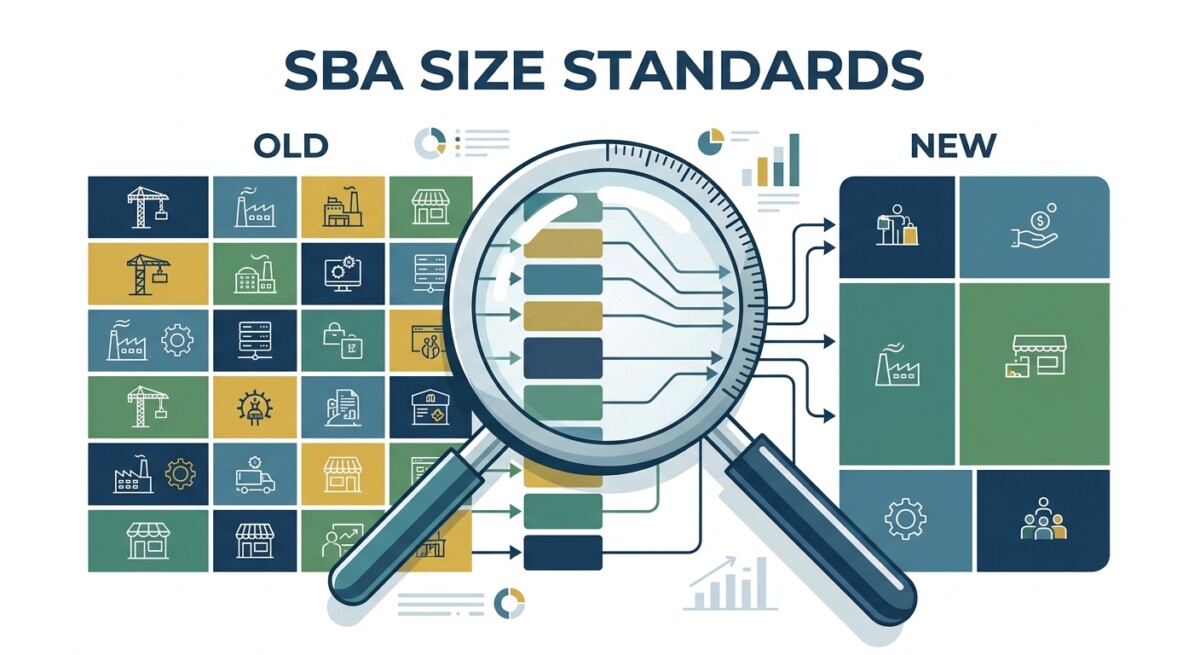
The Small Business Jobs Act of 2010 requires SBA to review each size standard at least once every five years. The current review is the third under that mandate. What is different this time is scope: instead of adjusting numbers for inflation and moving on, SBA is proposing to compress the framework itself. Under the current rules at 13 CFR Part 121, SBA maintains size standards at the six-digit NAICS level, producing close to 1,000 distinct standards once federal contracting exceptions are counted. The proposal would collapse this to 338 standards, set at the four-digit NAICS industry group level (276 standards) or the five-digit industry level (62 standards), and eliminates all 18 existing size standard exceptions.
The practical effect is that industries currently split into multiple six-digit codes with different thresholds will now share a single standard at the broader industry group level. SBA’s own example is Ship Building (1,300 employees) versus Boat Building (1,000 employees), which would merge into one standard. For contractors who have wrestled with edge-case NAICS classification calls, this removes a genuine source of protest risk. It also means some businesses will be grouped with larger or smaller peers than they are today, which can shift eligibility in either direction depending on the industry.
From our practice: NAICS choice is where the story starts
In our practice, the first review under any size standard change is not the math — it is the NAICS code the contractor has been certifying under. We regularly see clients using a six-digit NAICS that no longer reflects their primary line of business, or that will land in a different four-digit group under the proposal. Before you model receipts vs. employees, confirm you are running the model on the right code. A protest that turns on NAICS assignment is a protest you can lose before the numbers are even in evidence.
Which SBA size standards are moving from receipts to employees? 🔁
SBA is proposing to make employment-based standards the default whenever it has discretion, reversing the current presumption in favor of receipts outside manufacturing and services. Of the 338 proposed standards, 208 would be employment-based, up from 138 today, and 64 industries currently on receipts would convert to employees.
The stated rationale is that receipts fluctuate with inflation, productivity, and business cycles in ways that can push a contractor above and below the small business threshold from year to year, creating what SBA calls a “benefit cliff” that discourages growth. Employment is comparatively stable and carries an implicit productivity adjustment that receipts-based standards have historically lacked. That last point is doing real work in the proposal — see the methodology discussion below.
Contractors in the following categories should specifically check their primary NAICS to see whether the governing measure is changing:
- Farming and agriculture — several sub-industries are targeted for a switch to employee counts.
- Construction — receipts-based standards are on the list for conversion in a subset of trades.
- Retail non-service categories — currently on receipts; several would flip to employees.
- Manufacturing and distribution — a mix of conversions and threshold moves.
If your industry is on the switch list, the transition is not just a paperwork change. A $41.5 million average-receipts contractor with 250 full-time employees may be small under one measure and large under the other, and the two answers can diverge in either direction depending on the new threshold. Model both scenarios before certifying — the difference will decide whether you are eligible for the next set-aside solicitation you see.
A new methodology: what does “average market size” mean for SBA size standards? 📐
SBA is proposing to derive each size standard from a single concept — average market size — built from three inputs: (1) national industry size, (2) the number of geographic markets in which competition occurs, and (3) an adjustment for net imports and exports. The seven-factor 2024 methodology is being retired.
SBA frames the change as a closer fit to the statutory test that a small business not be “dominant in its field of operation,” reading “field of operation” as encompassing both product and geographic scope — similar to how competition authorities define markets in the 2023 Merger Guidelines. One immediate consequence: there is no longer an explicit ceiling on size standards, only a floor. That floor is 500 employees or, after adjustment, roughly $30.6 million in receipts. Industries with very large or very national markets, such as software publishing or aerospace manufacturing, could see materially higher standards than under the current methodology.
For the first time, SBA is also proposing to adjust receipts-based standards for productivity growth on top of inflation. Applied retroactively to SBA’s original 1954 baseline of $1 million, the inflation-only equivalent of roughly $9.7 million is pushed up to a $30.6 million minimum receipts-based standard in 2026 dollars. That single change explains why almost no industry sees a lower receipts threshold in the proposal.
No size standard is going down while the measure stays the same
Even where SBA’s own analysis would support a decrease, the agency is proposing to hold 45 industries at their current standards. SBA cites the defense and broader industrial base as a driving concern, noting that small businesses make up 73% of the defense industrial base even as the count of small Department of War vendors fell 49% between 2010 and 2024. The only industry expected to see a small number of firms lose status is Direct Property and Casualty Insurance Carriers, which is switching measures.
Will more competitors chase the same set-aside contracts? 🎯
Yes. SBA estimates the changes would increase the small business population from roughly 6.34 million to 6.46 million — about 114,500 more firms, including an estimated 37,000 firms already holding federal contracts worth more than $71 billion in FY 2025.
Professional and technical services industries see some of the largest projected gains in newly eligible competitors. SBA projects more than 5,300 additional eligible firms in Engineering Services (NAICS 541330) alone, with over 2,000 each in computer systems design and IT-related services. For an incumbent small business sitting near the current threshold, this cuts both ways. Higher standards mean more room to grow without losing set-aside eligibility, but they also mean a larger pool of competitors — including firms that outgrew the old standards and are now “small” again — chasing the same set-aside contracts.
| Where you sit today | Direction under the proposal | Practical planning move |
|---|---|---|
| Near or over the current receipts threshold in an industry converting to employees | Governing measure changes; new headcount threshold may leave you small again — or move you out. | Run both models now, and reprice capture strategy for the winning scenario. |
| Comfortable small under current receipts standard in a professional services NAICS | Threshold likely higher, but new competitors from formerly non-small firms. | Sharpen past-performance narrative; assume 5,000+ new eligibles in engineering-adjacent codes. |
| Currently using a six-digit NAICS exception that goes away | Absorbed into a broader four-digit group; new threshold may be different. | Confirm the new home code and threshold before your next certification. |
| Firm that outgrew a receipts standard within the last 3-5 years | Higher receipts thresholds and productivity adjustment may pull you back in. | Check both the receipts and the average-market-size floor; you may be small again. |
| Direct Property & Casualty Insurance Carrier at or near thresholds | SBA-flagged switch from employees to receipts; a small number of firms lose status. | Prioritize comment on the measure change; adjust succession/growth plans if final. |
What should contractors do before the Sept 21 comment deadline? 🚦
Identify your new NAICS home, model your status under both the current and proposed standards, watch your competitive set, and consider filing a comment before September 21. SBA has a track record of adjusting final rules in response to comments on prior five-year reviews.
- Identify your new NAICS home. Check where your primary NAICS code falls under the proposed four-digit or five-digit grouping, and confirm whether your governing size measure is changing from receipts to employees or vice versa.
- Model both scenarios. Calculate your status under the current standard and the proposed standard. If the transition could move you into or out of eligibility, that is a decision to bring to your capture and finance teams now, not the week the final rule drops.
- Watch your competitive set. In industries with large projected increases in small business counts, expect more competition for set-asides and factor that into capture strategy and past-performance positioning.
- Comment on the numbers that matter to you. SBA has specifically invited comment on the level of aggregation, the choice of size measure by industry, the geographic market methodology, and the minimum and anchor points used to calculate standards. Comments go through regulations.gov docket SBA-2026-0199 until September 21, 2026.
- Coordinate with your CPA and counsel. A change in governing size measure interacts with revenue recognition, employee classification, joint-venture arrangements, affiliation rules, and lending covenants tied to small business status. Do not treat this as a certifications-desk problem alone.
This is a proposed rule, not a final one, and SBA could still narrow or expand elements of it based on comments. But the direction is clear: simpler categories, a strong preference for employment-based standards, and higher thresholds across the board. Contractors who wait for a final rule to react will have less time to adjust than those who start modeling now.
Summary: what the proposed SBA size standards do
- Collapse roughly 1,000 current standards to 338, all at the four- or five-digit NAICS level; all 18 existing exceptions are eliminated.
- Default to employment-based measures wherever SBA has discretion — 208 of 338 standards, up from 138 today.
- Adopt a new “average market size” methodology built on national industry size, geographic markets, and net imports/exports; no explicit ceiling, and a $30.6 million receipts floor.
- Increase the small business population by an estimated 114,500 firms (6.34M → 6.46M), including 37,000 existing federal contractors.
- Comments are due September 21, 2026 through the regulations.gov docket SBA-2026-0199.
FAQ about the proposed SBA size standards ❓
Q. When do the new SBA size standards take effect?
Not yet. The two Federal Register notices published August 20, 2026 are proposals, not final rules. Comments are due September 21, 2026, and SBA has said it will consider public input before issuing a final rule. Contractors should model the impact now but keep certifying under the current standards at 13 CFR Part 121 until the final rule takes effect.
Q. How many SBA size standards will there be after the overhaul?
SBA is proposing to collapse the current framework — close to 1,000 distinct standards once federal contracting exceptions are counted — down to 338 standards. Of those, 276 would sit at the four-digit NAICS industry group level and 62 at the five-digit industry level. All 18 existing size standard exceptions would be eliminated.
Q. Will my business measure size by receipts or by employees?
For 208 of the 338 proposed standards, SBA is proposing an employment-based measure — up from 138 today. That includes 64 industries currently on receipts that would convert to employment (farming, construction, retail non-service categories, and various manufacturing and distribution sectors are singled out). Check your primary NAICS on the proposed table before certifying.
Q. Is any small business going to lose its status under the proposed sba size standards?
Very few. SBA is generally declining to lower any standard while keeping the same measure, and it is proposing to hold 45 industries at their current standards even where its own analysis would support a decrease. The one exception SBA flags is Direct Property and Casualty Insurance Carriers, which switches from an employee-based to a receipts-based measure and is expected to shift a small number of firms out of small status.
Q. How do I file a comment on the proposed rule?
Comments can be submitted through the regulations.gov docket SBA-2026-0199, or through the alternate methods listed at the top of each Federal Register notice. SBA has invited comment on the level of aggregation, the choice of size measure by industry, the geographic market methodology, and the minimum and anchor points used to calculate standards. The comment window closes September 21, 2026.
Q. Does the proposed methodology add anything new beyond an inflation update?
Yes. For the first time, SBA is proposing to adjust receipts-based standards for productivity growth in addition to inflation, which pushes the equivalent 1954 baseline of $1 million from about $9.7 million (inflation only) to a $30.6 million minimum receipts-based standard in 2026 dollars. It also introduces a single ‘average market size’ concept — national industry size, number of geographic markets, and a net imports/exports adjustment — in place of the seven-factor 2024 methodology.
This article is general information about a proposed rule, not legal or compliance advice for your business. Size determinations and set-aside eligibility turn on your specific NAICS, affiliations, and financials. If you would like a modeling session on how the proposal affects your certification, contact SW Accounting & Consulting Corp. See the SBA size standards program page for SBA’s own summary of the program.