Tip Deduction 2026: Who Qualifies for the $25K Break?
For decades, tips were ordinary wage income for federal tax purposes — taxable dollar-for-dollar. That changed when the One Big Beautiful Bill Act (OBBBA, P.L. 119-21) added a new deduction to the Internal Revenue Code. The tip deduction 2026 — codified as IRC §224 — lets qualifying workers subtract up to $25,000 of tip income from their federal taxable income for tax years 2025 through 2028. Payroll taxes still apply, state rules still apply, and income limits phase the deduction down or out entirely. Here is what every server, stylist, driver, and small-business owner should understand before the 2025 filing season closes.
At SW Accounting & Consulting Corp, our Los Angeles clients ask the same three questions every week: Do I qualify? How much can I actually deduct? And do I still owe payroll or California state tax on my tips? Below, we walk through the primary rules straight from the statute and IRS guidance — no marketing, no shortcuts.
What exactly is the new federal tip deduction? 💵
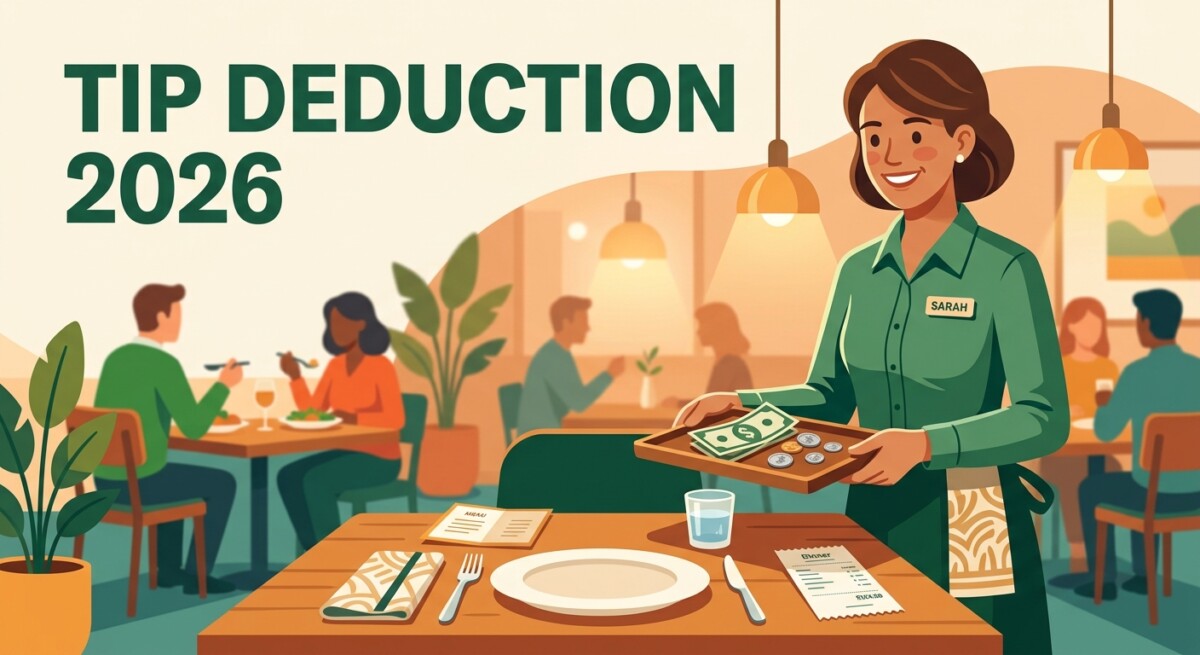
The tip deduction 2026 is an above-the-line federal income tax deduction of up to $25,000 for qualified tips earned in a customarily tipped occupation.
Congress added Section 224 to the Internal Revenue Code as part of the One Big Beautiful Bill Act. The provision creates a deduction — not an exclusion — for qualified tips received in tax years 2025 through 2028. Because it sits above the line, workers can claim it whether they take the Standard Deduction or itemize. The write-off reduces federal income tax, but it does not touch payroll taxes (Social Security and Medicare) or state and local income tax, both of which continue to apply.
Two structural details matter. First, the deduction covers only tips — voluntary payments a customer chooses to give — not wages, service charges billed by the establishment, or automatic gratuities coded as service charges. Second, the deduction is temporary. Under current law, it sunsets after the 2028 tax year unless Congress renews it.
Which jobs actually qualify under the tip deduction 2026? 🍽️
Only workers in occupations that customarily and regularly received tips on or before December 31, 2024, are eligible — and the IRS has published the official list.
The statute limits the deduction to jobs that “customarily and regularly” received tips before 2025, and the IRS has published the definitive list. See the IRS page on occupations that customarily and regularly received tips on or before December 31, 2024. Roughly 70 occupations are grouped into eight broad categories — food and beverage service, beauty and wellness, transportation and delivery, hospitality, entertainment, home and personal services, and others.
Common examples include waiters and waitresses, bartenders, hosts and hostesses, dishwashers when tipped through a pool, hair stylists and barbers, nail technicians, estheticians, massage therapists, caddies, taxi and rideshare drivers, delivery drivers, valet attendants, hotel bellhops and housekeepers, tour guides, and casino dealers.
Notably absent: tax preparers, attorneys, and other professional services are not on the list. A CPA who receives a “thank-you” tip from a happy client cannot claim the deduction on that amount because tips were not customary in that occupation before 2025.
How much can you actually deduct, and when does it phase out? 📉
The maximum is $25,000 per return, and the deduction phases out for higher-income workers by $100 for every $1,000 of modified adjusted gross income (MAGI) above $150,000 single or $300,000 married filing jointly.
The $25,000 cap is a return limit — not a per-spouse limit. A married couple filing jointly who together earned $30,000 of qualified tips still deducts a maximum of $25,000. Self-employed workers face a second cap: the deduction cannot exceed the net income of the business through which the tips were earned, computed after the deductible half of self-employment tax, retirement plan contributions, and self-employed health insurance.
The phaseout is straightforward but bites quickly. For every $1,000 (or fraction thereof) of MAGI above the threshold, the deduction shrinks by $100:
| Filing status | MAGI phaseout begins | Deduction fully eliminated at |
|---|---|---|
| Single / Head of Household | $150,000 | $400,000 |
| Married Filing Jointly | $300,000 | $550,000 |
Example. A married couple with $30,000 of combined qualified tips and $340,500 of MAGI first hits the $25,000 cap. Then, because MAGI is $40,500 above the $300,000 joint threshold, the deduction is further reduced by 40 × $100, or $4,000. Their final tip deduction is $21,000.
Do I still owe payroll and state taxes on tips? 💰
Yes — the tip deduction 2026 reduces federal income tax only. Social Security, Medicare, self-employment tax, and California state income tax on tips are unchanged.
Employees continue to owe Social Security and Medicare on tips, and employers continue to withhold those taxes on reported tip income. Self-employed workers continue to pay self-employment tax on tips at the same 15.3% combined rate on the first threshold and 2.9% Medicare above it (plus the 0.9% Additional Medicare Tax at higher income). None of that is affected by the new deduction.
State treatment is separate. California, for example, taxes tips as ordinary wage income and has not, as of this writing, adopted the federal tip deduction for California income tax purposes. A California worker who claims the federal deduction still owes California state tax on the full tip amount unless and until the state legislature and Franchise Tax Board act — a classic state conformity gap.
- Valid SSN required. The worker (and, if married, the spouse) must have a Social Security number valid for employment, issued before the due date of the return including extensions. An ITIN does not qualify. See SSA.gov on Social Security cards.
- Married couples must file jointly. A married worker who files a separate return cannot claim the deduction at all — a full disqualification, not a reduced cap.
How do I claim the tip deduction on my 2025 return? 📝
The IRS is not modifying 2025 forms — you claim the deduction as an above-the-line adjustment using amounts reported on your Form W-2 or Form 1099 and, for self-employed workers, from your books.
Employees will see reported tip income on Form W-2 (traditionally in box 1 for cash tips reported to the employer, and box 7 for the Social Security-tip portion). Self-employed workers should keep a contemporaneous daily record of tips — either through the payment processor, a POS system, or a simple log — because the IRS still expects substantiation on audit. Independent contractors receiving tips through platforms may see them reported on Form 1099-K or 1099-NEC.
Practical filing steps:
- Identify qualified tips only. Exclude auto-added service charges, banquet gratuities coded as service charges, and any tips received in a non-listed occupation.
- Compute MAGI first. Add back any foreign earned income exclusion, foreign housing costs, and income excluded for residents of Guam, American Samoa, the Northern Mariana Islands, or Puerto Rico.
- Apply the phaseout formula. Reduce the $25,000 (or lower actual tip total) by $100 for each $1,000 of MAGI over the applicable threshold.
- Report the deduction above the line. Follow current-year IRS Form 1040 instructions for the exact placement, which the IRS will publish in the 2025 form-year guidance.
- Keep documentation. Employer statements, POS reports, and a personal tip log should be retained for the standard three-year statute of limitations.
📌 Key Takeaways
- IRC §224 gives up to $25,000 of qualified tips as an above-the-line deduction for tax years 2025–2028.
- Only workers in the IRS’s roughly 70 customarily-tipped occupations qualify.
- MAGI phaseout begins at $150,000 single / $300,000 MFJ — deduction fully gone at $400K / $550K.
- Payroll tax and state tax still apply to tips.
- Valid SSN and (if married) joint filing are required — no exceptions.
Frequently Asked Questions ❓
Q. Is the tip deduction 2026 the same as making tips tax-free?
No. It is an income tax deduction of up to $25,000, not an exclusion. Payroll taxes (Social Security and Medicare) and state income taxes on tips are unchanged. Federal income tax is what the deduction reduces.
Q. Do I have to itemize to claim the tip deduction?
No. The deduction is above the line, so you can claim it whether you take the Standard Deduction or itemize your deductions.
Q. Which occupations are eligible?
Only jobs the IRS classifies as customarily and regularly receiving tips on or before December 31, 2024 — about 70 occupations across food service, beauty and wellness, transportation, hospitality, entertainment, and personal services. Consult the IRS occupation list before claiming the deduction.
Q. How does the income phaseout work?
Your maximum deduction is reduced by $100 for each $1,000 (or fraction thereof) of MAGI above $150,000 single or $300,000 married filing jointly. The deduction reaches zero at $400,000 single or $550,000 joint.
Q. Can I claim the deduction if I am married but file separately?
No. Married taxpayers must file a joint return to claim the tip deduction 2026. Filing separately fully disqualifies both spouses.
Q. Does California follow the federal tip deduction?
As of this writing, California has not conformed to the federal tip deduction, so tips remain fully taxable for California state income tax purposes. State treatment is a separate analysis from the federal claim.
Q. Are automatic service charges considered tips?
No. Amounts added by the establishment — such as a mandatory 18% banquet service charge — are treated as wages, not tips, and are not eligible for the deduction.
The tip deduction 2026 is one of the most consequential wage-side tax changes in years for California’s service industry. If you would like a review of your withholding, estimated payments, or self-employment structure ahead of the 2025 filing season, contact SW Accounting & Consulting Corp. Primary sources: IRC §224, the IRS occupations list, general guidance at IRS.gov, and the California Franchise Tax Board for state conformity.