Restaurant Tip Payroll 2026: Withholding, Form 8027 and the FICA Tip Credit
If you run a restaurant, a dental office, or any business with hourly and tipped workers, 2026 brings the biggest payroll reporting change in years. A new federal tips and overtime deduction lets employees write off a large share of their tip income and overtime premium — but it does not change what you withhold automatically, and it does add specific amounts you now have to track and report on the W-2.
At SW Accounting & Consulting Corp, we process payroll for Los Angeles dental practices, restaurants, and other small businesses, and this is the change generating the most client questions right now. Here is what actually changed, what your payroll system has to do, and the deadlines that come with it.
What is the new tips and overtime deduction? 🧾
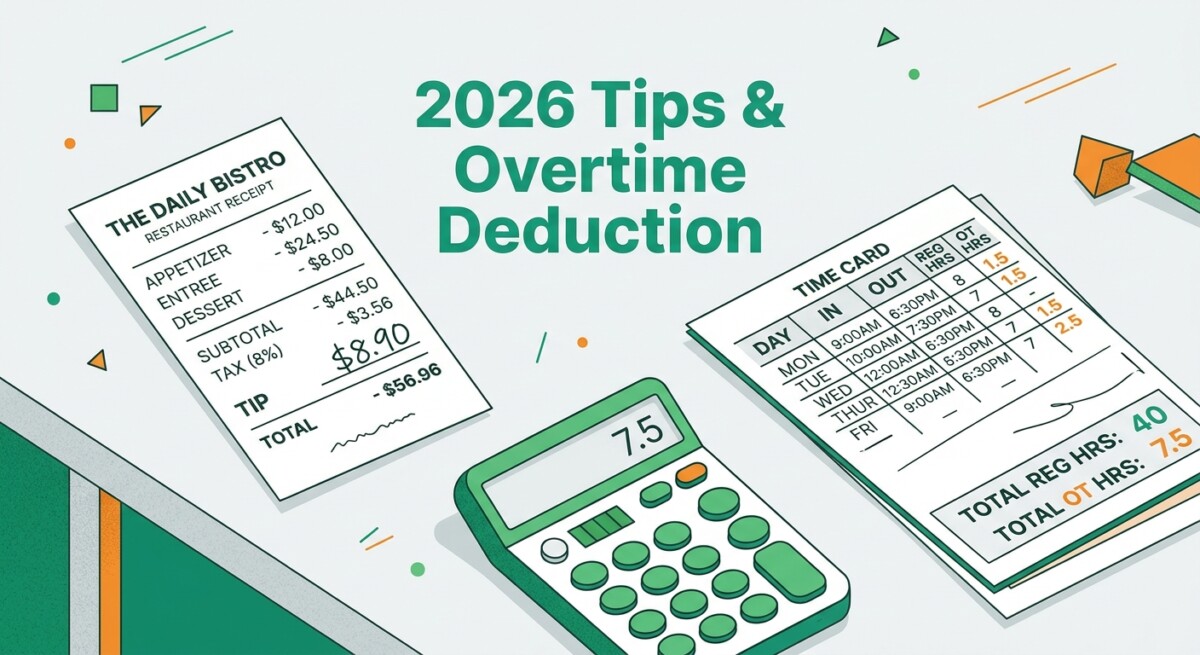
Two new above-the-line deductions let employees subtract qualified tips and the overtime premium from taxable income for tax years 2025 through 2028.
Under federal legislation enacted in 2025, workers may deduct:
- Qualified tips — up to $25,000 per year. This covers voluntary cash and charged tips. It does not cover mandatory service charges (auto-gratuity), which are treated as regular wages.
- Qualified overtime — up to $12,500 (single) or $25,000 (married filing jointly). The deduction applies only to the premium portion of overtime — the extra half-time above the regular rate — not to the base pay for those hours.
Both deductions are “above the line,” so employees can claim them whether or not they itemize, and both phase out at higher incomes (beginning around $150,000 of modified adjusted gross income, or $300,000 for joint filers). Because these are federal income-tax deductions, tips and overtime remain fully subject to Social Security and Medicare (FICA) taxes.
Does payroll withholding change automatically? ⚙️
No. The deduction is claimed on the employee’s tax return — your payroll system does not stop withholding on tips or overtime by itself.
This is the point employers most often get wrong. The new deduction reduces the employee’s final income-tax liability when they file Form 1040; it does not automatically reduce paycheck withholding during the year. What you do need to do is confirm your payroll software is loaded with the 2026 federal withholding tables from IRS Publication 15-T, and separately track the qualified tip and qualified overtime amounts so they can be reported to each employee.
Employees who expect a large tip or overtime deduction may want to update their Form W-4 so they are not over-withheld all year. That is a conversation to have with your staff early in 2026, not at tax time.
What does the employer have to report and by when? 🗓️
Employers must separately report qualified tips and qualified overtime on the W-2, and information returns are due at the end of January.
To let employees actually claim the deduction, the qualified amounts have to flow through your year-end reporting. Keep these dates on the calendar:
- January 31, 2026 (for TY2025): Forms W-2 to employees and 1099-NEC to contractors are due, and copies are due to the SSA/IRS the same day.
- Electronic filing is mandatory at 10 returns. If you file 10 or more information returns of all types combined, you must file them electronically — the old 250-return paper threshold is gone. See IRS e-file for information returns.
- Tip recordkeeping: employees receiving $20 or more in tips a month must report them to you, and you handle the associated FICA. See IRS tip recordkeeping and reporting.
What does this mean if you run a restaurant? 🍽️
For a restaurant, three things matter more than the deduction itself: the FICA tip credit you can claim, whether you owe Form 8027, and how your tip pool is built.
The deduction above is your employees’ benefit — it lowers their tax when they file. Your side of the ledger is different. Below is what actually changes cash and compliance for the operator.
1. The FICA tip credit (IRC §45B) — money back to you
You pay the employer share of Social Security and Medicare (7.65%) on every reported tip. Section 45B lets you take a dollar-for-dollar income tax credit for that same amount, to the extent tips push an employee above $5.15 an hour — a threshold frozen at the 1997 federal minimum wage. In a tipped restaurant this is often the single largest credit on the return, and it is the one most operators never claim. It also means accurate tip reporting puts money in your pocket, not just the IRS’s.
2. Form 8027 — the filing most operators miss
If tipping is customary and you averaged more than 10 employees on a typical business day last year, you are a “large food or beverage establishment” and must file Form 8027 annually — due February 28 on paper or March 31 electronically. It reports gross receipts and total tips per location. Miss it and you invite an examination into tip reporting across every location you run.
3. Your tip pool decides who can share. Since the 2018 amendment to the Fair Labor Standards Act, an employer who does not take a tip credit may run a pool that includes back-of-house staff — cooks and dishwashers. An employer who does take a tip credit may not. Managers and supervisors can never keep tips from a pool, in either case.
That third point lands differently in California. Because California does not allow a tip credit at all, California restaurants pay full state minimum wage regardless of tips — which is also what makes a kitchen-inclusive tip pool available here. Operators moving from a tip-credit state often carry over a pool structure that is no longer the right one.
In our practice these three items are handled together each payroll run, because they are connected: what you report on the W-2 drives what you can claim under §45B and what shows up on Form 8027. We run weekly payroll for multi-location restaurant groups in Los Angeles — including Silverlake Ramen, Avenue Shabu Shabu and OJI — and the reconciliation between those three is where errors surface.
How does tip payroll fit into prime cost? 📊
Tips themselves are not a restaurant cost — but the payroll tax on them is, and service charges are something else entirely. Getting the three apart is what makes prime cost comparable month to month.
Prime cost is cost of goods sold plus total labor, expressed as a percentage of sales. It is the single number most operators run the business on, because those two lines are the only large costs a manager can change this week. Rent cannot be renegotiated on a Tuesday; the schedule and the order guide can.
| Component | Typical range (full service) | What it includes |
|---|---|---|
| Food cost | 28–35% | Food purchases adjusted for inventory movement |
| Beverage cost | 18–24% | Liquor, beer, wine, non-alcoholic |
| Total labor | 30–35% | Wages, employer payroll taxes, benefits, workers’ comp |
| Prime cost | 55–65% | COGS + total labor as a share of sales |
Where tips complicate the labor line is that not every dollar an employee receives is a restaurant cost. A tip a guest leaves on the card is income to the server, and the restaurant is a conduit for it. It does not belong in wages when you calculate prime cost. What does belong is the employer share of FICA on those reported tips — 7.65% of every tip dollar your staff reports. On $400,000 of annual reported tips, that is roughly $30,600 of real labor cost sitting inside prime cost that has nothing to do with hours scheduled.
A mandatory service charge works the opposite way. It is not a tip. It is revenue to the restaurant, and whatever portion is paid out to staff is wages. So a service charge raises sales and raises labor at the same time — which is why prime cost percentages stop being comparable the month a restaurant switches from tipping to a service-charge model, and why year-over-year comparisons across that switch mislead almost every operator who tries them.
The FICA tip credit does not lower your prime cost
The IRC §45B credit is an income tax credit, not a payroll cost reduction. The employer FICA on tips stays in labor cost and stays in prime cost; the credit comes back later on the tax return through Form 8846. Operators who net the credit against labor understate prime cost and misread their own margins — keep them on separate lines.
Quick reference: 2026 tip and overtime deduction 📊
| Item | Qualified Tips | Qualified Overtime |
|---|---|---|
| Maximum deduction | $25,000/yr | $12,500 single / $25,000 joint |
| Applies to | Voluntary cash & charged tips | Overtime premium only (not base) |
| Excludes | Mandatory service charges | Straight-time hours |
| Still owes FICA? | Yes | Yes |
| Years available | 2025–2028 | 2025–2028 |
📌 Key Takeaways
- Employees can deduct up to $25,000 of tips and up to $12,500/$25,000 of overtime premium for 2025–2028.
- The deduction is claimed on the employee return — payroll withholding does not change automatically.
- Tips and overtime still owe FICA; mandatory service charges do not qualify.
- Track qualified tips/overtime for the W-2, and e-file if you have 10+ information returns.
Frequently Asked Questions ❓
Q. Do the tips and overtime deduction rules mean I stop withholding tax on that pay?
No. You keep withholding under the standard 2026 tables in Publication 15-T. The deduction reduces the employee’s tax when they file their return; it is not an automatic payroll exemption.
Q. Are tips and overtime still subject to Social Security and Medicare tax?
Yes. These are federal income-tax deductions only. FICA (Social Security and Medicare) still applies to both tips and overtime, for the employee and the employer share.
Q. Does a mandatory 18% party gratuity count as a qualified tip?
No. Mandatory service charges are treated as regular wages, not tips, so they do not qualify for the tip deduction. Only voluntary tips the customer chooses to leave qualify.
Q. How much overtime actually qualifies?
Only the premium — the extra half-time above the regular rate. If an employee earns $20/hour and $30/hour for overtime, the qualifying amount is the $10 premium per overtime hour, not the full $30.
Q. When do I have to file electronically?
If you file 10 or more information returns of all types combined (W-2, 1099-NEC, 1099-MISC, etc.), you must e-file. The previous 250-return paper threshold no longer applies.
Q. What if I employ tipped staff in California?
California does not allow a tip credit against minimum wage, so tipped employees must receive the full state or local minimum wage plus their tips. The federal deduction is separate from California wage rules — you must comply with both.
Payroll changes like these are simple to state and easy to mishandle in the numbers. If you would like your 2026 payroll setup reviewed — withholding tables, tip and overtime tracking, and W-2 reporting — contact SW Accounting & Consulting Corp. Primary sources: IRS Publication 15 (Circular E), Publication 15-T, and IRS e-file for information returns.
Q. Can I get a tax credit for the payroll taxes I pay on my staff’s tips?
Yes. The FICA tip credit under IRC §45B refunds the employer share of Social Security and Medicare tax paid on reported tips, to the extent those tips exceed $5.15 per hour of work. It is a dollar-for-dollar income tax credit, claimed on Form 8846. Many restaurants never claim it, which means they are paying tax they could have recovered.
Q. Does my restaurant have to file Form 8027?
You must file if tipping is customary and you averaged more than 10 employees on a typical business day in the prior year. The deadline is February 28 on paper or March 31 if filed electronically. It is filed per establishment, so a group with three locations may owe three forms.
Q. Can I include kitchen staff in the tip pool?
Only if you do not take a tip credit. Since 2018, employers who pay full minimum wage without a tip credit may include back-of-house staff such as cooks and dishwashers in a mandatory pool. Because California prohibits the tip credit entirely, California restaurants generally can. Managers and supervisors may never take a share.
Q. What is prime cost for a restaurant?
Prime cost is cost of goods sold plus total labor, measured as a percentage of sales. A full-service restaurant generally targets 55 to 65 percent, with food at 28 to 35 percent, beverage at 18 to 24 percent and total labor at 30 to 35 percent. It is the working number because COGS and labor are the two large costs an operator can actually change week to week.
Q. Do tips count as labor cost in prime cost?
The tips themselves do not — a tip is income to the employee and the restaurant is only passing it through. What does count is the employer share of FICA on reported tips, 7.65 percent of every reported tip dollar. Mandatory service charges are different again: they are restaurant revenue, and payouts to staff are wages, so a service charge raises both sales and labor.