
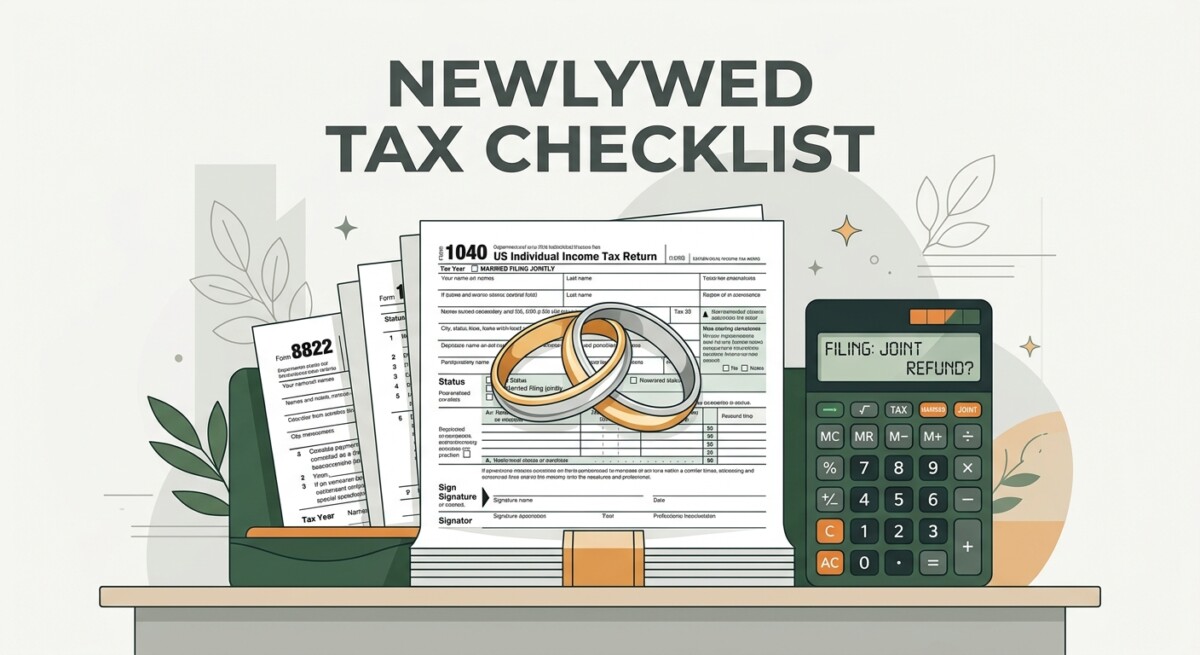
Newlywed Tax Checklist 2026: 6 Steps Before You File
Weddings come with a stack of paperwork, and most of it is not fun. But a short newlywed tax checklist handled in the weeks after the ceremony can prevent a lot of headaches at filing time — bounced refunds because a name doesn’t match Social Security, underwithheld paychecks that push you into an unexpected balance due, or a lost IRS notice sitting at your old address.
At SW Accounting & Consulting Corp, we prepare returns for Los Angeles couples every spring, and the same avoidable issues surface year after year. The IRS spells out the fixes in Tax Tip 2026-54. Here is how to work through them one by one before the 2026 filing season arrives.
Do I need to change my name with Social Security first? 🪪
Yes. Report any name change to the Social Security Administration before you file, because the name on your return has to match SSA records.
If either spouse changes a legal name, update it with the Social Security Administration first. The IRS matches the name and Social Security number on your tax return against SSA records. A mismatch — even a small one, like a hyphenated last name that wasn’t recorded on the SSA side — is a very common cause of return-processing delays and refund holds.
Use the SSA’s official Change your name page for the current instructions and required documents. Do this early — waiting until February to update the card and then trying to e-file the return is exactly the timing that creates rejections.
How do I tell the IRS I moved after getting married? 📬
File IRS Form 8822 to give the IRS your new mailing address, and tell your employer, the post office, and your financial institutions separately.
If either spouse — or both — moved into a new home after the wedding, update the address in several places, not just one. The IRS does not automatically pick up an address change from the post office in every case. To officially update your mailing address with the IRS, complete and submit Form 8822, Change of Address. The IRS’s own Topic No. 157 explains additional notification options.
Also notify your employer (so your W-2 goes to the right place next January), your bank and brokerage (so 1099s do not vanish), and the U.S. Postal Service. If the IRS mails a notice or a refund check to an old address, you may not receive it in time to respond — and some notices carry short deadlines.
Why is redoing my Form W-4 part of the newlywed tax checklist? 💵
Because marriage can move you into a different tax bracket, and the withholding you set as a single filer likely no longer produces the right result.
Marriage changes a couple’s combined tax responsibilities. The IRS instructs newlyweds to give each employer a new Form W-4, Employee’s Withholding Certificate, within ten days of the wedding. When both spouses work, the combined household income can push you into a higher bracket than either single return would have shown, and higher earners may also trigger the Additional Medicare Tax.
Run the numbers before you sign anything. The IRS provides a free Tax Withholding Estimator that models federal income tax withholding based on your household situation. For a deeper walk-through of withholding rules, estimated-tax rules, and safe harbors, see IRS Publication 505, Tax Withholding and Estimated Tax.
Should we file jointly or separately in our first year? 🧮
Your marital status on December 31 sets the filing options for the whole year — and while joint is usually better, it is worth running both.
The IRS treats you as married for the entire tax year if you are married as of December 31, no matter which day of that year the wedding took place. Married couples can choose to file jointly (Married Filing Jointly, or MFJ) or separately (Married Filing Separately, MFS). Filing jointly is usually more favorable — it opens access to more credits and preferable brackets — but it is not automatic that joint is best.
There are situations where MFS makes sense: significant medical expenses tied to one spouse, income-driven student-loan repayment considerations, or one spouse’s complex issue you’d rather not entangle with the other’s return. Because MFS closes off several credits (education credits, the Earned Income Credit, and more), model the return both ways and compare the combined bottom line before you file.
What tax documents should newlyweds keep together? 📁
Consolidate both spouses’ W-2s, 1099s, prior returns, and receipts for deductible expenses into a single file — physical or digital — before December.
Combining important tax documents makes your first joint return quicker to prepare and easier to review. Pull each spouse’s most recent tax return, this year’s Forms W-2 and 1099, any Form 1095-A/B/C on health coverage, mortgage-interest and property-tax statements, retirement-account contribution confirmations, charitable-contribution receipts, and childcare or education records. Having everything in one place reduces the odds of missing income (which the IRS matches automatically) or overlooking a deduction.
Which credits and deductions can marriage change? 🎯
Marriage can change eligibility and phase-out thresholds for a wide range of credits and deductions — so a break you claimed last year may look different this year.
Almost every income-based credit and deduction uses different thresholds for joint versus single filers. Combined household income can phase you out of some benefits and into others. Areas to review as a couple include the standard deduction, the Child Tax Credit if you have or add children, education credits, retirement-account contribution limits and Roth IRA phase-outs, capital-gain brackets, and any state-level credits. When one spouse has self-employment or side-business income, running estimated-tax projections after marriage is especially important — the new combined bracket may leave one or both of you underwithheld.
Newlywed tax checklist at a glance 📊
| Step | Action | Timing |
|---|---|---|
| Name change | File with SSA so name matches at tax time | Within weeks of the wedding |
| Address change | IRS Form 8822 + USPS + employer + banks | Immediately after moving |
| Withholding | New Form W-4 with each employer | Within 10 days of marriage |
| Filing status | Model MFJ vs MFS; pick the lower total tax | Before filing next spring |
| Documents | Combine both spouses’ W-2s/1099s/records | Ongoing through year-end |
📌 Key Takeaways
- Update SSA records before filing so your name matches your Social Security number.
- Use Form 8822 to give the IRS your new mailing address.
- Redo Form W-4 with each employer within 10 days of the wedding.
- Model MFJ vs MFS — joint is usually better, but not always.
Frequently Asked Questions ❓
Q. Does the IRS know I got married?
Not until you tell it, either by updating your name with Social Security or by filing a return that shows a married filing status. Your marital status on December 31 sets your filing options for the entire year.
Q. How long do I have to submit a new Form W-4 after the wedding?
The IRS instructs employees to submit a new Form W-4 within 10 days of any event that changes their withholding, including marriage. Use the IRS Tax Withholding Estimator to model the right entries for a two-income household.
Q. Do we have to file jointly just because we got married?
No. Married couples can choose Married Filing Jointly or Married Filing Separately. Joint is usually more favorable, but it is worth running both when one spouse has significant medical expenses, student-loan issues, or unresolved tax matters.
Q. What form do I file to change my address with the IRS?
Use Form 8822, Change of Address, for individual returns. Filing this form ensures IRS notices, refund checks, and correspondence reach your new address.
Q. Do I still need to change my name with Social Security if I already changed it on my driver’s license?
Yes. The IRS matches your return against SSA records, not against your driver’s license. Until the SSA has your new name, your return is at risk of a matching rejection.
Q. Are there special rules for newlyweds who own a business or are self-employed?
Yes — a couple’s combined bracket, self-employment tax, and estimated-tax obligations all shift after marriage. See IRS Publication 505 for the rules, and consider updating quarterly estimates so you are not surprised at filing time.
A short newlywed tax checklist handled during the summer is much easier than untangling problems the following April. If you would like a CPA review of your combined withholding, filing-status choice, and 2026 estimated payments, contact SW Accounting & Consulting Corp. Primary sources cited: IRS Form 8822, IRS Form W-4, IRS Tax Withholding Estimator, IRS Publication 505, IRS Topic No. 157, and the Social Security Administration’s Change your name page.