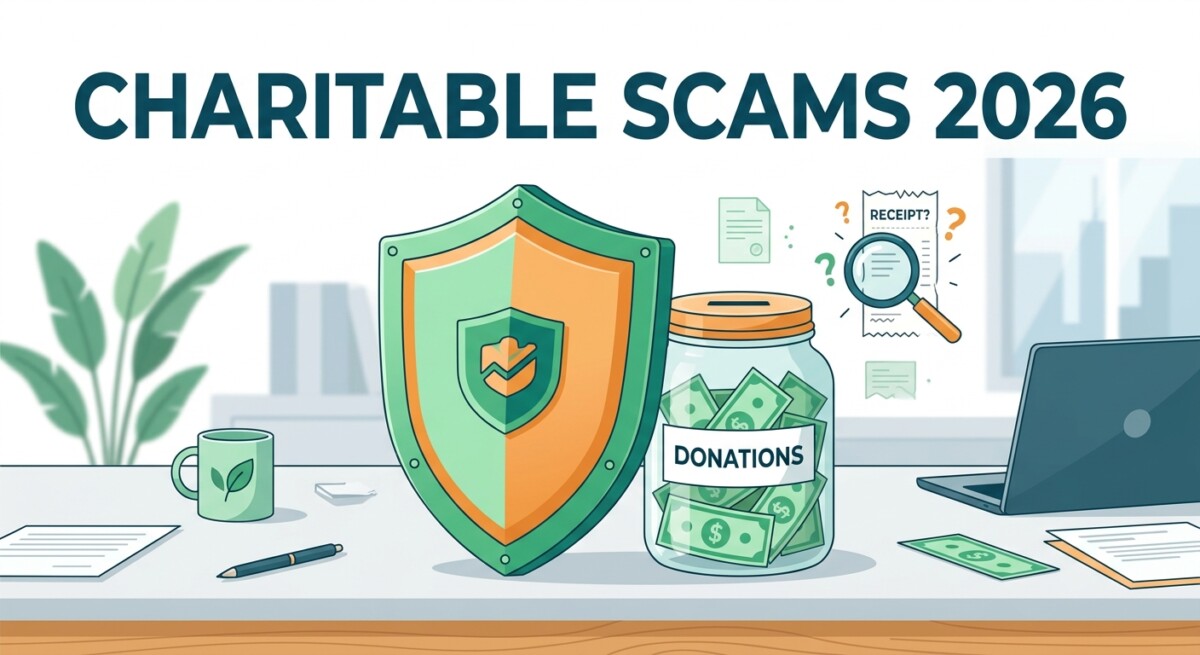
Charitable Contribution Scams (2026 IRS Dirty Dozen)
Every year the IRS publishes its “Dirty Dozen” — a list of the tax schemes it considers the most dangerous to ordinary taxpayers. In 2026, charitable contribution scams once again make the cut. The IRS is warning about two patterns in particular: fake charities that pop up after disasters, and promoter-driven arrangements that pitch dramatically inflated non-cash donations as a way to erase your tax bill.
At SW Accounting & Consulting Corp, we see the tail end of these pitches most often — usually months or years later, when a client shows us an IRS notice questioning a donation they made in good faith. Here is what the 2026 Dirty Dozen actually flags, how the rules work, and the concrete checks to run before you claim any charitable deduction on your return.
What are the charitable contribution scams on the 2026 Dirty Dozen? ⚠️
The IRS is focused on two categories: fake charities that solicit money and personal data, and inflated non-cash donation schemes that promise to eliminate your tax liability.
The IRS 2026 Dirty Dozen release calls out both. On the first, the agency notes that scams “of all kinds often increase” after a disaster or tragedy, when donors are moved to give quickly and are less likely to verify. On the second, the IRS specifically flags syndicated conservation easements, art donations, and other “gifted” property backed by inflated appraisals — schemes that continue to attract audit and enforcement resources.
Both patterns exploit the same weak points: donors who don’t confirm the recipient is a real tax-exempt organization, and donors who accept a promoter’s valuation without an independent, qualified appraisal.
How do fake-charity scams actually work? 🎭
Fraudsters set up an organization that looks like a charity — often mirroring the name of a legitimate group — to collect money, credit-card details, or Social Security numbers.
A few signals that a “charity” may not be legitimate:
- The organization can’t be found on the IRS Tax Exempt Organization Search (formerly Pub 78). If it isn’t listed, contributions are not deductible.
- The pitch is time-pressured — “give right now for the victims” — and the caller resists giving a mailing address or EIN.
- The request is for a donation to an individual (a GoFundMe-style pitch for one family, no matter how sympathetic). Individual gifts are never deductible under Internal Revenue Code §170.
- Payment is demanded by gift card, wire, or cryptocurrency, or the requester asks for a Social Security number “to send you a receipt.”
Even a real, well-known relief effort may not be tax-deductible if the payment goes through an entity that is not a qualified 501(c)(3). Compassion does not require a receipt — but claiming a deduction does.
What is the syndicated conservation easement scheme? 🌲
It is a promoter-marketed transaction in which investors buy an interest in a partnership that donates a conservation easement on real property and claims a charitable deduction many times the investors’ cash contribution.
The IRS has treated abusive versions of these transactions as listed transactions requiring formal disclosure. The pitch is nearly always the same: pay a small “investment” and receive a share of a charitable deduction two, three, or more times the amount paid in. In practice, the deductions rest on appraisals the IRS and the U.S. Tax Court have repeatedly found unsupported, and participants have faced disallowed deductions, accuracy-related penalties, and years of examination.
Ordinary conservation easements — where a landowner permanently restricts development on their own real property and follows the strict substantiation rules — can be legitimate. It is the packaged, promoter-driven, mass-marketed version with inflated appraisals that is the scheme.
How do I substantiate a legitimate charitable donation? ✅
The IRS substantiation rules escalate with the size and type of gift — and the IRS enforces them literally.
The core recordkeeping and documentation thresholds under IRC §170 and Treasury regulations:
- Any cash gift: keep a bank record (cancelled check or credit-card statement) or a written communication from the charity showing the organization, date, and amount.
- Cash or non-cash gift of $250 or more: obtain a contemporaneous written acknowledgment from the charity before you file your return. It must state the amount, describe any non-cash property, and confirm whether you received goods or services in return.
- Non-cash gift totaling over $500: file Form 8283 with your return.
- Non-cash gift over $5,000: obtain a qualified appraisal from a qualified appraiser and attach the required Form 8283 declaration. For gifts over $500,000, the full appraisal must be attached.
The most common enforcement pattern we see: taxpayers meet the dollar test but fail the paperwork test — no contemporaneous acknowledgment, no qualified appraisal, or a Form 8283 signed after the fact. Courts have disallowed six- and seven-figure deductions on those grounds alone.
Charitable donation checks at a glance 📋
| Gift type & size | Required documentation | Red flag |
|---|---|---|
| Any cash gift | Bank record or charity’s written receipt | Payment demanded in gift cards or crypto |
| Cash / non-cash $250+ | Contemporaneous written acknowledgment | Charity refuses to provide EIN or receipt |
| Non-cash over $500 | Form 8283 with the return | Pitch pre-fills the value for you |
| Non-cash over $5,000 | Qualified appraisal + Form 8283, Section B | Deduction is a stated multiple of cash paid |
| Gift to an individual | Not deductible under IRC §170 | “Help this family” style GoFundMe pitch |
📌 Key Takeaways
- Verify every charity on the IRS Tax Exempt Organization Search before you donate.
- Donations to individuals — GoFundMe-style — are not deductible under IRC §170.
- Non-cash gifts over $5,000 require a qualified appraisal — not a promoter’s number.
- Walk away from any pitch that promises a multiple-of-cash tax deduction.
Frequently Asked Questions ❓
Q. Are all charitable contribution scams targeted at wealthy taxpayers?
No. Fake-charity scams on the 2026 IRS Dirty Dozen list target ordinary donors, especially after disasters or tragedies. Non-cash and syndicated conservation easement schemes tend to be pitched to higher-income taxpayers, but any donor claiming an inflated appraisal is exposed.
Q. How do I verify a charity is really tax-exempt?
Use the IRS Tax Exempt Organization Search on IRS.gov. Enter the organization’s name or EIN — if it does not appear as a qualified organization, contributions to it generally cannot be deducted under IRC §170.
Q. Can I deduct a donation I sent directly to a family affected by a disaster?
No. Contributions to individuals are not deductible, no matter how deserving the recipient. To claim a deduction, give through a qualified 501(c)(3) that supports the affected community.
Q. What paperwork do I need for a donation over $5,000?
You need a contemporaneous written acknowledgment from the charity, a qualified appraisal from a qualified appraiser, and Form 8283 (Section B) attached to your return. For non-cash gifts over $500,000, the appraisal itself must be attached.
Q. What is a “syndicated” conservation easement, and why is the IRS focused on it?
It is a promoter-marketed partnership arrangement that claims a charitable deduction several times the investors’ cash contribution. The IRS has treated abusive versions as listed transactions requiring disclosure, and the U.S. Tax Court has disallowed many of the underlying deductions and imposed penalties.
Q. How do I report a suspected charitable-contribution scam?
The IRS consolidates fraud-reporting options at IRS.gov/help/report-fraud. You can also submit an anonymous tip through IRS.gov if you suspect a promoter is marketing an abusive charitable arrangement.
Charitable giving belongs in almost every tax plan — but only real charities and real appraisals earn a deduction. If you’re planning a significant end-of-year gift and want a second set of eyes on the paperwork, contact SW Accounting & Consulting Corp. Primary sources: IRS 2026 Dirty Dozen, IRS Tax Exempt Organization Search, IRS Publication 526, and the Form 8283 instructions.