No Tax on Overtime Deduction: How Much Can You Claim?
On August 6, 2026 the IRS released Fact Sheet FS-2026-13, updating the frequently asked questions about the no tax on overtime deduction created by the One, Big, Beautiful Bill Act (OBBBA, P.L. 119-21). The update supersedes the January 2026 FAQ (FS-2026-01) and finally answers what employees and employers have been asking all year — how much of an overtime paycheck really escapes tax, what has to appear on the W-2, and what happens if it does not.
At SW Accounting & Consulting Corp, we prepare returns and run payrolls for Los Angeles employers whose workforces regularly rack up overtime — restaurants, medical practices, contractors, logistics operators. The short answer for 2026: the deduction is real, it is meaningfully smaller than the headline suggests, and the paperwork burden falls squarely on the employer.
What exactly is the no tax on overtime deduction? 💵
It is an above-the-line income tax deduction — added by OBBBA at IRC §225 — for the FLSA-required portion of overtime pay, available whether the taxpayer itemizes or takes the standard deduction.
The deduction runs from tax year 2025 through 2028. Two limits control it: an overall cap of $12,500 of qualified overtime compensation per return ($25,000 for joint filers), and a phase-out that reduces the deduction once modified adjusted gross income (MAGI) exceeds $150,000 single / $300,000 joint. The deductible amount is computed on new Schedule 1-A (Form 1040), Part III.
Which portion of overtime pay actually qualifies? 🧮
Only the “half” in “time-and-a-half” — the premium required by 29 USC §207 above the employee’s regular rate. Straight-time hours, “double time,” and non-FLSA overtime (state law, contract, weekend, holiday) do not qualify.
The IRS spells the formula out in Q12 of the fact sheet:
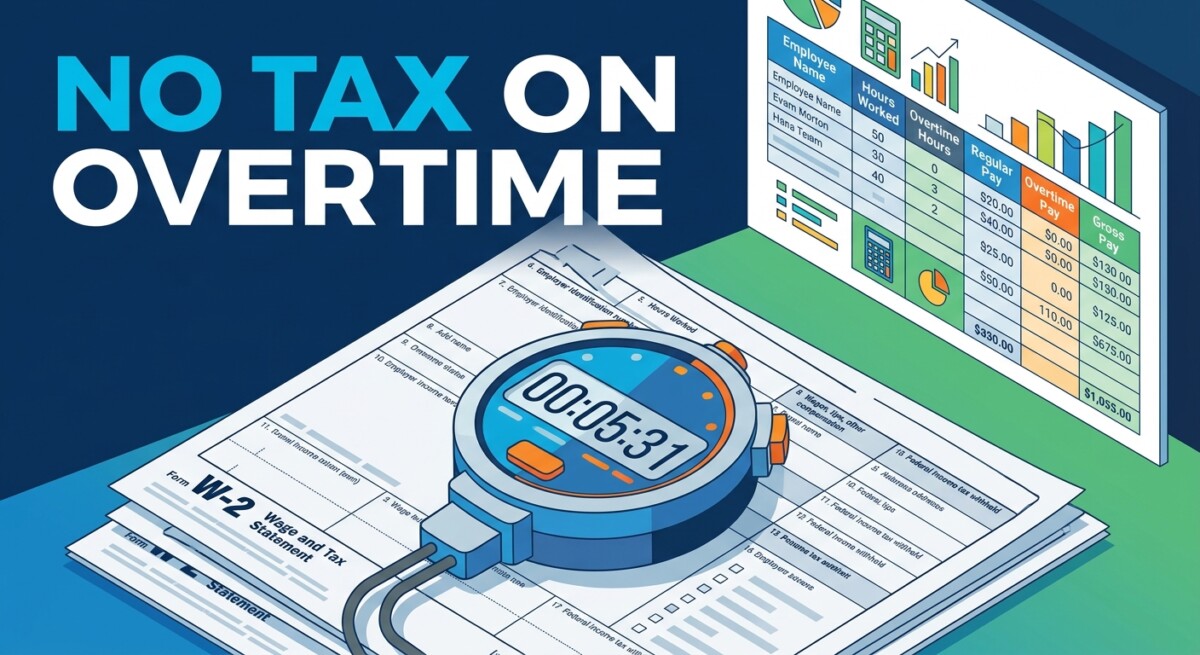
A worked example: an employee earns $20/hour and works 50 hours in a week. FLSA overtime pay is 10 hours × $30 = $300. The base-rate $200 of that is not deductible; only the $100 half-time premium is qualified overtime compensation. If the employer voluntarily pays “double time” ($400 for those 10 hours), the deductible amount is still $100 — the extra is not required by the FLSA.
Who is an “FLSA overtime-eligible” employee? 👷
Employees covered by the FLSA overtime requirement and not exempt from it — which excludes bona fide executives, administrative and professional employees, outside sales, certain computer-related roles, and other statutory exemptions.
If a worker is exempt from FLSA overtime, no part of their pay is qualified overtime compensation — regardless of what a state law, employment contract, or collective bargaining agreement calls “overtime.” Employers should verify status against DOL Fact Sheet #17A (white-collar exemptions) and related Wage and Hour Division guidance before assuming an employee’s overtime is deductible. A special rule in Q5 confirms that an employee who owns at least a 20% equity interest in the employer and is actively involved in management is treated as an exempt executive.
What does the employer have to do on the W-2? 📄
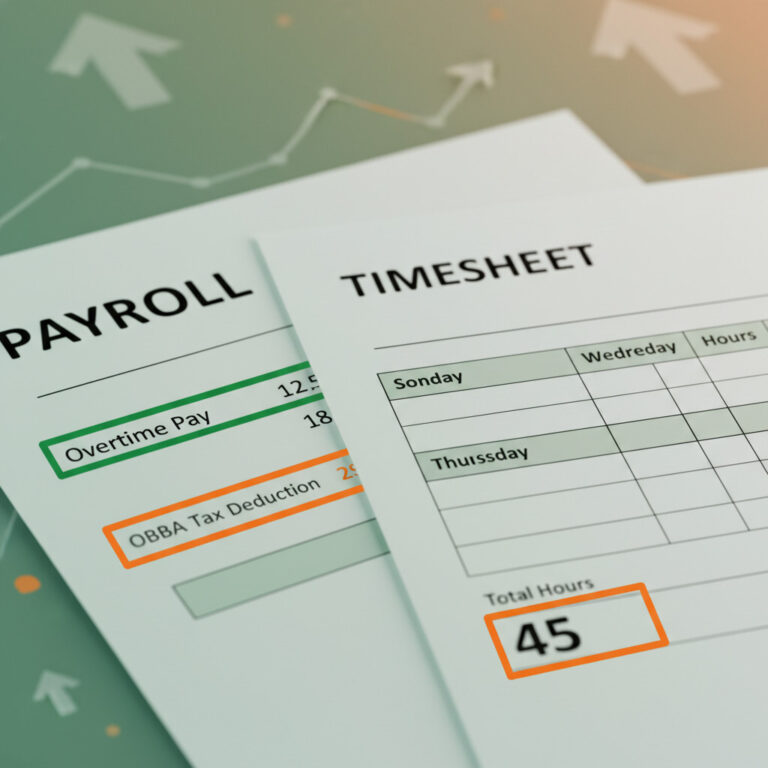
Starting with tax year 2026, employers must separately report qualified overtime compensation on Form W-2, box 12, using code TT — and get the amount right, because the employee cannot deduct anything more than what is reported.
Three practical points from the fact sheet employers keep missing:
- The 2025 relief is gone. Under Notice 2025-69, employees could still claim the 2025 deduction even if code TT was not on the W-2. For 2026 and later, no W-2 code TT entry = no deduction. Missed reporting directly costs your employees money.
- Report the full FLSA premium, even above the cap. If an employee earns $30,000 of qualified overtime, box 12 code TT reports $30,000 — the $12,500/$25,000 cap is applied at the employee’s return, not at the payroll level.
- Fix errors with a W-2c. Over-reporting is not free money for the employee; the employee is limited to actual FLSA overtime paid. Under-reporting or over-reporting exposes the employer to §6721/§6722 information-reporting penalties.
What should employees do before year-end? ✅
Confirm you are FLSA overtime-eligible, keep your own record of weekly overtime hours, and — if the expected deduction is large — submit an updated Form W-4 to right-size your withholding.
Concrete checklist for tax year 2026:
- Verify your FLSA classification. Non-exempt hourly and non-exempt salaried employees generally qualify; exempt “white collar” employees do not.
- Track your weekly overtime hours yourself so you can reconcile box 12 code TT on next January’s W-2 against reality — before you file.
- Estimate whether your household MAGI will clear $150,000 single / $300,000 joint. If it will, the deduction phases down and your planning value shrinks.
- Use the updated IRS Tax Withholding Estimator if you want the paycheck benefit now via a new W-4 step 4(b) entry rather than a larger April refund.
No tax on overtime — quick reference 📊
| Item | Single | Joint |
|---|---|---|
| Maximum qualified overtime deduction | $12,500 | $25,000 |
| MAGI phase-out threshold | $150,000 | $300,000 |
| Tax years available | 2025 – 2028 | |
| What qualifies | The FLSA §207 half-time premium only — not base pay, not “double time,” not state / contract overtime | |
| Employer reporting | Form W-2 box 12, code TT (mandatory from 2026); Form 1099-MISC box 14 / 1099-NEC box 1d in rare cases | |
| Employee claim | Schedule 1-A (Form 1040), Part III | |
📌 Key Takeaways
- Cap: $12,500 single / $25,000 joint, phased above $150K / $300K MAGI.
- Only the FLSA §207 half-time premium qualifies — not base pay, “double time,” or state/contract overtime.
- Employers must report qualified overtime in W-2 box 12 code TT starting 2026 — no entry, no deduction.
- Do not reduce withholding without a new Form W-4 (step 4(b)) from the employee.
Frequently Asked Questions ❓
Q. Is my overtime pay actually tax-free under the no tax on overtime deduction?
No. Overtime pay remains subject to income tax withholding, Social Security, Medicare, and unemployment tax. The deduction lets an eligible employee subtract the FLSA-required overtime premium from taxable income on their return, up to $12,500 single / $25,000 joint, with a phase-out above $150K / $300K MAGI.
Q. What if my employer forgets to put my overtime in box 12 code TT?
For tax year 2025, IRS Notice 2025-69 allowed the deduction even without the W-2 entry. For 2026 and later, no relief is available — under IRC §225(a) the employee can only deduct qualified overtime compensation that the employer reported on a properly furnished Form W-2. Ask your employer to issue a Form W-2c before you file.
Q. Does the no tax on overtime deduction cover “double time” or weekend pay?
No. Only the half-time premium required by 29 USC §207 (the “half” in time-and-a-half) qualifies. Any overtime that exceeds what the FLSA requires — including double time, weekend or holiday premiums, or overtime under a state law or union contract that goes beyond federal FLSA — is not qualified overtime compensation.
Q. I am a salaried “manager.” Do I qualify?
Usually not. Employees exempt from FLSA overtime under the executive, administrative, or professional exemptions are not FLSA overtime-eligible and their overtime pay — if any — is not qualified overtime compensation. Confirm your classification against DOL Fact Sheet #17A.
Q. Can I lower my paycheck withholding to reflect this deduction?
Only by furnishing your employer with a new Form W-4 that estimates the deduction on step 4(b). The 2026 Form W-4 and the IRS Tax Withholding Estimator have both been updated to include the qualified overtime deduction. Without a new W-4, your employer must continue withholding on the full wages.
Q. How long is the no tax on overtime deduction available?
The deduction applies for tax years 2025 through 2028 under OBBBA. Whether Congress extends it beyond 2028 is a separate legislative question.
If you run payroll for hourly or non-exempt salaried employees — or you have employees regularly earning overtime — the W-2 box 12 code TT reporting is now a hard requirement. If you would like a review of your 2026 payroll set-up before year-end W-2s go out, contact SW Accounting & Consulting Corp. Primary sources: IRS Fact Sheet FS-2026-13, P.L. 119-21 (OBBBA §225), and U.S. Department of Labor Fact Sheet #23 on FLSA overtime.