IRS 2026 warning: is the Tribal Tax Credit scam real?
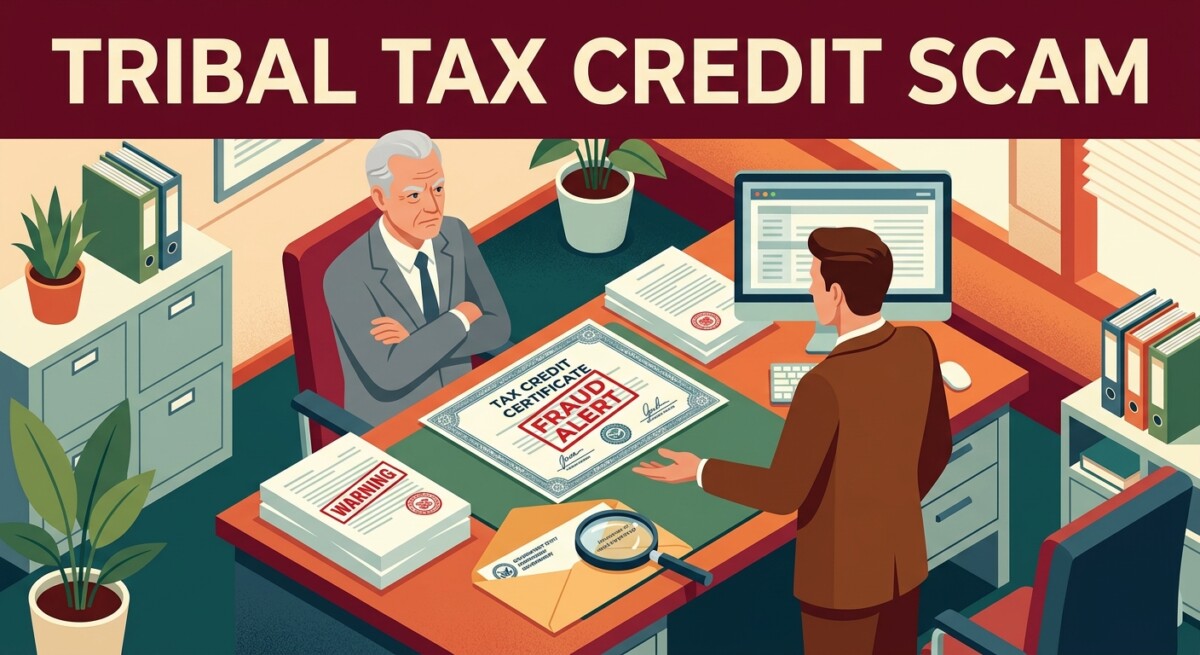
Every filing season brings a new label on the same trick. This year, promoters are marketing something called a “Tribal Tax Credit” — sometimes rebranded as a Native American Tax Credit or a Sovereign Tribal Tax Credit — and telling taxpayers, businesses, and even tax professionals that they can buy these credits at a discount to erase federal tax or generate refunds. On September 18, 2026, the IRS put the scheme on notice in IR-2026-112. The message was direct: the credit does not exist, and the Tribal Tax Credit scam is now an active enforcement priority. This post walks through what the IRS actually said, why the pitch sounds plausible, the tax and criminal exposure for buyers, and the steps a taxpayer or advisor should take today.
What is the Tribal Tax Credit scam the IRS is warning about? 🕵️
It is a marketing scheme in which promoters sell fake federal credits — labeled as “Tribal,” “Native American,” or “Sovereign Tribal” — that do not exist under federal law. Buying or claiming one is not a tax planning strategy; it is a false claim.
The pitch is old-fashioned in shape: a promoter offers a certificate, an assignment, or a set of documents that they say represent federal tax credits generated by a tribal community, then sells them to a taxpayer for a fraction of face value. The taxpayer is told to claim the credit on their Form 1040 or business return and either owe less tax or receive a refund. Promoters often bundle in a purported legal opinion or a reference to an interagency agreement to make the arrangement sound tightly documented.
The IRS answer is short. There is no Internal Revenue Code section that creates a Tribal Tax Credit. There is no Treasury regulation implementing one. There is no agreement between the Treasury Department, the Department of the Interior, and any tribal government that converts trust fund payments into transferable federal credits. A taxpayer who claims one is filing a false return, whether they know it or not, and the IRS has confirmed that acceptance of a filed return is not approval of a credit claimed on it.
The scheme also targets the tribal community itself, not just outside buyers. Promoters sometimes approach tribal members and small tribal businesses with a variant of the pitch that promises credits based on sovereign status. The IRS explicitly warned tribal communities in the same release that these credits are not real and that participating exposes them to the same civil and criminal penalties as any other buyer.
How do promoters make the Tribal Tax Credit scam look real? 🎭
They dress a fake credit in the vocabulary of real ones — transferable clean-energy credits, §45D New Markets Tax Credits, executive orders, and unnamed interagency agreements — and add urgency and NDAs to keep buyers from checking.
The IRS release names six recurring tactics. Reading them in order is a useful checklist because the strongest promoters combine all six.
- Claim a government agreement exists. Promoters cite a purported agreement among the Treasury Department, the Department of the Interior, and one or more tribal governments to convert tribal trust fund payments into federal tax credits. No such agreement exists. Anyone can search the Federal Register and the Treasury press page for a real interagency instrument; a program that leaves no public footprint is not real.
- Misrepresent transferable tax credits. The Inflation Reduction Act allows the transfer of certain clean-energy credits under §6418 in narrowly defined categories. Promoters borrow the vocabulary of transferability to make a Tribal Tax Credit sound like a routine assignment. The IRS guidance on transferable clean-energy credits list which credits can be sold and how; a Tribal Tax Credit is not among them.
- Misuse the New Markets Tax Credit. Promoters point to Internal Revenue Code §45D and the New Markets Tax Credit as if it authorized the transaction. §45D is administered by the CDFI Fund for investments in qualified community development entities and has no connection to a Tribal Tax Credit. The reference is a name-drop, not a legal foundation.
- Make false claims about tribal ownership. A common variant says that a company owned by tribal members automatically qualifies for a federal tax credit because of sovereign status. Sovereign status affects the taxation of tribal governments themselves; it does not create a credit that outside taxpayers can buy.
- Misrepresent executive orders or Code sections. Promoters cite presidential executive orders and Internal Revenue Code provisions to imply authority. Neither creates a Tribal Tax Credit. Executive orders cannot authorize a federal tax credit; only Congress can.
- Point to previously accepted returns. The pitch ends with, “Look, the IRS already let this through — they cashed the refund check.” The IRS’s acceptance of a filed return is not approval of the credit claimed on it. Refunds are issued on the return as filed and can be recovered by assessment, audit, or refund-suit years later.
Why does the IRS say the Tribal Tax Credit does not exist under federal law? ⚖️
Because no statute creates it. Federal tax credits are creatures of statute. Congress writes them into the Internal Revenue Code, and Treasury implements them through regulations.
A useful diagnostic when a new credit is pitched is to ask three questions in order: what Code section authorizes it, what regulation implements it, and who administers it. A real federal credit will have a specific IRC section, a Treasury regulation or IRS guidance, and a defined administrator such as the IRS, the CDFI Fund, or a state agency working under federal delegation. The Tribal Tax Credit fails all three. The pitch cites vague executive orders, references §45D or clean-energy transfers by analogy, and points to an unnamed interagency agreement to explain who issues the credit.
The IRS release is also clear that the sovereign status of tribal governments does not change the answer. Tribal governments are recognized as sovereign entities for many purposes under federal law, and Congress has enacted specific provisions — such as the general welfare exclusion for certain tribal program payments — that respect that status. None of those provisions creates a credit that a non-tribal taxpayer can buy from a promoter.
What are the red flags of a Tribal Tax Credit scam pitch? 🚩
Steep discounts, artificial urgency, secret government agreements, unverifiable legal opinions, and an NDA before basic disclosure. If a taxpayer sees any two of these, walk away.
The IRS release lists warning signs that a promotion is abusive. Each one is worth flagging on its own; the pattern of two or more together is the reliable tell.
- Offers to purchase tax credits for substantially less than their face value. Real transferable credits do trade at a discount, but the discount is narrow, disclosed, and paired with a signed transfer agreement filed with the IRS. A pitch that offers 30 or 40 cents on the dollar and does not identify the underlying Code section is a scam.
- Claims that only a limited number of credits are available or that you must act quickly. Federal credits do not sell out. Urgency is a compliance-testing tool, not a market signal.
- References to government or interagency agreements that are not publicly available. Real federal programs generate public documents — proposed rules, notices, press releases, and guidance. If the promoter cannot point you to the Federal Register, the IRS Newsroom, or a Treasury release, there is nothing to point to.
- Legal opinions that cannot be verified directly with the attorney or law firm identified. Ask for the opinion, then call the firm using the number on its website — not the number the promoter gave you. Legitimate opinions are traceable.
- Requests to sign a nondisclosure agreement before receiving basic information. Real tax planning is not confidential in this way. If the mechanics of a credit cannot be discussed with your own CPA under normal engagement terms, the mechanics do not withstand scrutiny.
From our practice: the NDA is the tell
In our practice, the single most reliable signal is the NDA. A promoter who requires a nondisclosure agreement before you can share the pitch with your CPA is protecting the pitch, not the transaction. Every Tribal Tax Credit pitch we have seen this year started with an NDA request, and every one of them fell apart within an hour once we asked to see the statute, the regulation, and the administrator. Clients who signed first and asked later spent months of legal fees unwinding paperwork that never should have been signed.
What happens if you claimed a fake Tribal Tax Credit? 💥
The IRS will assess the correct tax, add penalties and interest, and in serious cases pursue criminal charges. Refunds already paid can be recovered; audits reach back years.
The IRS release lists the civil consequences directly: assessment of the correct tax, penalties, interest, and “potentially, fines and imprisonment.” That last phrase is not decorative. Filing a return claiming a credit the filer knew or should have known did not exist is the fact pattern the Department of Justice Tax Division uses to open a §7206(1) false-return case.
| Consequence | How it applies to a fake Tribal Tax Credit |
|---|---|
| Assessment of correct tax | The credit is disallowed, and the taxpayer owes the tax that would have been due without it, plus interest from the original due date. |
| Accuracy-related penalty | Under §6662, a 20% penalty applies to underpayments attributable to negligence or a substantial understatement. A larger 40% gross-valuation-misstatement penalty may apply where the claimed credit is grossly inflated relative to any real basis. |
| Civil fraud penalty | Under §6663, a 75% penalty applies to any portion of an underpayment attributable to fraud. Buying a credit the taxpayer knew did not exist can support this penalty. |
| Erroneous refund recovery | Under §6532(b) and §7405, the IRS can sue to recover a refund it paid on a false return. |
| Criminal exposure | Under §7206(1), willfully signing a return known to be false is a felony with fines and up to three years’ imprisonment. Under §7201, tax evasion adds a fine and up to five years. The IRS and DOJ have used both against buyers and promoters of fake credits. |
Acceptance of a return is not approval of a credit
The IRS specifically called this out in IR-2026-112. Some promoters point to a prior refund as proof the credit is valid. A refund issued on a filed return is a mechanical action — the IRS processes the return as submitted and issues the refund the return computes. The IRS can and does open the return under audit for years afterward and recover the refund with penalties. If your promoter is showing you a refund check as evidence, they are showing you a timer that has not run out yet.
How do you report a suspected Tribal Tax Credit scam? 📝
File Form 14242, Report Suspected Abusive Tax Promotions or Preparers with the IRS Lead Development Center, and add a tip at IRS.gov/submitatip. Include the promoter’s materials, names, and any documents they asked you to sign.
Form 14242 is short, but the value of a report scales with the exhibits. The IRS’s Lead Development Center reads dozens of these each week; the reports that trigger fastest are the ones with the promoter’s website archived, the pitch deck, the sample credit certificate, the legal opinion, and the NDA. CPAs and financial advisors are especially useful reporters because they can attach a preparer’s read of the arithmetic and the legal citations.
- Preserve every artifact. Save the emails, texts, brochures, sample certificates, and legal opinions before they are pulled offline. Take screenshots, not just links.
- Complete Form 14242. Attach the artifacts as PDFs. Identify the promoter by legal name, DBA, address, and any registered agents you can find.
- Report the tax preparer separately if one signed the return. A preparer who signed a return claiming a fake credit faces §6694 preparer penalties and can lose their PTIN and CAF privileges. Form 14157 covers preparer misconduct in parallel with Form 14242.
- Submit a tip at IRS.gov/submitatip. This adds the promoter to the IRS’s electronic tip stream and cross-references your Form 14242 filing.
- Consult a CPA or tax attorney if you already claimed the credit. A voluntary correction is not a defense to every charge, but it materially improves outcomes on civil penalties and, in some cases, on criminal exposure.
The IRS also groups this type of scheme with its IRS Dirty Dozen list each year — the annual roundup of the most aggressive schemes it wants taxpayers and preparers to recognize. Reviewing the list at the start of filing season, and again mid-year when a client walks in with an unfamiliar pitch, is a low-cost habit that has prevented several client engagements at our firm from going wrong.
Summary: what the IRS said about the Tribal Tax Credit scam
- No federal Tribal Tax Credit exists under the Internal Revenue Code. Related labels — Native American Tax Credit, Sovereign Tribal Tax Credit — describe the same fake product.
- Claiming one is filing a false return, whether or not a refund was issued. Acceptance is not approval.
- Red flags: steep discount, urgency, secret interagency agreement, unverifiable legal opinion, NDA before disclosure. Any two together — walk away.
- Civil exposure runs from a 20% accuracy penalty to a 75% civil fraud penalty and refund recovery; criminal exposure includes §7206(1) false-return charges.
- Report the promoter on Form 14242 and at IRS.gov/submitatip; report a signing preparer on Form 14157. Consult a CPA before amending a return that already claimed the credit.
Frequently asked questions about the Tribal Tax Credit scam ❓
Q. Is there a federal ‘Tribal Tax Credit’ I can buy or claim?
No. There is no federal Tribal Tax Credit, Native American Tax Credit, or Sovereign Tribal Tax Credit under the Internal Revenue Code. In IR-2026-112, the IRS said plainly that these credits do not exist and that anyone who claims one is filing a false return. Federal law authorizes clean-energy credits to be transferred between taxpayers in narrow circumstances, but that authority does not create a tribal credit and cannot be used to launder a fake one.
Q. What happens if I already claimed a fake Tribal Tax Credit on a filed return?
The IRS treats the return as containing a false claim, whether or not it issued a refund. Expect the IRS to assess the correct tax, add penalties and interest, and in serious cases open a criminal investigation. Acceptance of a return does not mean the IRS approved the credit. If you claimed one, contact a CPA or tax attorney immediately to discuss amending the return, disclosing the position, and preserving records that show you were misled.
Q. What are the biggest red flags of a Tribal Tax Credit scam pitch?
The IRS listed several in IR-2026-112: offers to sell credits for far less than face value, urgency and ‘limited supply’ language, references to interagency agreements that are not publicly available, legal opinions that cannot be verified with the named attorney, and NDA gates before basic disclosure. If the promoter asks you to sign a nondisclosure agreement before you can see how the credit works, walk away.
Q. Does the New Markets Tax Credit have anything to do with tribal credits?
No. The New Markets Tax Credit under §45D is a specific program administered by the CDFI Fund for investments in qualified community development entities. Promoters sometimes cite §45D to make a Tribal Tax Credit sound legitimate, but the two are unrelated, and the IRS specifically called out this misuse in IR-2026-112.
Q. How do I report a suspected Tribal Tax Credit scam?
File Form 14242, Report Suspected Abusive Tax Promotions or Preparers, with the IRS Lead Development Center. You can also submit a tip at IRS.gov/submitatip. Include the promoter’s name, contact information, marketing materials, the alleged authority they cited, and any documents they asked you to sign. Reports from CPAs and financial advisors help the IRS build cases before more taxpayers are pulled in.
Q. As a CPA or financial advisor, what should I do if a client asks about buying one?
Say no in writing and keep the file. Preparers who sign returns claiming credits they know do not exist face preparer penalties, injunction actions, and potential loss of PTIN and CAF privileges. Encourage the client to walk away, save the promoter’s materials, and report the scheme on Form 14242. In our practice, one clear written ‘no’ from the advisor is often enough to end the conversation.
This article is general information, not tax or legal advice for your situation. Enforcement actions turn on facts and timing. If you or a client has been approached about a Tribal Tax Credit, or already claimed one on a filed return, contact SW Accounting & Consulting Corp for a confidential review before the next filing date.