SALT Deduction Cap 2026: Now $40,000 (Courts Uphold It)
For high-tax-state residents, few provisions sting like the cap on state and local tax deductions. The good news and the bad news arrived together this year: courts keep upholding the SALT deduction cap, but Congress has temporarily made it far more generous. This guide explains where the law stands, the new $40,000 limit, the income phase-out, and a planning move that may help business owners.
At SW Accounting & Consulting Corp, we help Los Angeles individuals and pass-through business owners navigate the SALT rules. Below: the litigation status, the pre-2018 baseline, the One Big Beautiful Bill changes, the high-income phase-out, and the pass-through entity workaround.
Are courts going to strike down the SALT cap? ⚖️
No. The courts are not unlocking the SALT cap. A U.S. district court in New Jersey recently dismissed a claim that the cap is unconstitutional, following a similar rejection by a federal appeals court.
In a 2026 case, a New Jersey district court dismissed a challenge arguing that the annual SALT limit imposed by the Tax Cuts and Jobs Act (TCJA) is unconstitutional. That outcome echoes the U.S. Court of Appeals for the Second Circuit, which rejected similar claims from a New York resident in New York v. Yellen, 15 F.4th 569 (2d Cir. 2021), with the U.S. Supreme Court declining to hear the case. In short, taxpayers should plan around the cap rather than wait for the courts to remove it. You can read federal appellate decisions through the U.S. Courts system and review the underlying statute at 26 U.S.C. § 164.
What was the SALT deduction before the cap? 📜
Before 2018, taxpayers who itemized could fully deduct their state and local taxes, with no dollar cap.
Prior to the TCJA, SALT payments were fully deductible by itemizers on their personal returns regardless of amount. That included state and local property taxes, plus either state and local income taxes or state and local sales taxes. Beginning in 2018 and lasting through 2025, the TCJA capped the SALT deduction at $10,000. So a taxpayer who paid $50,000 in state and local taxes was still limited to a $10,000 deduction. Because of this cap and other TCJA changes, many taxpayers switched from itemizing to the standard deduction and received no tax benefit from their SALT payments at all.
How much is the new SALT cap under the One Big Beautiful Bill? 💵
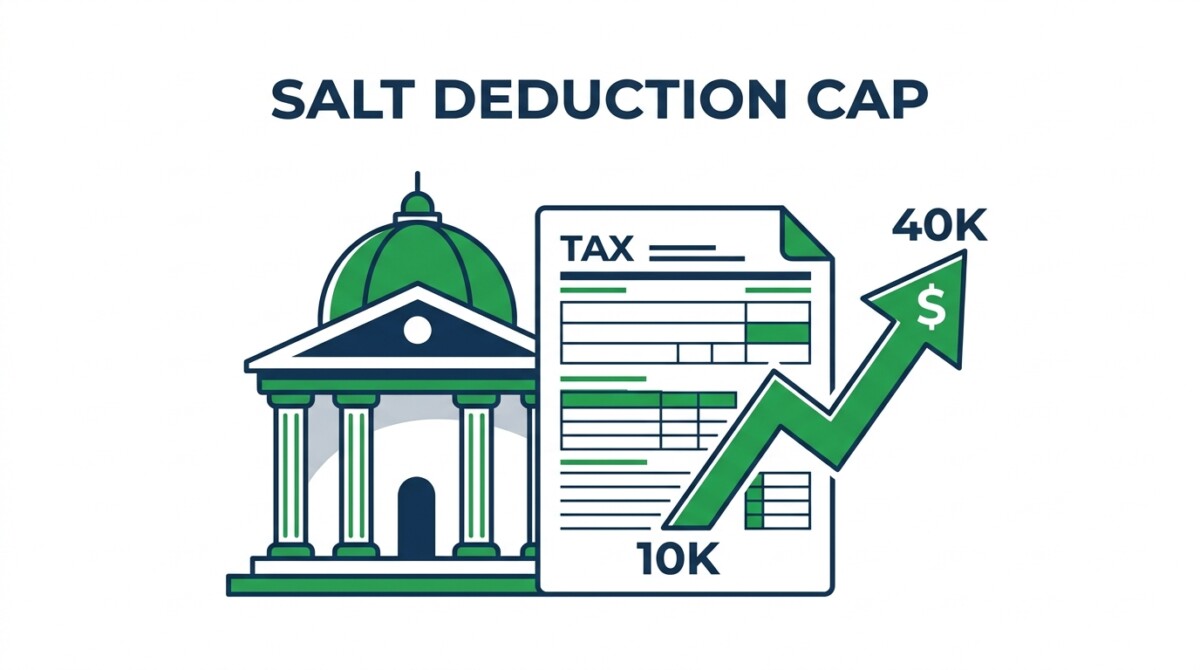
The One Big Beautiful Bill (OBBBA) raised the SALT cap to $40,000 — four times the prior amount — beginning in 2025, with a 1% annual increase for 2026 through 2029 before it reverts to $10,000 in 2030.
This is a major, if temporary, expansion. The $40,000 cap applies to both single and joint filers. For 2026 through 2029, that $40,000 ceiling rises by 1% each year. Then, unless Congress acts again, the cap drops back to $10,000 in 2030. For itemizers in high-tax states, the window from 2025 through 2029 may allow a substantially larger deduction than was available from 2018 to 2024.
| Period | SALT deduction cap |
|---|---|
| Before 2018 | No cap (fully deductible if itemizing) |
| 2018–2024 (TCJA) | $10,000 |
| 2025 (OBBBA) | $40,000 |
| 2026–2029 | $40,000 + 1% increase per year |
| 2030 | Reverts to $10,000 |
Is there an income limit on the new SALT deduction? 📉
Yes. The OBBBA includes a phase-out that reduces the deduction limit by 30% of the amount by which modified adjusted gross income (MAGI) exceeds $500,000.
The larger cap is not unlimited for high earners. Under the phase-out, the $40,000 limit is reduced by 30 cents for every dollar of MAGI above $500,000. Like the cap itself, this $500,000 threshold increases by 1% each year through 2029. The result: some high-income individuals will pay more tax overall — even if they itemize — because their expanded SALT deduction is clawed back as income rises.
For clients near the $500,000 MAGI line, timing matters. Because the SALT benefit phases out at 30% above that threshold, accelerating or deferring income across tax years can change how much of the $40,000 cap you actually keep. We model the SALT deduction alongside other MAGI-sensitive items before year-end — it is rarely a standalone decision.
Can business owners get around the SALT cap? 🏢
Many states allow a pass-through entity (PTE) tax workaround: the entity pays the state tax and the owner claims a deduction or credit, effectively moving the SALT deduction above the individual cap.
If you own an interest in a pass-through entity — a partnership, S corporation, or LLC — your state may permit an elective entity-level tax. The entity makes the state tax payment and deducts it, and the owner then claims a corresponding deduction or credit on their personal return, reducing federal taxable income. The details vary state to state, and the election usually must be made on time, so this is a planning move to set up deliberately, not a last-minute fix.
A bigger cap tempts people to stop planning. Two traps: (1) the phase-out can quietly erase much of the benefit above $500,000 of MAGI, and (2) the expansion is temporary — it reverts to $10,000 in 2030. Build both the phase-out and the 2030 cliff into multi-year projections instead of assuming $40,000 is permanent.
- Courts continue to uphold the SALT cap; a NJ federal court dismissed another challenge in 2026.
- OBBBA raised the cap from $10,000 to $40,000 starting in 2025 (then +1%/yr through 2029).
- A phase-out cuts the limit by 30% of MAGI above $500,000.
- The cap reverts to $10,000 in 2030; PTE workarounds may help business owners.
Frequently asked questions
The One Big Beautiful Bill raised it to $40,000 beginning in 2025, with a 1% annual increase for 2026 through 2029. It is scheduled to revert to $10,000 in 2030.
No. A New Jersey federal court dismissed a constitutional challenge in 2026, consistent with the Second Circuit’s rejection in New York v. Yellen, which the Supreme Court declined to review.
Yes. The limit is reduced by 30% of the amount by which modified adjusted gross income exceeds $500,000 (a threshold that rises 1% per year through 2029).
Many states let a partnership, S corporation, or LLC pay state tax at the entity level and deduct it, with the owner claiming a deduction or credit personally — effectively bypassing the individual SALT cap. Rules vary by state.
How can SW Accounting help? 💼
At SW Accounting & Consulting Corp, we help LA-area itemizers and pass-through business owners make the most of the expanded SALT deduction — modeling the $500,000 phase-out, timing income across years, evaluating a pass-through entity tax election in your state, and projecting the 2030 reversion so there are no surprises. If state and local taxes are a big line on your return, we will help you capture every dollar the law now allows.
📩 Plan your SALT deduction strategy
Disclaimer: This article is for informational purposes only and is not tax or legal advice. Consult a qualified professional about your specific situation. Primary sources: 26 U.S.C. § 164 (state and local tax deduction); New York v. Yellen, 15 F.4th 569 (2d Cir. 2021); U.S. Courts; the One Big Beautiful Bill Act.