How does the Education Freedom Tax Credit work in 2027?
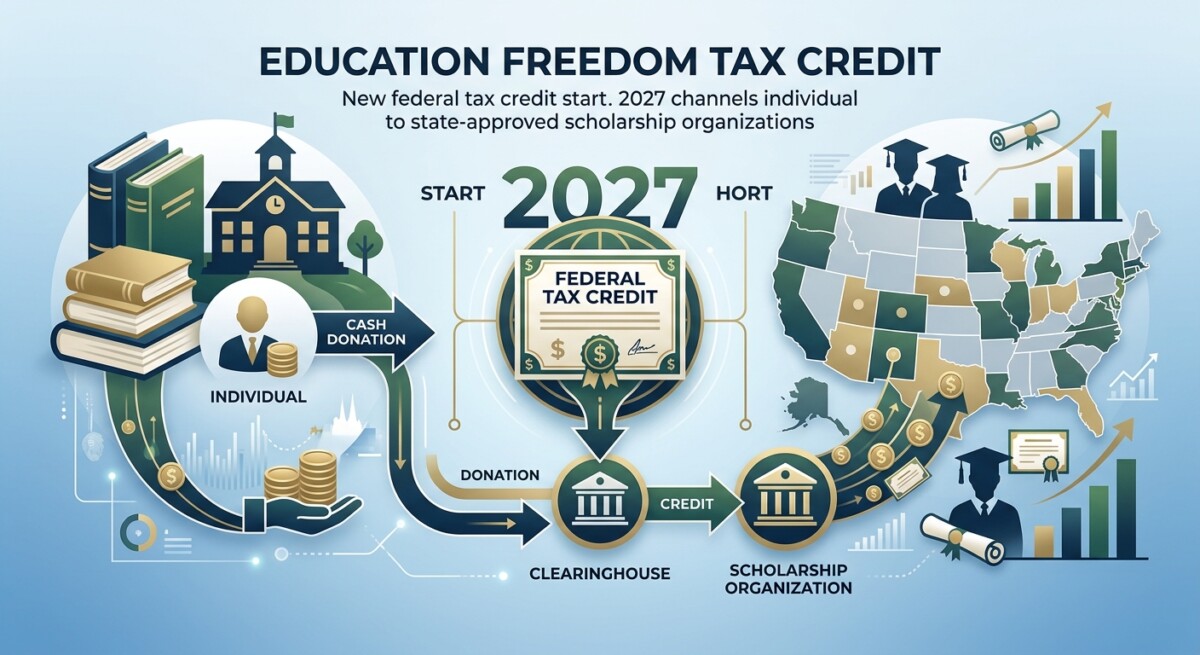
A new line is coming to the 2027 Form 1040. Individual taxpayers who give cash to certain scholarship charities will be able to claim a nonrefundable federal credit of up to $1,700 under Internal Revenue Code Section 25F — a provision commonly called the Education Freedom Tax Credit. The credit does not launch quietly. It routes through a new IRS State Portal, requires each state to opt in on Form 15714, and depends on an IRS-approved list of Scholarship Granting Organizations. As of the IRS’s most recent update, 30 states had already elected to participate, and the IRS is verifying every state’s point of contact ahead of the portal opening this fall. This post walks through what the credit does, who qualifies, why the state election matters, and what CPAs and taxpayers should do in 2026 to be ready for the first year of eligibility.
What is the Education Freedom Tax Credit under Section 25F? 🎓
It is a new nonrefundable federal credit of up to $1,700 for cash gifts an individual makes to a Scholarship Granting Organization on their state’s IRS-approved list, effective for tax years beginning on or after January 1, 2027.
Section 25F sits in the individual-credit block of the Internal Revenue Code alongside credits for children, savers, and education expenses. Unlike a deduction, a credit reduces tax dollar-for-dollar; unlike a refundable credit, a nonrefundable credit cannot drop your tax below zero. For most taxpayers with meaningful federal income tax, that distinction does not bite — the credit simply lowers the bill. Read the statute directly at Internal Revenue Code Section 25F.
Three pieces of the design are worth memorizing. First, only cash contributions count. Appreciated securities, real estate, tangible property, and pledges do not generate the credit. Second, the payee has to be a Scholarship Granting Organization (SGO) — a public charity that grants scholarships for qualifying educational expenses. Third, the SGO must appear on the list the taxpayer’s state has submitted to the IRS. A gift to a public charity that is not on the state list does not qualify, even if the organization is otherwise Section 501(c)(3).
The IRS confirms these mechanics on its IRS Federal Scholarship Tax Credit page, which is the taxpayer-facing landing page for the program. That page is the SSOT — the single source of truth — for the credit, and it will be updated as guidance rolls out through 2026 and into 2027.
Who can claim the credit, and what counts as a Scholarship Granting Organization? 💰
Only individual taxpayers can claim Section 25F. The qualifying donee is a public charity that grants scholarships for educational expenses and that has been added to the electing state’s IRS-submitted list of SGOs.
The credit is designed for individuals; it is not a business credit. If you contribute through a passthrough entity, the mechanics fall back to the individual owner’s Form 1040 return. Because the ceiling is $1,700 per taxpayer, high-dollar donors will not turn the credit into an unbounded subsidy — the credit caps out well before typical major-gift levels. Excess cash to the same SGO in the same year is not lost; it can still be deductible as a charitable contribution, subject to the usual Section 170 rules and the coordination rule below.
An SGO is a Section 501(c)(3) public charity — the kind you can already verify through the IRS Tax Exempt Organization Search — with the specific mission of granting scholarships for qualifying educational expenses. To qualify for the credit, however, exempt status alone is not enough. The IRS is building a state-by-state list of the SGOs each electing state has approved, and only donations to organizations on that list unlock the Section 25F credit. Before donating in 2027, confirm two things: the organization holds a current determination as a 501(c)(3) public charity, and it appears on your state’s IRS-listed SGOs for that year.
From our practice: the state list is the gate, not the mission statement
In our practice, clients often confuse the moral fit (“they give scholarships”) with the legal fit (“they are on the IRS-approved list for this state, this year”). Only the second unlocks Section 25F. Ask the SGO directly for a copy of the state notice, or check the state’s education department page once the IRS portal goes live. The credit is easy to lose by writing a well-intentioned check to a lookalike organization.
Why does my state have to elect in, and how does Form 15714 work? 🏛️
Congress made the credit contingent on state participation. A state that wants its residents to be able to claim Section 25F must file Form 15714 with the IRS to elect in and to submit a list of SGOs.
The IRS’s Federal Scholarship Tax Credit rollout is running on a two-track schedule. On track one, states file Form 15714, Advance Election to Participate under Section 25F to elect in and to name a point of contact for future IRS communications. On track two, states build and maintain the SGO lists that the IRS will publish for taxpayers. Both tracks feed into the new State Portal the IRS is standing up this fall for the 2027 calendar year.
As of the IRS’s most recent update, 30 states had elected to participate. That leaves 20 states and the District of Columbia yet to decide. States that have already elected are being asked to reverify their point of contact — a housekeeping step, but a consequential one, because the point of contact receives every future notice the IRS sends about the program in that state. States that have not yet elected can still submit Form 15714 on the same form and be added to the list in time for the 2027 launch.
If your state does not elect in, you get no credit
This is the biggest planning risk with Section 25F. A donor in a non-electing state can make a fully appropriate gift to a public charity that grants scholarships and still get zero Education Freedom Tax Credit. The gift may remain deductible under the ordinary charitable-contribution rules if the donor itemizes, but the Section 25F credit is off the table until the state has filed Form 15714 and the SGO appears on the IRS list. Track your state’s status through 2026 before locking in 2027 giving plans.
How does the IRS State Portal work, and when does it open? 🖥️
The IRS is launching a new online State Portal this fall for electing states to submit their SGO lists for the 2027 calendar year. Taxpayers will see the resulting SGO lists on IRS.gov before the credit becomes claimable.
The State Portal is the mechanism the IRS uses to bring the credit online. Its rollout is sequenced deliberately: the IRS first verifies every electing state’s point of contact, then opens the portal so states can upload their SGO lists, then publishes the lists ahead of the January 1, 2027 effective date. Taxpayers do not use the portal directly — it is a state-facing tool — but the lists it produces are what taxpayers and preparers will consult before claiming the credit.
The practical takeaway for a 2026 return is that the credit is not yet claimable. It is a 2027 credit that will first appear on returns filed in 2028. Any advice that suggests you can “lock in” the credit by prepaying scholarships in 2026 misreads the statute — Section 25F is available for taxable years beginning on or after January 1, 2027, and the contribution has to be made in the credit year, to a state-listed SGO.
| Milestone | What happens | When |
|---|---|---|
| State point-of-contact verification | IRS reverifies each electing state’s contact using data from the state’s Form 15714. | Ongoing through fall 2026 |
| State Portal opens | Electing states submit their SGO lists to the IRS through the new online portal. | Fall 2026 |
| IRS publishes SGO lists | Taxpayers and preparers can see which SGOs qualify in each electing state. | Before January 1, 2027 |
| Section 25F credit becomes claimable | Cash contributions to listed SGOs generate up to $1,700 per taxpayer. | Tax year 2027 |
| First returns claim the credit | The 2027 Form 1040 (filed in early 2028) is the first return with a Section 25F line. | Filing season 2028 |
How does the credit compare with 529 plans and other education tax benefits? 📚
Section 25F is not a substitute for 529 plans or the higher-education credits — it is a separate credit tied to donations, not personal tuition. The programs solve different problems and can coexist on the same return.
The federal education-tax landscape already has several pieces: 529 plans (income-tax-free growth for education savings), the American Opportunity Tax Credit and the Lifetime Learning Credit (both for personal higher-education tuition), and the standard charitable-contribution deduction under Section 170. The Education Freedom Tax Credit is a fifth piece with a distinct job — subsidizing gifts to scholarship organizations rather than personal education spending.
- Section 25F (Education Freedom Tax Credit) — nonrefundable credit up to $1,700 for individual cash contributions to state-listed SGOs, starting in 2027.
- Section 25A (American Opportunity Tax Credit / Lifetime Learning Credit) — credits for qualified tuition and related expenses paid for the taxpayer, spouse, or dependent; these are unaffected by Section 25F.
- Section 529 plans — state-run education savings vehicles with federal income-tax-free growth and federal tax-free withdrawals for qualified education expenses. A donor’s own 529 contribution is not an SGO contribution and does not generate a Section 25F credit.
- Section 170 charitable-contribution deduction — the ordinary deduction for gifts to public charities. Any excess above the Section 25F ceiling can be considered here, but the same dollars cannot both generate a credit and be deducted (see below).
Coordination rule: the same dollar does not get both benefits
Section 25F treats the credited contribution as already receiving a federal tax benefit; the itemized charitable-contribution deduction is reduced by the amount claimed for the credit. A donor who gives $2,500 to a state-listed SGO would claim the $1,700 Section 25F credit and consider the remaining $800 for the ordinary charitable deduction, not the full $2,500 twice. Run the arithmetic before writing the check so the deduction, the credit, and the state charitable rules all line up.
Summary: Education Freedom Tax Credit
- New federal nonrefundable credit under Internal Revenue Code Section 25F — up to $1,700 for individual cash contributions to Scholarship Granting Organizations.
- Effective for taxable years beginning January 1, 2027; first claimed on 2027 returns filed in 2028.
- State-dependent: a state must file Form 15714 to elect in, and the SGO must be on the IRS-published list for that state.
- As of the IRS update, 30 states had already elected to participate; the IRS is building a new online State Portal opening this fall for 2027 SGO lists.
- Only cash gifts qualify. The same dollars cannot generate both the Section 25F credit and a Section 170 charitable deduction — coordinate before the gift.
Frequently asked questions about the Education Freedom Tax Credit ❓
Q. When does the Education Freedom Tax Credit begin, and how much is it?
The credit is available for taxable years beginning on or after January 1, 2027. Under Internal Revenue Code Section 25F, an individual taxpayer may claim a nonrefundable federal credit of up to $1,700 for cash contributions to a Scholarship Granting Organization (SGO) in a state that has elected to participate. The credit is not available for the 2026 tax year, and only cash contributions qualify — appreciated stock, property, and pledges do not.
Q. Does the credit apply automatically in every state?
No. A state (or the District of Columbia) has to affirmatively elect in and provide the IRS a list of qualifying SGOs before its residents can claim the credit for contributions to SGOs in that state. If your state has not elected in for 2027, contributions to in-state SGOs will not generate a Section 25F credit even if the organization is otherwise a public charity.
Q. How does a state elect in, and how many states have done so?
An electing state files Form 15714, Advance Election to Participate under Section 25F, following the form instructions. As of the IRS announcement, 30 states had elected to participate. States that have not yet elected can still do so by submitting Form 15714; states already on the list use the same form to update the point of contact the IRS uses to communicate.
Q. What is a Scholarship Granting Organization, and how do I know if my donation qualifies?
An SGO is a public charity — described in Internal Revenue Code Section 501(c)(3) and eligible to receive tax-deductible contributions — that grants scholarships for qualifying educational expenses. For the credit, only donations to SGOs appearing on the electing state’s IRS-submitted list qualify. Before writing a check in 2027, confirm the organization is on the state’s SGO list and verify its exempt status through the IRS Tax Exempt Organization Search.
Q. Can I claim both the Education Freedom Tax Credit and a charitable deduction for the same gift?
No. Section 25F treats the credit as a tax benefit for the contribution, and a taxpayer cannot double up by also deducting the same dollars as a charitable contribution. A donor who itemizes must reduce the charitable deduction by the amount of the contribution taken into account for the Section 25F credit. Coordinate with your CPA before assuming the gift lands in both places on the return.
Q. What should CPAs and clients do in 2026 to be ready?
Confirm whether your state of residence has filed Form 15714 or plans to; identify local SGOs likely to appear on the state list; plan cash contributions around the $1,700 per-taxpayer credit rather than large lump-sum gifts; and keep contemporaneous written acknowledgments from any SGO you support so the paperwork matches when you file the 2027 return in 2028.
This article is general information, not tax or legal advice for your situation. Section 25F is new, sub-regulatory guidance is still developing, and state elections are moving. Contact SW Accounting & Consulting Corp before locking in a 2027 giving plan.