U.S. Living Trust: The Ultimate Guide to Avoiding Probate in 2026
If you own any assets in the United States—a home, a business, or even just a bank account—you’re sitting on what could be a legal landmine for your family. It’s a scary thought, right? We all work hard to build something for our loved ones, but without the right plan, we could be leaving them with a massive legal headache. The good news? There’s a surprisingly simple and powerful way to disarm it. Let’s dive into the world of U.S. Living Trusts and figure out why this isn’t just for the super-rich… it’s probably for you. 😊
The “Probate Gauntlet”: A Legal Nightmare for Your Heirs 🤔
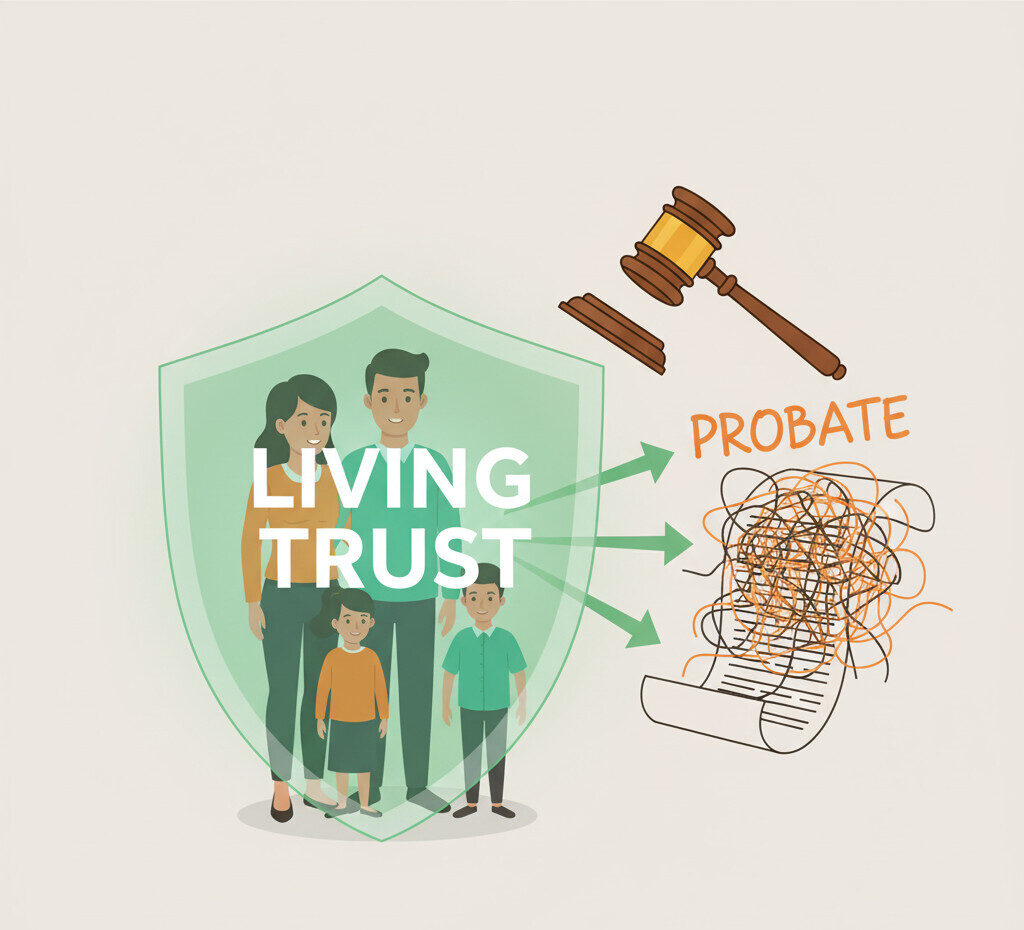
So, what happens if you *don’t* have a plan? When you pass away, your assets don’t just magically transfer to your family. Instead, they get stuck in a tangled legal process called **Probate**. The video’s guest, U.S. Attorney John Chung, calls it a “colossal headache,” and he’s not wrong. Probate is the formal, court-supervised process of validating your will (if you have one) and distributing your assets. And here’s the kicker: The court is in control, not your family.
This isn’t just a minor inconvenience; it’s a full-blown “gauntlet” for your grieving family. Here’s what they’d face:
- 1. Court Intervention: A judge and court administrators must oversee the entire process, from validating the will to approving the final distribution.
- 2. Frozen Assets: This is a big one. While your estate is in probate, your assets are often frozen. Your family may not be able to access your bank accounts or manage your property for months, or even years.
- 3. Costly Fees: Probate isn’t free. In fact, it’s expensive. Legal and court fees can easily consume 3% to 5% of your *entire* estate’s value. On a $500,000 estate, that’s $15,000 to $25,000 gone.
- 4. Public Record: Because probate is a public court proceeding, your entire estate becomes public knowledge. Your will, a list of your assets, their values, and who got what—it’s all available for anyone to look up.
As Attorney Chung puts it: “It’s slow, it’s costly, it’s public… You don’t want to deal with it.” And you definitely don’t want your family to deal with it.
The Solution: What is a Revocable Living Trust? 🛡️
Okay, so how do you protect your family from that mess? The answer is the “magic key” that lets you bypass probate entirely: a **Revocable Living Trust**. But “trust” sounds complicated, right? It’s really not. A Living Trust is simply a private legal document. That’s it.
Here’s the process: 1. You (the **Grantor**) create a legal entity (the Trust). 2. You transfer the ownership of your major assets (like your house, bank accounts, etc.) from your individual name into the name of the Trust. 3. You name yourself as the **Trustee** (the manager), so you still have 100% control to buy, sell, or refinance anything. 4. You name who gets what after you’re gone (the **Beneficiaries**).
Think of it like creating a small, private company for your assets. You’re the founder, the CEO, and the main shareholder, all at the same time. While you’re alive, nothing changes. But when you pass, because your assets are “owned” by the Trust (which *you* still controlled), there’s nothing for the probate court to supervise. Your chosen successor Trustee simply follows your private instructions and distributes the assets. No court, no fees, no public record.
Key Roles in Your Trust (Simplified)
| Role | Trust Title | What They Do |
|---|---|---|
| The Creator | Grantor (or Settlor) | That’s you. You create the trust and put your assets in. |
| The Manager | Trustee | Also you (while you’re able). You manage all the assets. You also name a “Successor Trustee” to take over when you can’t. |
| The Recipient | Beneficiary | Primarily you (while you’re alive), and then your chosen heirs (family, friends, charities) after you pass. |
More Than Just Probate: The Other Key Benefits 📊
Avoiding probate is the #1 reason (it’s 99% of the value!), but a Living Trust has a few other incredible superpowers:
- Total Control (Still!): This is crucial. It’s a *revocable* trust, meaning you can change or cancel it anytime. You can still buy, sell, or refinance any asset just like you do now. Your day-to-day life does not change one bit.
- Total Privacy: A will becomes a public document. A trust does not. Your finances, your assets, and your decisions remain completely private, known only to your family.
- The Incapacity Plan: This might be the most underrated benefit. What if you become ill or incapacitated and *can’t* manage your own affairs? Without a trust, your family would have to go to court to get a conservatorship. With a trust, your hand-picked Successor Trustee can step in immediately to pay your bills and manage your assets, all without a single court filing.
- Faster Distribution: Instead of waiting months or years for probate to close, your Successor Trustee can often distribute assets to your heirs in a matter of weeks.
Who Actually Needs a Living Trust? 🙋♀️
So, is this just for millionaires? Absolutely not. The answer is simple:
You should seriously consider a Living Trust if you are a:
- Homeowner: Owning real estate almost guarantees your estate will go through probate without a trust.
- Parent: You can set up provisions in your trust to manage inheritance for minor children.
- Business Owner: A trust ensures your business can be managed or transferred smoothly.
- Anyone with U.S. Assets: It’s the standard tool for U.S. estate planning.
As a general rule of thumb, if your total assets are worth more than **~$150,000**, a Living Trust is no longer a “nice-to-have.” In many states, it’s an absolute must to spare your family from the probate process.
Busting the 3 Biggest Living Trust Myths 👻
If trusts are so great, why doesn’t everyone have one? Honestly, it’s because of confusion and some very persistent myths. Let’s clear them up right now.
Myth #1: “If I put my house in a trust, I lose control of it.”
FALSE. This is the biggest myth, and it’s 100% wrong. With a *Revocable* Living Trust, you maintain 100% control. You are the Grantor *and* the Trustee. You can sell the house, refinance it, or even pull it out of the trust tomorrow. You are still the boss.
Myth #2: “A Living Trust helps me avoid taxes.”
MOSTLY FALSE. A standard *Revocable* Living Trust is “tax-neutral.” The IRS sees the assets as yours, so it doesn’t change your income or estate taxes. Its main job is avoiding *probate*, not taxes. People get confused by this because a different, more complex tool—the *Irrevocable* Trust—is used for tax reduction. But for 99% of us, the Revocable Living Trust is the right tool.
This is the source of most confusion!
- Revocable Trust (What we’re talking about): Simple, flexible, you keep 100% control. Main goal: **Avoid probate.**
- Irrevocable Trust (A different tool): Complex, rigid, you *give up* control. Main goals: Tax reduction or advanced asset protection.
Myth #3: “It’s too complicated and expensive to set up.”
FALSE. While it’s more involved than a simple will, a good attorney can make it a very straightforward process. But let’s talk about “expensive.” The one-time cost of setting up a trust is *tiny* compared to the money your estate will lose to probate. Let’s compare:
| Cost Comparison | Living Trust (Upfront) | Probate (Later) |
|---|---|---|
| The Cost | A one-time flat fee. | 3% to 5% of your *total* estate value. |
| Example ($500k Estate) | A few thousand dollars (one time). | $15,000 – $25,000 in guaranteed fees. |
| Bottom Line | A smart, cost-effective investment. | A guaranteed and significant loss for your heirs. |
Conclusion: The “First Button” of Your Financial Plan 📝
Let’s bring it all home. Think about getting dressed. If you get that first button wrong, the whole shirt is out of whack. In U.S. estate planning, the Living Trust is that first, most critical button you have to fasten.
It’s not some advanced, complicated strategy just for the wealthy. It is the foundational, fundamental first step for *anyone* who owns property in the United States. Getting it right gives your family privacy, control, and, most importantly, peace of mind during the most difficult of times. It’s truly one of the greatest gifts you can leave them.
Living Trust Key Facts
Frequently Asked Questions ❓
I hope this guide cleared up the confusion! A Living Trust is one of the most powerful and loving things you can set up for your family. If you have any more questions, feel free to ask in the comments~ 😊