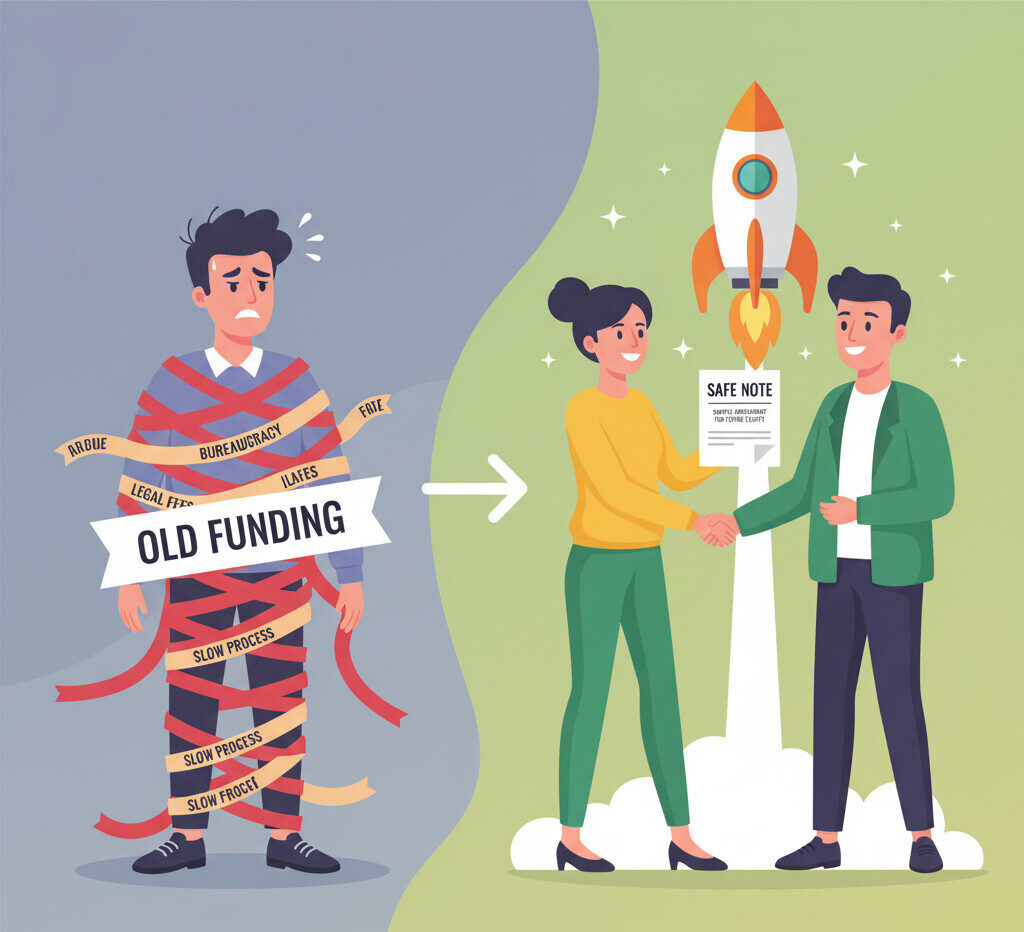
Startup SAFE: The Founder-Friendly Guide to Raising Money Fast
You have it. That billion-dollar idea that just woke you up in the middle of the night. You’ve sketched it on napkins, you’ve built a prototype in your garage, and you know, deep down, this thing could be huge. But then, reality hits. Every great idea needs fuel to become more than just an idea. And in the startup world, that fuel is capital. Cold, hard cash. 😊
For the longest time, getting that first critical check was a nightmare. As a founder, you were basically stuck between a rock and a hard place. Let’s talk about those painful old paths, shall we?
The Old vs. The New: Why SAFEs Were a Game-Changer 💡
Traditionally, founders faced two main (and pretty terrible) options for funding:
- Equity: You could sell off a piece of your company (equity) right from the start. But this meant getting bogged down in endless, complicated negotiations. How much is your pre-revenue idea “worth”? $1 million? $5 million? You’d spend weeks arguing about it, all while paying sky-high legal fees for massive, complex documents.
- Debt: The other option was taking on debt, basically a loan. This meant strict repayment schedules and the constant, nagging fear of defaulting if things went south. It’s a heavy anchor to tie to a brand-new, fragile little boat of a company.
Founders were screaming, “I need to focus on building the business, not the paperwork!” We needed a third option. We needed a path that let a founder get the money they desperately needed right now but pushed all those difficult, messy arguments about valuation way down the road.
And that, my friends, is exactly how the SAFE was born.
So, What is a SAFE, Anyway? 🤔
SAFE stands for Simple Agreement for Future Equity. Created by the legendary startup accelerator Y Combinator, it’s a revolutionary little document that’s all about one thing: speed.
Think of it as a hybrid. It’s not debt, so there are no interest payments or maturity dates to worry about. And it’s not equity… yet. The investor doesn’t get stock certificates or voting rights the day they give you the money.
Instead, a SAFE is exactly what its name says: a simple promise. It’s an investment contract that gives an investor the right to get company stock in a future funding round. The investor gives you cash now, and you promise to give them shares later, once you’ve figured out what those shares are actually worth.
The key innovation of the SAFE is that it decouples the timing of the investment from the pricing of the company. Investors can put money in quickly without getting stuck in a month-long valuation debate.
How Does a SAFE Actually Work? (A 4-Step Guide) 📊
The whole process is designed to be incredibly simple and efficient. It slices right through all the usual red tape. Here’s the play-by-play:
- Step 1: Cash In. An investor (often an “angel investor” or friend/family) loves your idea and wants to be one of the first believers. They provide cash to the startup.
- Step 2: SAFE Signed. In return, they don’t get a stack of complicated stock documents. They just get a simple, (often 5-10 page) signed SAFE agreement. The money is in your bank account, and you’re off to the races.
- Step 3: Business Grows. You take that cash and get to work. You build your product, grow your team, find customers, and hit important milestones. Your company starts to become more valuable.
- Step 4: The Conversion. This is the magic moment. Down the line (maybe 1-2 years later), your company is much bigger and ready for a “proper” funding round. A large Venture Capital (VC) firm comes in and leads a “priced round” (like a Series A), officially setting a per-share price. When this happens, the original SAFE automatically converts into stock for that early, visionary investor.
This is a key term! A “priced round” is a funding event where a specific price per share is set, establishing a formal valuation for the company. This is different from a SAFE, which deliberately avoids setting a price. The first priced round (like a “Series A”) is what usually triggers the SAFEs to convert into equity.
But Wait… What’s in it for the Investors? 🧮
This is the question, isn’t it? Why on earth would an investor just hand over a pile of cash without knowing exactly how much of the company they’re getting? It sounds risky for them!
Well, they’re not doing it out of pure kindness. The SAFE has two brilliant, clever protections built right in, specifically to reward those investors for taking that early leap of faith.
Protection 1: The Valuation Cap
You can think of the **Valuation Cap** as a “ceiling” on the price for the early investor. It sets the maximum company valuation at which their money will convert into stock, ensuring they get a favorable price.
📝 Example: The Valuation Cap in Action
- You invest $50,000 with a SAFE that has a $5 million valuation cap.
- The startup does incredibly well! Two years later, a big VC firm leads a Series A round, valuing the company at $10 million.
- The new VC investors have to buy shares at that high $10 million valuation.
- But you? Your SAFE “cap” kicks in. Your $50,000 converts into stock as if the company was only worth $5 million.
The Result: You get twice as many shares for your money as the new investor who paid the $10 million price. That’s your reward for believing in them early!
Protection 2: The Discount
This one is even more straightforward. The **Discount** gives the SAFE investor a percentage discount on the share price that the later, big-money investors have to pay. It’s just another way to say “thanks for being first.”
📝 Example: The Discount in Action
- You invest $50,000 with a SAFE that has a 20% discount.
- The Series A round happens, and the VC firm sets the price at $1.00 per share.
The Result: The new VCs pay $1.00 per share. But you get your 20% discount, so your $50,000 converts into shares at only $0.80 per share. You get more stock for your money. Simple!
Most SAFEs include both a Valuation Cap and a Discount. The investor typically gets whichever one gives them a better deal (i.e., the lower price). This creates a powerful, fair, and aligned scenario of shared risk and shared reward.
The Win-Win: Benefits for Founders & Investors 👩💼👨💻
When you lay it all out, the benefits on both sides are just crystal clear. It’s a truly elegant solution that balances the needs of both parties.
| ✅ Benefits for Founders | ✅ Benefits for Investors |
|---|---|
| Speed: Get fast funding to start building immediately. No more waiting months for lawyers. | Upside: Get in on the ground floor of a hot company with powerful protections (Cap & Discount). |
| Simplicity: Less complex paperwork. The standard YC SAFE is famously simple. | Protection: The Cap and Discount ensure their early risk is handsomely rewarded. |
| Cost-Effective: Lower legal fees. No more $50,000 legal bills just to get your first $100,000. | Efficiency: A much simpler and faster process to deploy capital into promising startups. |
| Flexibility: Postpones the awkward valuation conversation until you’ve actually built something of value. | Alignment: The investor’s success is directly tied to the startup’s future success. A perfectly shared goal. |
The “Not-So-Simple” Part: A Word of Caution ⚠️
Okay, so it sounds perfect, right? Well, like anything in the real world, it’s not always that simple. While the idea is brilliant, the real world can throw a wrench in the works, especially when you’re dealing with money crossing borders.
The SAFE is still a relatively new concept in the grand scheme of international finance. Imagine you’re an investor in a country with very strict financial rules (like Korea, for example). Your local regulators are used to seeing two boxes: “Equity” or “Debt.”
This newfangled “SAFE” thing? It doesn’t fit neatly into their boxes. This can cause major delays, extra questions, and a lot of headaches as they try to figure out what it is. The bottom line is clear: if you are dealing with international SAFEs, you absolutely need to work with lawyers and finance pros who really get these international quirks.
Conclusion: Is the SAFE the Future of Funding? 📝
One more point if your company grants stock options: a SAFE sets no price for your common stock, but the cash raised and the valuation cap are information your next 409A valuation has to take into account.
Even with those occasional bumps in the road, the purpose of the SAFE remains crystal clear. It was invented to cut through all the noise, complexity, and nonsense of early-stage fundraising.
It’s a tool that lets founders stop worrying about paperwork and focus on what actually matters: building a great business.
And that brings us to a really interesting final thought. The fact that SAFEs are so popular now makes you wonder about the future of venture capital, doesn’t it? As fundraising gets faster, simpler, and more standardized, are we moving into a new era? An era where maybe the only things that truly matter are the power of your idea and the speed at which you can make it happen.
SAFE Funding: The Key Takeaways
Frequently Asked Questions ❓
This whole world of startup funding can feel intimidating, but tools like the SAFE are making it more accessible every day. It’s a sign that the industry is shifting to value execution and speed above all else. What are your thoughts on SAFEs? If you have any questions, feel free to ask in the comments~ 😊